
Is It Time to Revisit Your Implants? What NJ Patients Need to Know
If you’re exploring breast revision in New Jersey, here’s a quick summary of what it involves:
- What it is: Surgery to correct, update, or remove breast implants after a previous augmentation
- Who needs it: Women experiencing complications (like capsular contracture or rupture), size dissatisfaction, or implant aging
- Common procedures: Implant exchange, pocket adjustment, capsulectomy, breast lift, or full removal
- How long it takes: Typically 1 to 3 hours, depending on complexity
- Recovery: Most patients return to non-strenuous work within 1 to 2 weeks
Most women who get breast implants don’t expect to need another surgery. But the reality is that implants are not lifetime devices. Over time, things change — your body, your preferences, and sometimes the implants themselves.
Capsular contracture, implant rupture, shifting, rippling, or simply wanting a different size — these are all real and common reasons women in New Jersey seek revision surgery. In fact, capsular contracture alone affects up to 16% of women with breast implants, and can appear as early as one to two months after the original procedure.
The good news? Breast revision surgery has advanced significantly. With the right surgeon and the right plan, corrective outcomes can be excellent.
I’m Dr. John A. Cece, a fellowship-trained plastic and reconstructive surgeon at The Plastic Surgery Group of New Jersey, with specialized training in aesthetic breast surgery from the world-renowned Manhattan Eye, Ear, and Throat Hospital — making breast revision in New Jersey a core part of my practice. Whether you’re dealing with a complication or simply ready for a change, this guide will walk you through everything you need to know to make a confident, informed decision.

Understanding Breast Revision New Jersey: Why Patients Seek Corrective Surgery
When patients visit our office in Montclair, New Jersey, they often ask: Why does a breast implant revision become necessary?
While a primary breast augmentation can provide stunning results that last for many years, the natural aging process, weight fluctuations, and the inherent physical properties of breast implants mean that a secondary procedure is often required down the line. In fact, the average implant lifespan is generally considered to be around 10 to 15 years, though some patients enjoy their implants for much longer without issue.
Over time, aesthetic changes such as tissue thinning, natural sagging (ptosis), and changes in tissue elasticity can affect how your implants look and feel. Additionally, physical comfort can play a major role. Heavy, oversized implants can lead to neck and back pain, or cause the breast pocket to stretch out, leading to displacement.
Whether you are seeking to restore your physical comfort or want to refresh your aesthetic look, understanding your options is the first step. For a detailed breakdown of the procedure, you can find More info about breast implant revision NJ to help guide your journey.
Common Reasons for Breast Revision New Jersey
Every patient’s body reacts uniquely to breast implants. Over the years, we have seen a wide variety of reasons why women seek out breast revision in New Jersey. Here are the most common:
- Capsular Contracture: This occurs when the natural collagen scar tissue capsule that forms around the implant becomes abnormally thick, tight, and hard. It can compress the implant, causing pain, firmness, and a distorted, high-riding appearance.
- Implant Rupture or Deflation: In saline implants, a rupture causes a noticeable, flat deflation almost instantly as the harmless saltwater is absorbed by the body. In silicone implants, a “silent rupture” may occur where the thick cohesive gel stays within the scar tissue pocket, often only detectable via ultrasound or MRI.
- Size or Style Change: Personal style preferences shift over time. A patient who wanted a dramatic, high-projection look in her twenties might prefer a smaller, more athletic, and natural profile in her forties.
- Implant Rippling: Visible or palpable wrinkling of the implant can happen if there is insufficient natural breast tissue covering the device, or if a saline implant is underfilled.
- Implant Malposition (Shifting): Implants can shift from their ideal position. They may drop too low (“bottoming out”), slide to the sides under the armpits, or merge in the center of the chest (a rare condition known as symmastia or “uniboob”).
| Implant Complication | Key Symptoms | Common Surgical Solution |
|---|---|---|
| Capsular Contracture | Firmness, pain, unnatural roundness, high-riding implant | Capsulectomy (removal of scar tissue) & implant exchange |
| Implant Rupture | Sudden deflation (saline) or subtle shape change/hardening (silicone) | Implant removal, pocket wash, and replacement |
| Rippling & Wrinkling | Visible ridges on the outer or lower breast, palpable edges | Swapping to cohesive silicone gel or performing fat transfer |
| Bottoming Out | Nipples pointing too high, implant sitting below the breast crease | Pocket reconstruction, internal bra support (mesh/ADM) |
| Symmastia | Loss of cleavage definition, implants merging in the center | Medial pocket repair and suturing |
When to Choose Breast Implant Removal Without Replacement
For some women, the ideal path forward does not involve putting new implants in. Instead, they choose complete breast implant removal, also known as explantation.
There are several reasons why you might choose to go “au naturel.” Some patients experience a group of systemic symptoms often referred to as Breast Implant Illness (BII), which can include fatigue, joint pain, brain fog, and autoimmune issues. While not yet universally classified as a distinct medical disease, many patients report a significant improvement in their symptoms after explantation.
Other patients undergo explantation simply due to lifestyle changes. They may want to embrace a lighter, more active lifestyle without the maintenance of implants. When implants are removed, the surrounding breast skin and tissue can sometimes look deflated or saggy. To restore a youthful shape, we often combine explantation with a breast lift or autologous fat transfer to rebuild a soft, natural breast contour. If you are considering reconstruction after explantation, you can Learn more about breast reconstruction options to see how we can restore your silhouette.
How Breast Revision Differs from Primary Breast Augmentation
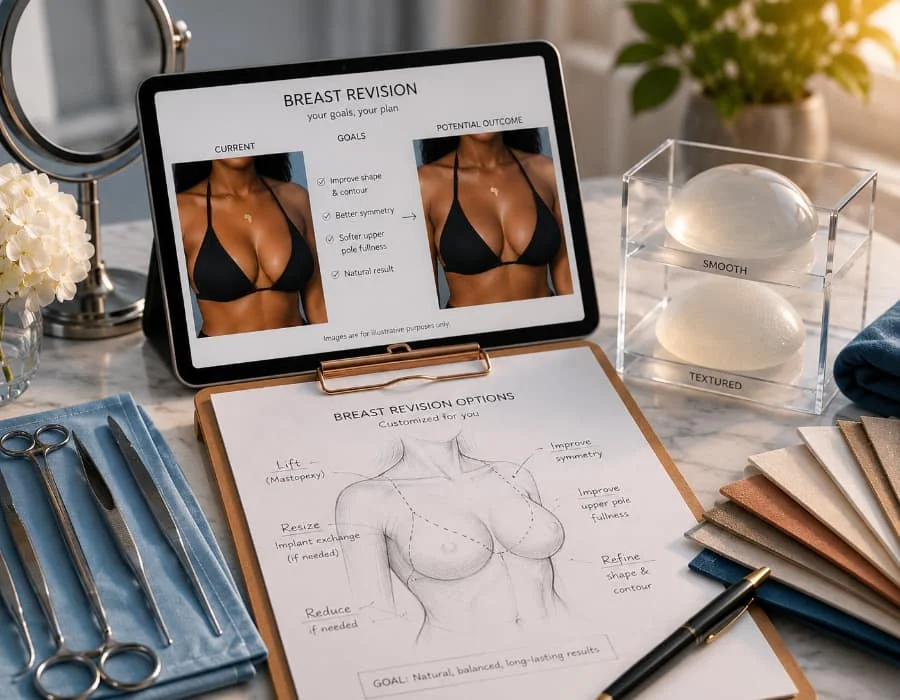
Many patients assume that a breast revision is just like their first breast augmentation. However, revision surgery is significantly more complex.
A primary breast augmentation is performed on “virgin” tissue, meaning there is no pre-existing scar tissue, the natural anatomy is unaltered, and the surgical plane is clear. A breast revision, on the other hand, requires operating in an environment that has already been surgically modified.
The presence of scar tissue, altered blood supply, and stretched-out skin makes revision surgery a highly specialized art form. It requires meticulous surgical planning, advanced anatomical knowledge, and a customized approach to ensure safety and beautiful, long-lasting results. For residents in the Essex County area, you can find More info about breast revision surgery in Montclair to understand how our local specialists approach these complex procedures.
The Complexity of Scar Tissue and Capsular Contracture
Whenever a foreign object like a breast implant is placed in the body, a thin layer of scar tissue naturally forms around it. This is called a capsule, and it is a completely normal defense mechanism.
However, when this capsule becomes thick, hard, and constrictive, it turns into capsular contracture. Operating on a contracted breast requires specialized techniques. The surgeon must perform either a capsulotomy (scoring or releasing the scar tissue) or a capsulectomy (removing the scar tissue capsule entirely).
Removing this tough, calcified tissue while preserving the surrounding thin breast tissue and muscle requires extreme precision. Once the scar tissue is addressed, the implant pocket must be carefully reconstructed to ensure the new implant sits in a stable, natural position. To learn more about how this condition is managed, read our More info about capsular contracture treatment.
How Board-Certified NJ Plastic Surgeons Approach Complex Cases
At The Plastic Surgery Group of New Jersey, our board-certified plastic surgeons, Dr. Rosen and Dr. Ablaza, approach breast revision cases with a deep commitment to safety, education, and tailored planning.
We begin with a comprehensive pre-operative consultation. We review your medical history, analyze your previous operative reports, and perform a detailed physical examination. We also utilize advanced tools and imaging to evaluate your current implants and plan the new pocket dimensions.
Patient education is the cornerstone of our practice. We believe that an informed patient achieves the best results. We discuss all available options, including different implant types, pocket locations, and whether supportive materials like acellular dermal matrix (ADM) are necessary to reinforce your breast tissues.
Advanced Surgical Techniques and Options in Breast Revision

To address the unique challenges of a revision, we utilize several advanced surgical techniques. We don’t believe in a one-size-fits-all approach; instead, we tailor the procedure to your specific anatomy and goals.
- Implant Exchange: Swapping out old implants for newer, safer models. Many patients choose to transition from older saline implants to highly cohesive “gummy bear” silicone gel implants for a softer, more natural feel.
- Pocket Reconstruction and Adjustment: If your implants have shifted, we can surgically resize, reinforce, or repair the implant pocket to restore symmetry and a beautiful cleavage.
- Acellular Dermal Matrix (ADM) or Mesh: For patients with severe tissue thinning or recurrent pocket failure (like bottoming out), we can use a biocompatible mesh or ADM. This acts as an “internal bra,” providing structural support to keep the implant securely in place.
- Fat Transfer (Autologous Fat Grafting): To camouflage mild rippling or to soften the edges of an implant, we can harvest fat from another area of your body (like the abdomen or thighs) via liposuction and gently inject it into the breast tissue.
If you are planning to swap your current implants, check out More info about breast revision NJ implant swaps for an in-depth look at your options.
Combining Breast Revision New Jersey with a Breast Lift
As we age, our skin naturally loses its elasticity. If you have had large implants for many years, the weight of the implants may have stretched out your breast skin, leading to sagging (ptosis).
If we simply replace your old implants with smaller ones, you may be left with loose, empty skin—a look often referred to as the “double bubble” or “deflated balloon” effect. To prevent this, we frequently combine a breast revision with a breast lift (mastopexy).
By removing the excess skin and tightening the surrounding breast tissue, we can lift the nipple-areola complex to a higher, more youthful position on the breast mound. This dual procedure ensures that your new breasts are not only the right size but also beautifully contoured and lifted. For more details on this combined approach, you can Learn more about breast revision surgery.
Capsulotomy vs. Capsulectomy for Implant Exchange
When performing an implant exchange, we must decide how to handle the existing scar tissue capsule.
A capsulotomy involves making strategic incisions in the capsule to release tension and allow the pocket to expand or change shape. This is ideal for minor pocket adjustments or mild tightness.
A capsulectomy involves removing the capsule entirely. A total capsulectomy is the gold standard for treating severe capsular contracture, implant rupture, or cases where BII is suspected. By removing the entire capsule, we eliminate the diseased scar tissue, creating a clean, healthy space for the new implant. To understand which approach is right for your anatomy, read More info about capsulotomy implant exchange.
Frequently Asked Questions About Breast Revision
Undergoing a secondary breast surgery can bring up many questions. We believe in providing clear, honest answers to help you prepare for your journey. Here are some of the most common questions we hear at our New Jersey offices:
Post-Operative Recovery Milestones
- Days 1–3: Expect mild to moderate swelling and discomfort. We recommend resting at home and having a loved one assist you with daily activities.
- Week 1: Most patients can stop prescription pain medications and transition to over-the-counter relief. You will visit us for your first post-op checkup.
- Weeks 1–2: You can typically return to a non-strenuous desk job. Light walking is encouraged to promote healthy circulation.
- Weeks 3–4: Swelling begins to subside significantly. You may be cleared for light lower-body exercises, but must avoid heavy lifting or high-impact activities.
- Weeks 6+: Most patients are fully cleared to resume all normal activities, including upper-body workouts and running. Your new breast shape will continue to soften and settle over the next few months.
How long does breast revision surgery take and what is the recovery time?
A typical breast revision surgery takes between 1 to 3 hours, depending on the complexity of the correction (such as whether we are performing a total capsulectomy or adding a breast lift). The procedure is performed under general anesthesia in our state-of-the-art surgical facility.
While recovery is highly individual, most patients find that the recovery from a revision is actually less painful than their primary augmentation, especially if the implants are staying in the same pocket plane (e.g., under the muscle). You should plan to take 1 to 2 weeks off from work, and you must avoid heavy lifting or strenuous exercise for at least 4 to 6 weeks.
How can I minimize the risk of capsular contracture recurring?
While capsular contracture can happen to anyone, modern plastic surgery has introduced exceptional tools to minimize this risk:
- The Keller Funnel: This is a sterile, clear sleeve used to gently slide the implant into the pocket without it touching the patient’s skin. Studies published in the Aesthetic Surgery Journal show that using the Keller Funnel can reduce capsular contracture rates by over 50% by preventing microscopic bacterial contamination.
- Advanced Implant Technology: Newer implant brands, such as Motiva, feature advanced surface texturing and highly cohesive gels. Clinical data has shown that Motiva implants have an incredibly low capsular contracture rate of only 0.5%, compared to the historical 10% to 30% seen with older implant models.
- Triple Antibiotic Irrigation: During surgery, we thoroughly wash the breast pocket with a specialized antibiotic solution to eliminate any bacteria that could trigger a capsule-hardening response.
Can I switch from saline to silicone implants during a revision?
Yes, absolutely! In fact, switching from saline to silicone is one of the most common requests we receive.
Many patients who received saline implants in the past are unhappy with the firm feel, visible rippling, or the “sloshing” sound that can sometimes occur. Modern cohesive silicone gel implants (often called “gummy bear” implants) offer a much softer, highly natural feel and hold their shape beautifully over time, even if the outer shell is compromised. Swapping to silicone is an excellent way to achieve a significant aesthetic update.
Ready for Your Next Chapter?
Deciding to undergo breast revision in New Jersey is a highly personal decision, but you do not have to navigate it alone. Whether you are dealing with a painful complication like capsular contracture, addressing an implant rupture, or simply wanting to update your look to match your current lifestyle, our team is here to support you.
At The Plastic Surgery Group of New Jersey, we pride ourselves on delivering natural, beautiful results. Our highly regarded, experienced plastic surgeons, Dr. Rosen, Dr. Ablaza, and Dr. Cece, utilize the latest surgical techniques and state-of-the-art technology to provide you with the ultimate body transformation experience in a warm, welcoming, and safe environment.
Ready to take the next step toward feeling comfortable and confident in your body again? Schedule your consultation for breast augmentation and revision with us today, and let us help you achieve the beautiful, balanced results you deserve.


