
Why So Many People Are Choosing Earlobe Repair — and What to Expect
Earlobe repair is a short, in-office surgical procedure that fixes torn, stretched, or damaged earlobes — and it’s one of the most commonly performed cosmetic procedures by plastic surgeons today.
Here’s a quick overview of what it involves:
- What it is: A minor outpatient surgery (also called lobuloplasty) to restore the shape and integrity of a damaged earlobe
- How long it takes: Typically 15 to 60 minutes, depending on the extent of damage
- Anesthesia: Local anesthesia only — no general sedation needed
- Recovery: Most patients return to normal activities the next day
- Re-piercing: Safe after 3 to 6 months, at least 3mm from the repair site
- Cost: Generally ranges from $500 to $2,000 depending on complexity
Whether your earlobes have been gradually stretched by years of heavy earrings, torn in an accident, or permanently widened by gauges, the damage doesn’t have to be permanent. Millions of Americans with ear piercings face this exact issue — and most are surprised by how simple the fix actually is.
I’m Dr. Valerie J. Ablaza, a board-certified plastic surgeon and partner at The Plastic Surgery Group of New Jersey, with extensive experience performing earlobe repair procedures as part of a comprehensive range of cosmetic and reconstructive surgeries. In this guide, I’ll walk you through everything you need to know to make a confident, informed decision about your earlobe repair.

Understanding Earlobe Repair Surgery
At its core, earlobe repair (medically known as lobuloplasty) is a precise reconstructive procedure designed to mend the fleshy lower part of the ear. Unlike the upper portions of the ear, the earlobe contains no cartilage; it is composed entirely of skin and fat. While this makes the lobe soft and ideal for jewelry, it also means it lacks the structural “scaffolding” to resist gravity or sudden trauma.
When we perform Expert Earlobe Repair Surgery in New Jersey | The Plastic Surgery Group of New Jersey, we treat it as a meticulous art form. Even though it is an outpatient procedure that usually takes only 15 to 30 minutes per ear, it requires an expert eye for facial symmetry. We perform these repairs in our state-of-the-art surgical suite in Montclair, ensuring you are in a sterile, professional environment that far exceeds a standard exam room.
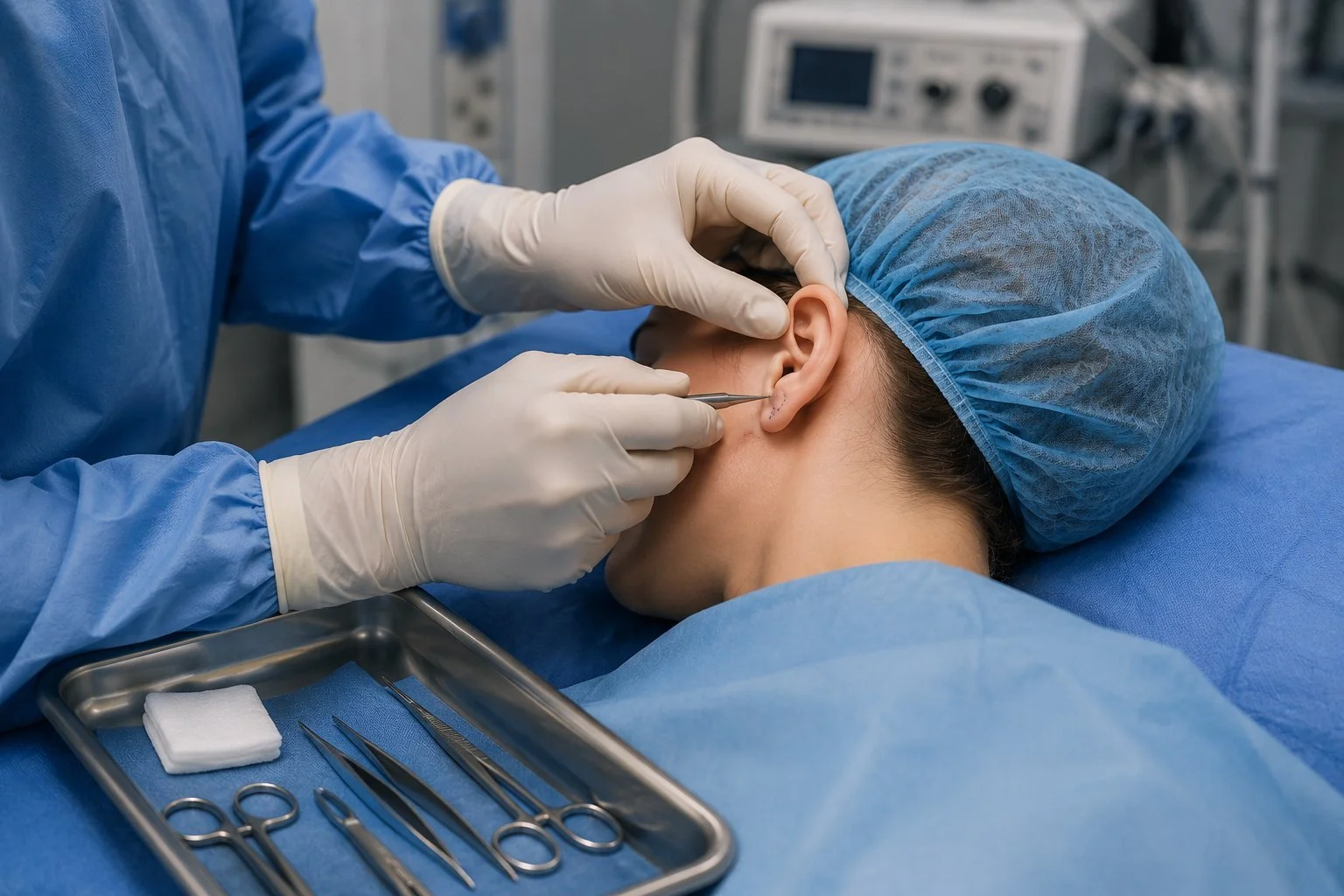
The procedure is most commonly performed under local anesthesia. This means you’ll be awake and comfortable, able to chat with us or listen to music while we work. Because the earlobe is highly vascularized, it heals remarkably well, but the surgery is still a balance between reconstructive necessity (closing a gap) and cosmetic refinement (ensuring the lobe looks natural and youthful).
Candidates for Earlobe Repair
How do you know if you are a good candidate for this procedure? Generally, if you are in good health and unhappy with the appearance or functionality of your earlobes, you are likely a fit. We commonly see patients for:
- Split Earlobes: Where a piercing has pulled all the way through the bottom of the lobe.
- Elongated Piercings: Often called “slit” or “stretched” holes that make earrings sit crooked or fall out.
- Gauged Ears: Lobes that have been intentionally stretched with plugs and no longer shrink back on their own.
- Keloid Scars: Thick, raised scar tissue that often forms after a piercing or trauma, particularly common in patients with darker skin tones.
- Congenital Clefts: Being born with a notch or “split” in the lobe.
- Aging Lobes: Lobes that have become thin, wrinkled, or excessively long due to the natural loss of collagen and elastin.
Common Causes of Earlobe Damage
It is estimated that 80-90% of women in the US have earlobe piercings, and a growing number of men do as well. With that many piercings, damage is almost inevitable for a significant portion of the population.
The most frequent culprit is heavy jewelry. Years of wearing “chandelier” earrings or heavy hoops act like a slow-motion cheese cutter, gradually pulling the piercing hole downward. Accidental trauma is another major factor—think of an earring getting snagged on a sweater, a hairbrush catching a hoop, or a curious toddler or playful pet giving a sudden, sharp tug.
Interestingly, even our modern habits contribute to damage. Frequently holding a phone between your shoulder and your ear can put lateral pressure on earrings, contributing to “slit” elongation over time.
Simple Tears vs. Gauged Reconstruction
The approach we take depends heavily on the type of damage. A simple tear is a straightforward closure, while gauged ears require a more complex “puzzle-piece” reconstruction to remove excess skin and restore a rounded shape.
| Feature | Simple Tear / Slit | Gauged Earlobe (Flesh Tunnel) |
|---|---|---|
| Primary Cause | Heavy earrings or sudden tugs | Intentional stretching with plugs |
| Procedure Time | 15–30 minutes | 45–60 minutes |
| Complexity | Low; involves freshening edges | High; requires tissue rearrangement |
| Tissue Loss | Minimal | Significant excess skin removal |
| Recovery Goal | Close the gap | Restore natural circular contour |
The Earlobe Repair Procedure: A Step-by-Step Guide
Precision is the hallmark of a successful earlobe repair. Before we begin, we use precise surgical markings to map out the incision. This ensures that the final result is symmetrical with your other ear and aligns perfectly with your jawline.

The first step is the administration of Lidocaine (a local anesthetic) to completely numb the area. Once you are comfortable, the most critical phase begins: “freshening” the edges. When an earlobe tears or stretches, the skin heals over the inside of the hole (this skin is called epithelium). If we simply stitched the hole closed, it wouldn’t stay shut because skin won’t bond to skin. We must carefully remove that thin layer of healed skin to reveal “fresh” tissue that can heal together permanently.
For More info about earlobe repair services, our surgeons utilize a layered closure technique. This isn’t just a simple stitch on the surface; we close the middle tissue and the skin on both the front and back of the lobe. This provides the strength needed to prevent the lobe from stretching again in the future.
Steps of the Earlobe Repair Procedure
- Anesthesia: Local numbing of the lobe.
- Excision: Removing the scarred or epithelialized edges of the tear or the inner ring of a gauged hole.
- Tissue Rotation: For larger holes, we may move small flaps of healthy tissue to ensure the lobe doesn’t look “notched” or pinched at the bottom.
- Suturing: Using microscopic accuracy and incredibly fine sutures (often 6-0 Prolene or Vicryl) to join the edges.
Minimizing Visible Scarring
We know that the biggest concern for many patients is the scar. Our goal is to make the incision line as faint as possible. We achieve this through tension reduction. By using deep, dissolvable stitches to hold the weight of the repair, the surface stitches (the ones you see) don’t have to pull hard on the skin. This prevents the “railroad track” look of older surgical methods.
We often employ advanced techniques like Z-plasty or inverted V-plasty. These methods create a tiny zigzag pattern in the incision rather than a straight vertical line. This “breaks up” the scar, making it much harder for the human eye to track and preventing the bottom of the earlobe from developing a “notched” look as it heals.
Recovery and Long-Term Aftercare
One of the best things about earlobe repair is the relatively easy recovery. Most New Jersey patients report only mild soreness during the first 24 hours, which is usually well managed with Tylenol or Motrin.
Immediately following the procedure, we apply a small amount of antibiotic ointment and a light dressing. You’ll need to keep the area clean and dry for the first few days. We typically recommend:
- Sleeping Positions: Try to sleep on your back or the opposite side for the first week to avoid putting pressure on the sutures.
- Activity Restrictions: You can return to work the next day, but avoid strenuous exercise or swimming for about a week.
- Suture Removal: If we use non-dissolvable stitches, they are removed in our office 7 to 10 days later.
Re-piercing After Earlobe Repair
The question everyone asks is: “When can I wear earrings again?”
Patience is key here. While the skin “knits” together in a week, the internal scar tissue takes much longer to regain its strength. We recommend waiting 3 to 6 months before re-piercing.
When you do get re-pierced, follow the 3mm rule: the new hole should be at least 3mm away from the surgical scar. Scar tissue is never quite as strong as original tissue; if you pierce directly into the scar, the weight of an earring could cause the lobe to split again. For your first few months back in jewelry, stick to lightweight gold or silver studs.
Potential Risks and Complications
While complications are rare, they can include infection, slight asymmetry, or the formation of a “notch” at the bottom of the lobe. In patients prone to keloids, there is a risk of the scar tissue returning. In severe keloid cases, we may coordinate a low-dose radiation treatment immediately following surgery to ensure the keloid does not recur. Following our aftercare instructions—especially regarding smoking cessation and wound cleaning—is the best way to ensure a smooth result.
Frequently Asked Questions about Earlobe Repair
What is the typical cost of earlobe repair?
The cost of earlobe repair generally ranges from $500 to $2,000. Pricing depends on whether one ear or both ears are being treated, as well as the complexity of the repair, such as a simple split versus a larger gauged opening. During your consultation in our Montclair office, we provide a clear, all-inclusive quote.
Is the procedure covered by insurance?
In the vast majority of cases, earlobe repair is considered a cosmetic procedure and is not covered by insurance. However, if the tear was the result of a sudden, traumatic injury (like an earring being ripped out in an accident), some plans may offer partial coverage. We can help you navigate these questions during your visit.
Can both ears be repaired in one session?
Absolutely. In fact, we recommend it. Performing a bilateral repair ensures we can achieve the best possible symmetry between the two sides while you only have to go through one recovery period and one set of appointments.
Final Thoughts: Restoring Shape, Comfort, and Confidence
Your earlobes play a subtle but vital role in your overall facial harmony. Whether you’re looking to close the chapter on your “gauged” years or simply want to wear your favorite pair of studs without them drooping, earlobe repair is a safe, effective, and life-changing solution.
At The Plastic Surgery Group of New Jersey, Dr. Rosen, Dr. Ablaza, and our entire team are dedicated to providing natural-looking results in a warm, welcoming environment. We combine surgical precision with an artistic touch to restore not just your earlobes, but your confidence.

Ready to restore your look? Schedule your consultation for earlobe repair at our convenient New Jersey location today. We look forward to helping you achieve the beautiful, natural results you deserve.


