
When a Simple Earring Hole Becomes a Real Problem
Ear hole repair is a minor surgical procedure that fixes torn, stretched, or split earlobes — and it’s one of the most common cosmetic procedures performed today.
Here’s a quick look at your main options:
| Problem | Solution | Recovery |
|---|---|---|
| Slightly stretched hole | Dermal fillers (non-surgical) | Minimal, repeat yearly |
| Partial tear or elongated hole | Surgical lobuloplasty | 1-2 weeks |
| Complete split earlobe | Surgical lobuloplasty | 1-2 weeks |
| Gauged/stretched lobe | Reconstructive lobuloplasty | 1-2 weeks |
The procedure is quick, done in-office under local anesthesia, and most people return to normal life the very next day.
So how did you get here? Maybe a heavy earring snagged on a sweater. Maybe years of wearing statement jewelry slowly stretched your piercing into an elongated slot. Or maybe you’re ready to move on from the gauges you got at 19 and want your ears to look professional again.
Whatever the cause, you’re not alone — and the fix is simpler than most people expect.
I’m Dr. Allen Rosen, one of America’s Top Docs and a board-certified plastic surgeon with over two decades of experience performing ear hole repair and other facial aesthetic procedures at The Plastic Surgery Group of New Jersey. In this guide, I’ll walk you through everything you need to know — from understanding what caused the damage to what your ears will look like after they heal.
Understanding Earlobe Damage and the Need for Ear Hole Repair
The earlobe is a unique piece of anatomy. Unlike the rest of the ear, which is supported by firm cartilage, the lobe consists of skin, fat, and collagen. This makes it soft and aesthetically pleasing, but it also means it is susceptible to gravity and trauma. When we talk about ear hole repair, we are usually addressing a loss of structural integrity in this delicate tissue.

There are several common culprits behind earlobe damage:
- Heavy Jewelry: Years of wearing large hoops or “statement” pieces can gradually pull the piercing downward, creating an elongated slot or a “slit” appearance.
- Accidental Trauma: This is the “ouch” moment. A child pulls on an earring, a hoop gets snagged on a sweater, or a phone cord catches a stud. This often results in a full split, where the lobe is divided into two distinct halves.
- Ear Gauging: Intentional stretching of the lobe using plugs or tunnels can reach a point where the skin will no longer “snap back” on its own.
- The Aging Process: As we age, we lose collagen and skin elasticity. This can cause even small piercings to look saggy or wrinkled, affecting overall facial harmony.
To help you identify your specific situation, consider this comparison:
| Condition | Appearance | Primary Cause |
|---|---|---|
| Partial Tear | Elongated, vertical slot | Heavy earrings over time |
| Full Split | Lobe divided into two “flaps” | Sudden trauma or snagging |
| Gauged Lobe | Large circular hole with thin rim | Intentional stretching |
Who is a Candidate for Lobuloplasty?
Most people with earlobe concerns are excellent candidates for a lobuloplasty (the technical name for ear hole repair). We typically see patients in our Montclair and New Jersey offices who are bothered by:
- Stretched piercings that make earrings sit crooked or fall out.
- Split lobes that prevent the wearing of earrings entirely.
- Large holes from previous gauging that no longer fit their professional or personal lifestyle.
- Keloid scars (thick, raised scar tissue) that have formed around a previous piercing.
- Congenital defects or irregularities in earlobe shape.
Ideally, candidates should be in good health and non-smokers, as smoking can significantly hinder the blood flow necessary for the delicate skin of the ear to heal properly.
Non-Surgical Alternatives for Minor Stretching
Not every stretched ear requires a scalpel. For patients with minor “drooping” or thinness in the lobes, we often recommend earlobe rejuvenation using dermal fillers.
By injecting a hyaluronic acid-based filler (like Juvéderm) into the lobe, we can add instant volume. This “plumps” the tissue, making the earring hole smaller and providing a sturdier base for your jewelry. While this is a fantastic “lunchtime” procedure with no downtime, it is temporary. You will likely need annual re-injections to maintain that youthful, firm look. However, for a full split or a significantly stretched gauge, surgery remains the gold standard.
The Lobuloplasty Procedure: What to Expect
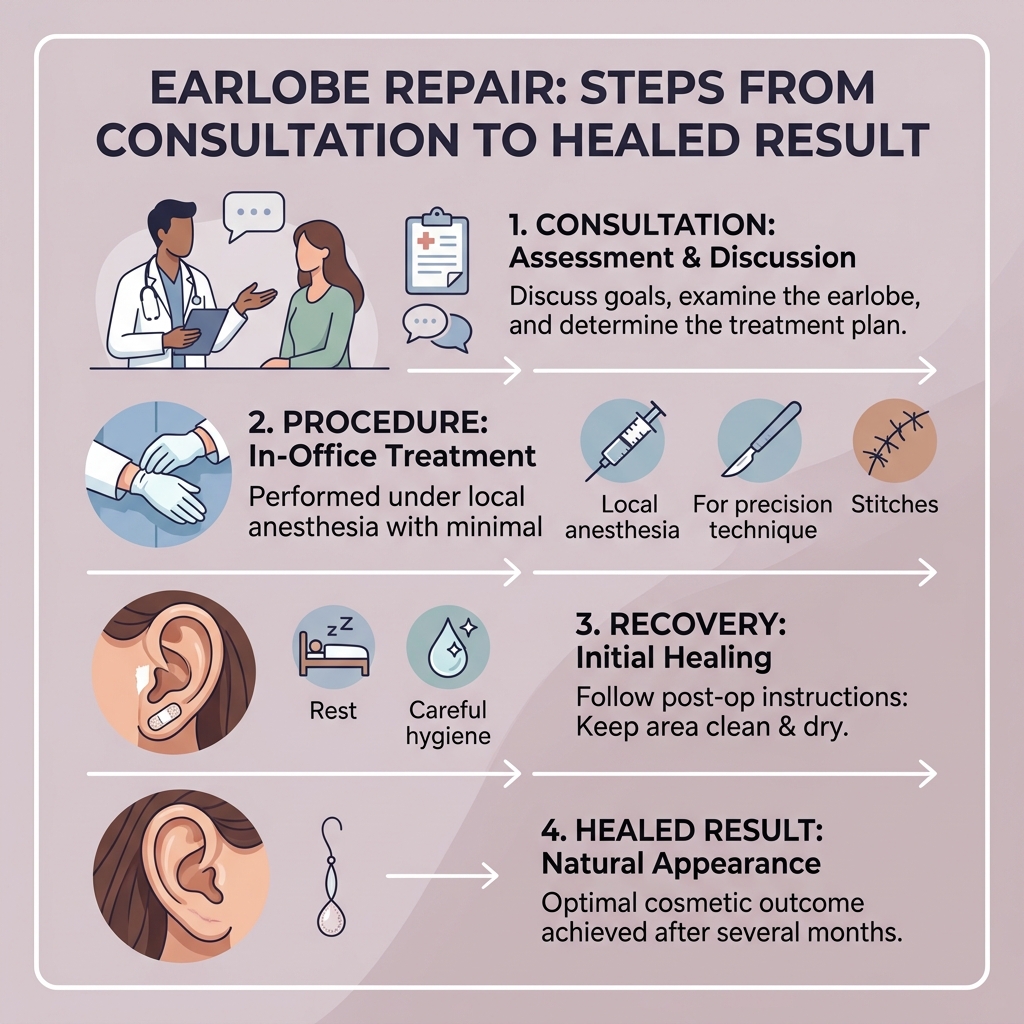
If you decide to move forward with ear hole repair, you’ll be pleased to know it is a straightforward, outpatient experience. At The Plastic Surgery Group of New Jersey, we perform this right in our state-of-the-art facility.
The procedure generally follows these steps:
- Local Anesthesia: We numb the earlobe completely. You’ll be awake and able to chat with us, but you won’t feel any pain—just a bit of tugging.
- Scar Excision: To get the two sides of a tear to grow back together, we must remove the old skin that has healed over the edges of the tear. We carefully “freshen” the edges to create a new wound.
- Layered Suturing: We use very fine, delicate stitches to join the tissue back together. We often use a layered technique to ensure the repair is strong and the resulting scar is as thin as a hair.
- Duration: The entire process usually takes between 30 to 60 minutes per ear.
Preparing for Your Ear Hole Repair
Preparation is key to a smooth recovery. During your consultation with Dr. Rosen or Dr. Ablaza, we will review your medical history and perform a physical examination of the ear tissue.
We ask our patients to:
- Disclose all medications: Certain supplements and blood thinners can increase bruising.
- Stop Smoking: Nicotine constricts blood vessels, which is the enemy of healing.
- Clean the Area: Ensure your ears are free of any infections or rashes prior to the date.
For more detailed guidance, you can read our guide on How to Prepare for Ear Surgery to ensure you’re ready for the big day.
Related Ear Procedures: Eardrum vs. Earlobe
It is important to distinguish between cosmetic ear hole repair (the lobe) and medical ear surgery (the eardrum). While we focus on the external aesthetic of the lobe, some patients experience “holes” deeper in the ear due to infections or trauma.
Procedures like a Tympanoplasty: Surgery Details & Recovery or a Myringoplasty: Procedure Details & Recovery are performed by ENT specialists to repair the tympanic membrane (eardrum) to restore hearing or prevent infection. If your “ear hole” is affecting your hearing or causing internal drainage, you may need to consult an otolaryngologist for those specific procedures.
Recovery and Aftercare: Healing Your Lobes
Recovery from ear hole repair is remarkably easy. Most of our patients in Livingston and NYC return to work the very next day.
Immediately after the procedure, we apply a small dressing or just a coat of antibiotic ointment. You may experience some mild swelling or redness, but significant pain is rare. According to medical resources like Health and the Eardrum repair: MedlinePlus Medical Encyclopedia, keeping the surgical site clean and dry is the most important factor in preventing complications.
Managing Post-Operative Discomfort
While discomfort is minimal, here is how to handle the first few days:
- Pain Relief: Over-the-counter medications like Tylenol are usually more than enough.
- Elevation: Sleep with your head slightly elevated for the first night or two to minimize swelling.
- Wound Care: We will provide specific instructions on how to gently clean the area with hydrogen peroxide or saline and apply ointment.
- Avoid Pressure: Try not to sleep directly on the repaired ear for the first week.
For our younger patients, parents can find helpful tips on managing recovery at the Myringoplasty | Children’s Hospital of Philadelphia resource, which emphasizes the importance of keeping little hands away from the stitches!
Life After Surgery: Re-piercing and Prevention
Once the stitches are removed (usually 1 to 2 weeks post-op), the healing process continues beneath the surface. The scar will initially look like a thin red line, but it will fade to a nearly invisible white line over several months.
To protect your “new” ears, we recommend:
- Sunscreen: Apply SPF to your earlobes! Sun damage breaks down collagen and can make the scar more visible.
- Supportive Backings: Use large “butterfly” backings or stabilizing patches for heavier earrings.
- Nightly Routine: Always take your earrings out before bed to prevent accidental snags.
You can learn more about the long-term results of this procedure on our dedicated Earlobe Repair service page.
When Can I Re-pierce After Ear Hole Repair?
This is the question everyone asks! While you’ll be tempted to show off your repaired lobes immediately, patience is a virtue.
The scar tissue that forms after surgery is never quite as strong as the original skin. If you pierce too early, the weight of an earring can easily pull right through the healing tissue.
- The Wait: We typically recommend waiting a minimum of three to six months before re-piercing.
- The Location: Never pierce directly through the scar. Your new piercing should be at least 3mm away from the repair site.
- The Professional: Go to a professional piercer who uses a needle, not a piercing gun, as it is much gentler on the tissue.
Frequently Asked Questions about Earlobe Repair
How much does ear hole repair cost?
The cost of ear hole repair can vary depending on the complexity of the tear and whether one or both ears need work. Generally, prices range from $500 to $2,000. For example, a simple single-ear repair may be on the lower end, while a bilateral reconstructive repair for large gauges is more involved. During your consultation at The Plastic Surgery Group of New Jersey, we provide a transparent quote and can discuss financing options to make the procedure affordable.
Will the surgery leave a visible scar?
Because we use extremely fine sutures and precise plastic surgery techniques, the resulting scar is usually a very faint, vertical line. Most people will not notice it unless they are looking at your ear with a magnifying glass! Over 6–12 months, the scar matures and blends in significantly with the surrounding skin.
Can I fix gauged ears with this procedure?
Absolutely. Fixing gauged ears is a more complex version of ear hole repair. Because there is often a significant amount of “extra” skin and a large hole, we don’t just stitch it shut. We use a “tissue rotation” technique to reshape the lobe into a natural, rounded appearance. This is a permanent solution that can help you achieve a more traditional, professional look.
Your Next Step Toward a Whole, Natural-Looking Earlobe
A torn or stretched earlobe might feel like a major blow to your confidence, but it doesn’t have to be a permanent problem. At The Plastic Surgery Group of New Jersey, Dr. Rosen, Dr. Ablaza, and our entire team are dedicated to helping you restore your natural beauty with minimal stress.
Whether you’re dealing with a recent injury or a long-standing stretch, we offer the expertise and the state-of-the-art environment you need for a perfect result. Stop hiding your ears behind your hair and get back to wearing the jewelry you love.
Contact us today to schedule your consultation! and take the first step toward fixing your earlobes for good.


