
What to Expect From Breast Reduction Scars
Breast reduction scars are a normal and expected part of the surgery — but what they look like, how fast they fade, and what you can do about them varies a lot from person to person.
Here is a quick overview of what most patients can expect:
- Scar patterns: Anchor (inverted-T), lollipop (vertical), or donut (periareolar) — chosen based on breast size and how much tissue is removed
- Initial appearance: Red, raised, and firm in the first weeks after surgery
- Fading timeline: Most scars soften and fade significantly within 12–18 months
- Permanent? Yes — but with proper care, they typically become thin, pale lines easily hidden under a bra or swimsuit
- Manageable? Absolutely — silicone products, sun protection, gentle massage, and professional treatments all help
The good news is that for the vast majority of patients, the physical relief and renewed confidence from breast reduction far outweigh concerns about scarring. Most scars end up in discreet locations — along the breast fold, around the areola, or on the lower breast — and are not visible in everyday clothing or swimwear.
This guide walks you through everything: the types of scars, how they heal, and the most effective ways to minimize their appearance.
I’m Dr. John A. Cece, a fellowship-trained plastic and reconstructive surgeon with specialized training in aesthetic breast surgery at Manhattan Eye, Ear, and Throat Hospital, where managing breast reduction scars was a core part of my clinical education. As a breast reduction specialist NJ, I’ll walk you through what the research and real patient outcomes tell us, so you can approach your surgery with clear, realistic expectations. You can also learn more about what to expect during your healing journey in our guide on breast reduction recovery week by week.

When we talk to patients in our Montclair, New Jersey office, one of the first questions they ask is: “What will my scars actually look like?” It is completely natural to feel a bit anxious about surgical marks. However, understanding the mechanics of how these scars form and why they are necessary can help demystify the recovery process.
Breast reduction scars are the body’s natural, healthy response to the healing of surgical incisions. During a reduction, we do not just remove excess fat and glandular tissue; we also remove excess skin and reposition the nipple-areola complex to a higher, more youthful position on the breast mound. This comprehensive restructuring requires specific incision patterns.
The final appearance of your scars is influenced by several key variables:
- The surgical technique used: Different incision patterns leave different scar shapes.
- The volume of tissue removed: Larger reductions typically require more extensive incisions.
- Your skin’s natural elasticity: Highly elastic skin often heals with finer, less noticeable lines.
- Your genetics and lifestyle: Factors like smoking, nutrition, and your genetic predisposition to scarring play a massive role.
To help you visualize your options, we have compiled a quick comparison of the primary surgical approaches:
| Incision Technique | Scar Pattern Description | Best Suited For | Degree of Scarring |
|---|---|---|---|
| Donut (Periareolar) | A single circular line restricted entirely to the border of the areola. | Mild reductions, minor sagging, or simple nipple repositioning. | Minimal; easily camouflaged by the natural pigment change of the areola. |
| Lollipop (Vertical) | A circular line around the areola combined with a straight vertical line running down to the breast crease. | Moderate reductions with moderate sagging (ptosis). | Moderate; vertical line fades well but remains visible on the lower breast. |
| Anchor (Inverted-T / Wise Pattern) | A circle around the areola, a vertical line down to the crease, and a horizontal line along the natural breast fold. | Significant reductions, severe sagging, or reconstructed shapes. | Most extensive; however, the horizontal portion is completely hidden in the breast fold. |
| Liposuction-Only | Tiny, puncture-like marks (approx. 4-6mm) usually hidden under the arm or in the breast crease. | Patients with excellent skin elasticity and fat-dominant breast tissue. | Virtually scarless; no traditional incisional lines. |
To help determine which surgical approach aligns best with your anatomy and aesthetic goals, you can explore our detailed guide on Is Breast Reduction Right for Me?.
How Incision Techniques Shape Breast Reduction Scars
The specific shape of your breast reduction scars is determined entirely by the incision technique we select during your surgical planning. Let’s look at these techniques in closer detail:
The Anchor Incision (Wise Pattern)
The anchor incision is the gold standard for dramatic transformations. If you are seeking relief from extremely heavy, sagging breasts, this technique is typically the most effective. It involves three incision lines: one around the areolar border, one running vertically down, and one tracing the natural curve of the inframammary fold. While the anchor pattern results in the most extensive scarring, it gives the surgeon maximum control over shaping, lifting, and reducing tissue. Fortunately, the horizontal scar rests precisely within the natural shadow of the breast crease, making it completely invisible when you are standing up.
The Lollipop Incision (Vertical Technique)
For patients requiring a moderate reduction, the lollipop technique is an excellent option. By omitting the horizontal incision along the breast fold, we limit the scar to a circle around the nipple and a single vertical line extending downward. This vertical line often heals into a very fine, faint mark over time. It is a highly popular option for women who want to avoid scars in the breast crease but still require a noticeable lift and reduction.
The Donut Incision (Periareolar Pattern)
The donut technique involves a single circular incision around the perimeter of the areola. This is often referred to as a “short-scar” or “minimal-scar” approach. Because the incision sits right at the transition zone between dark areolar skin and lighter breast skin, the resulting scar is incredibly easy to conceal. However, this technique is limited to patients who only need a small amount of tissue removed and have minimal sagging, as it cannot accommodate major structural lifting.
Liposuction-Only Reduction
In very specific cases, we can perform a “scarless” breast reduction using advanced liposuction. This involves inserting thin cannulas through tiny puncture wounds to suction out excess fatty tissue. Because there are no large skin incisions, there are no traditional surgical scars. This method is ideal for patients with high skin elasticity whose breast volume is primarily composed of fat rather than dense glandular tissue.
Surgical Artistry and Scar Placement
Minimizing breast reduction scars is not just about what happens after surgery; it begins with meticulous planning and surgical artistry in the operating room. Highly experienced plastic surgeons use advanced techniques to ensure your scars heal as beautifully as possible:
- Strategic Placement: We carefully map out incisions so they align with the natural boundaries of your body, such as the areolar border and the inframammary fold (the crease beneath your breast). By tucking scars into these natural shadows and transitions, they become far less perceptible to the naked eye.
- Tension-Free Closure: One of the primary causes of wide, stretched, or raised scars is excessive tension on the skin edges as they heal. To prevent this, we utilize a meticulous, multi-layered suturing technique. Deep dermal layers are closed using strong, absorbable sutures that support the weight of the breast tissue from the inside out. This leaves the outer layer of skin free of tension, allowing the surface incision to heal into a thin, flat line.
- Fine Suturing and Tissue Handling: Using delicate instruments and precise skin-edge alignment prevents unnecessary trauma to the surrounding tissues, which dramatically improves the overall quality of the final scar.
The Scar Healing Timeline: From Incision to Maturation
Healing is not a sprint; it is a long-term journey. Your body goes through several distinct biological phases to repair the skin, and your scars will look dramatically different at one week, six months, and one year post-op.
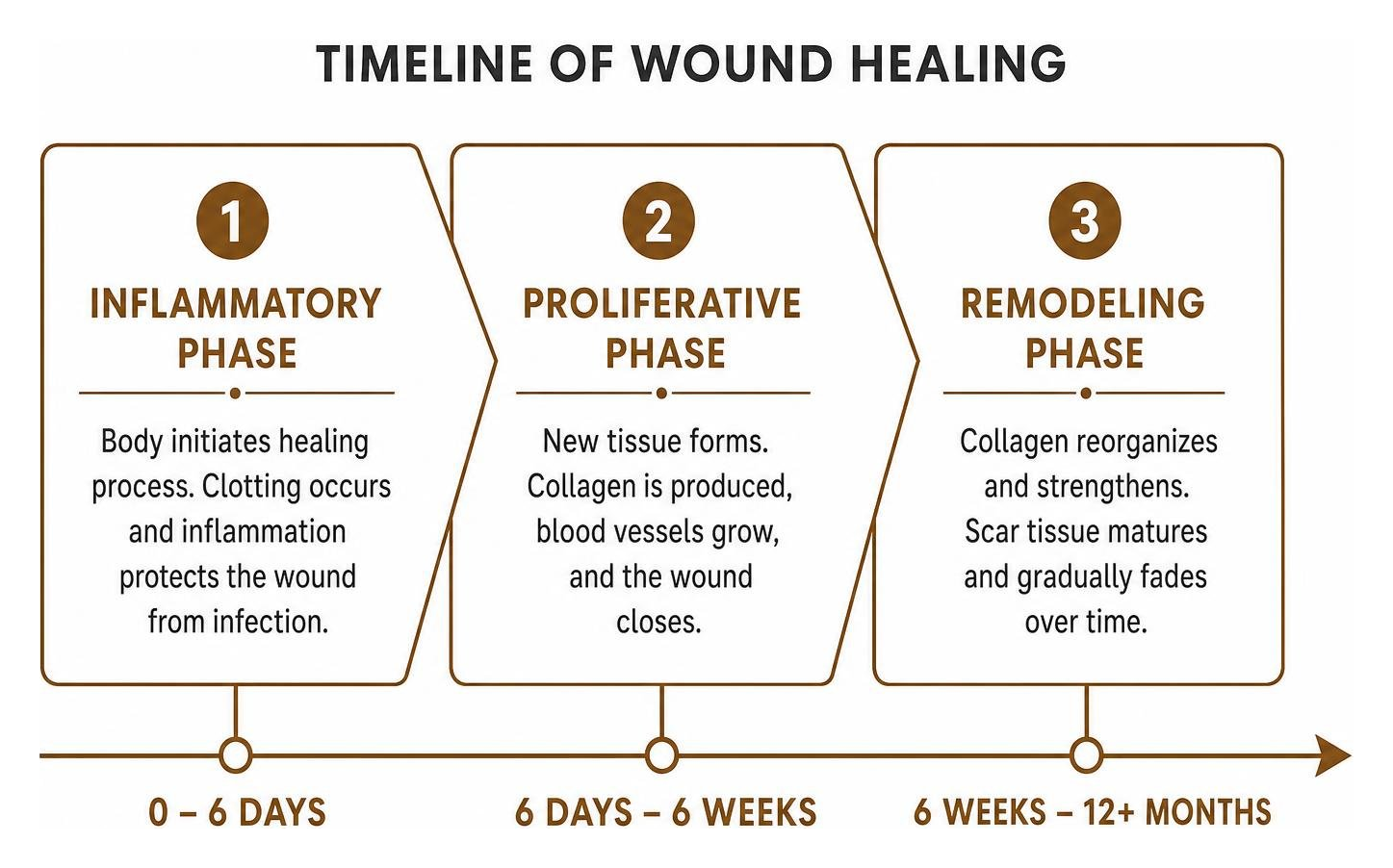
Understanding this timeline can prevent unnecessary worry during the “awkward phases” of healing. For a comprehensive look at what to expect during your broader recovery journey, read our guide on breast reduction recovery week by week. You can also review clinical insights on wound healing via the Cleveland Clinic’s guide to breast reduction scars.
The First Six Weeks: Inflammatory and Proliferative Phases
The initial phase of healing is characterized by rapid cellular activity:
- Weeks 1 to 2 (Inflammatory Phase): Immediately after surgery, your body sends a rush of blood and healing cells to the incision sites. Your incisions will look like thin, dark red or pink lines, often held together by surgical tape, medical glue, or internal stitches. Some mild swelling, bruising, and tenderness are completely normal.
- Weeks 3 to 6 (Proliferative Phase): During this stage, your body begins rebuilding the skin barrier by producing new collagen fibers. This new tissue is highly vascularized, meaning it contains a lot of tiny blood vessels. As a result, your scars will likely look quite red, pink, or even slightly purple. They may also feel firm, raised, or occasionally itchy. This is a sign of active healing, not permanent damage!
During these first six weeks, your primary job is to support the incisions. This means wearing your prescribed surgical support bra to reduce tension, keeping the area clean and dry, and avoiding any heavy lifting or strenuous activities that could stretch the healing skin.
Six Months to Two Years: The Maturation Phase
Once you pass the two-month mark, your scars enter the final and longest phase of healing: the maturation (remodeling) phase.
- Months 2 to 6: The initial redness may peak or begin to slowly change. The body is constantly reorganizing the collagen fibers within the scar tissue. The scars will gradually start to soften and lose some of their firm texture.
- Months 6 to 12: This is where the most dramatic aesthetic improvements happen. The bright pink or purple hues will begin to fade into a softer pink, a light tan, or a pale white, depending on your natural skin tone. The raised ridges will flatten out, blending more seamlessly with the surrounding skin.
- 12 to 18 Months and Beyond: By the one-year mark, most breast reduction scars are considered fully mature. They will have reached their final texture and color. While they will never completely disappear, they should now be soft, flat, and faded enough to be easily camouflaged.
Effective Strategies to Minimize Scarring
While your surgeon’s technique sets the foundation, your daily post-operative care routine plays an equally vital role in how your scars ultimately look. Active, consistent scar management can make the difference between a highly visible mark and a faint, barely-there line.

To see real-world examples of how well these scars can heal with proper care, we encourage you to view our gallery of before and after breast reduction photos.
At-Home Scar Care and Topical Treatments
Once your incisions are fully closed and any scabbing has naturally fallen off (typically around the 3 to 4-week mark), you can begin a dedicated at-home scar care regimen. Always obtain direct clearance from your surgeon before starting any topical treatments.
- Silicone Gel Sheets and Creams: Silicone is globally recognized as the gold standard in non-invasive scar management. It works by creating a protective, hydrating barrier over the scar, which regulates collagen production and prevents the scar from becoming raised or hypertrophic. For optimal results, silicone sheets should be worn for at least 12 to 24 hours a day for 2 to 6 months.
- Gentle Scar Massage: Once your incisions are structurally sound, performing daily scar massage can help break up rigid collagen bands beneath the skin. Using a small drop of silicone gel or a gentle moisturizer, use the pads of your fingers to apply light-to-moderate pressure in circular, vertical, and horizontal motions along the scar line for 2 to 3 minutes, twice daily.
- Broad-Spectrum Sun Protection: Unprotected sun exposure is the ultimate enemy of healing scars. UV rays stimulate melanin production, which can permanently darken a healing scar (a process called hyperpigmentation). Keep your scars covered with clothing, or apply a broad-spectrum sunscreen with SPF 30 or higher daily for at least one full year post-surgery.
- Strict Nicotine Avoidance: Nicotine is a potent vasoconstrictor, meaning it shrinks blood vessels and drastically cuts off oxygen supply to healing tissues. Smoking or vaping during your recovery can lead to delayed wound healing, wider scars, or even wound separation. We require all patients to completely quit nicotine at least 4 to 6 weeks before and after surgery.
Advanced Dermatological Interventions
If your scars require a little extra help to reach their aesthetic potential, we offer several highly effective clinical treatments:
- Laser Resurfacing: Modern laser therapies are incredibly efficient at improving both the color and texture of scars. Pulsed dye lasers (PDL) target and reduce the redness in early-stage scars, while fractional CO2 lasers create microscopic channels in the skin to stimulate healthy collagen remodeling, smoothing out thick or uneven scar tissue.
- Corticosteroid Injections: If a scar begins to feel excessively thick, itchy, or raised, we can inject a mild steroid solution directly into the scar tissue. This helps break down excess collagen fibers, flattening the scar and relieving discomfort.
- Microneedling: This treatment uses tiny, sterile needles to create controlled micro-injuries in the scar tissue, prompting the body to produce fresh, organized collagen that blends the scar more naturally with the surrounding skin.
- Surgical Scar Revision: In rare instances where a scar has stretched significantly or healed poorly due to tension or infection, we can perform a minor surgical revision. This involves carefully removing the old scar tissue and re-closing the skin with ultra-fine sutures under zero tension. We typically wait at least 12 to 18 months for the scar to fully mature before considering this option.
Special Considerations: Skin Tone and Healing Complications
Everyone’s skin is unique, and biological differences mean that healing is not a one-size-fits-all process. Factors such as your genetic heritage, skin tone, and natural wound healing capacity can influence how your body responds to surgical incisions.
If you are pursuing surgery to find relief from chronic physical discomfort, read more about how this procedure can assist in our guide to breast reduction for back pain.
Breast Reduction Scars on Darker Skin Tones
Patients with darker skin tones (Fitzpatrick skin types III through VI) possess a higher concentration of melanin-producing cells. While this provides excellent natural protection against sun damage, it also means the skin is more prone to specific healing responses:
- Hyperpigmentation: Healing scars on darker skin can sometimes overproduce melanin, causing the scar line to turn a dark brown or deep purple color. Conversely, some patients may experience hypopigmentation, where the healed scar appears lighter than the surrounding skin.
- Customized Laser Protocols: If laser therapy is used to treat scars on darker skin, it must be performed with specialized, skin-safe wavelengths (such as Nd:YAG lasers) to avoid damaging surrounding pigment cells.
- Proactive Care: We closely monitor our patients of color from day one, often initiating gentle silicone therapy and pigment-stabilizing treatments earlier in the recovery process to ensure an even, beautiful tone.
Identifying Abnormal Scarring: Keloids vs. Hypertrophic Scars
It is important to understand the difference between normal healing scars and abnormal scar formations:
- Hypertrophic Scars: These are raised, red, and firm scars that develop when the body produces too much collagen during the proliferative phase. Crucially, hypertrophic scars remain strictly within the boundaries of the original incision. They often improve significantly with consistent silicone therapy or steroid injections and can naturally fade over time.
- Keloid Scars: Keloids are a more aggressive form of abnormal scarring where the scar tissue continues to grow, spreading beyond the boundaries of the original incision into healthy surrounding skin. They can be itchy, tender, and firm. Keloids are highly linked to genetics and are more common in individuals of African, Asian, or Hispanic descent. Treating keloids requires specialized medical intervention, such as targeted steroid injections, cryotherapy, or specialized pressure garments.
Frequently Asked Questions About Breast Reduction Scars
Are breast reduction scars permanent?
Yes, all surgical incisions that go beneath the superficial layer of the skin will leave some form of permanent mark. However, “permanent” does not mean “highly visible.”
With modern surgical techniques and proactive aftercare, your scars will fade significantly over 12 to 24 months, eventually maturing into soft, flat, silvery-white or pale tan lines. Furthermore, we strategically place these incisions so they are completely hidden beneath standard bra cups, crop tops, and bikini tops. You can confidently wear low-cut necklines or swimwear without your scars being visible.
When should I contact my surgeon about abnormal healing?
While mild redness, swelling, and itching are completely normal parts of the healing process, you should contact our office immediately if you notice any of the following warning signs:
- Wound Separation (Dehiscence): If the edges of your incision begin to pull apart or open up, particularly at the “T-junction” where the vertical and horizontal incisions meet on an anchor scar.
- Signs of Infection: Excessive or worsening redness, localized heat radiating from the breast, severe swelling, or a fever.
- Abnormal Discharge: Any yellow, green, or foul-smelling purulent drainage oozing from the incision lines.
- Severe, Throbbing Pain: Pain that suddenly increases or is not relieved by your prescribed pain medication.
Early intervention is the key to resolving healing complications quickly and preserving the aesthetic outcome of your scars.
How does surgeon skill affect the final appearance of scars?
The technical precision and experience of your plastic surgeon are the single most important factors in determining your scar outcomes. An expert surgeon understands how to handle delicate breast tissues gently, precisely align skin edges, and close incisions using advanced, multi-layered suturing to completely eliminate tension on the skin’s surface.
To learn more about what to look for when choosing your surgical team, read our guide on selecting a top breast reduction specialist in NJ.
Achieving Your Ideal Contour in Montclair, New Jersey
At The Plastic Surgery Group of New Jersey, we believe that a successful breast reduction is a perfect blend of physical relief and exquisite aesthetic results. Our state-of-the-art facility in Montclair, New Jersey, is designed to provide you with a safe, luxurious, and deeply personalized surgical experience.

Our practice is home to highly regarded, experienced plastic surgeons who specialize in advanced breast restructuring:
- Dr. Allen D. Rosen M.D. is a board-certified plastic surgeon recognized for his exceptional surgical artistry, meticulous attention to detail, and commitment to delivering natural, beautiful contours.
- Dr. Valerie J. Ablaza M.D. is a board-certified plastic surgeon known for her warm, compassionate patient care and her expert command of advanced, tension-reducing wound closure techniques.
- Dr. John A. Cece brings specialized fellowship training in aesthetic breast surgery, offering our patients the latest modern innovations in short-scar and scar-minimizing procedures.
We understand that every patient’s body, lifestyle, and aesthetic goals are unique. During your private, comprehensive consultation, we will carefully evaluate your anatomy, discuss your ideal breast size, and design a customized surgical plan tailored to minimize visible scarring while maximizing your physical comfort and confidence.
We will also walk you through all of your questions, including financial options and our comprehensive breast reduction cost in NJ guide.
If you are ready to take the first step toward a lighter, more comfortable, and more confident version of yourself, we invite you to schedule your consultation today. Let us help you achieve the beautiful, natural results you deserve. You can learn more about our Breast Reduction services or schedule a consultation with Dr. Cece by filling out our online contact form to get started.


