
Understanding Your Options for Safe Mole Removal
Mole removal is a common medical procedure to eliminate moles from your skin, either for health reasons (like suspected cancer) or cosmetic concerns. Here’s what you need to know:
Quick Overview:
- Medical Removal – Required when a mole shows signs of melanoma (skin cancer) using the ABCDE rule
- Cosmetic Removal – Optional for moles that are bothersome, irritating, or aesthetically unwanted
- Main Methods – Surgical excision (cutting and stitching), shave removal (surface shaving), or laser treatment
- Typical Cost – $100-$500 depending on method, with insurance covering medically necessary removals
- Healing Time – 1-3 weeks for most procedures, with minimal discomfort
Most adults have between 10-40 moles by their mid-20s, and the vast majority are completely harmless. But knowing when a mole needs professional attention—and understanding your removal options—can literally save your life.
Never attempt to remove moles at home. Over-the-counter removal products can cause serious scarring, infections, and most dangerously, delay the diagnosis of skin cancer. The FDA strongly warns against these products for good reason.
This guide covers everything you need to know about professional mole removal: how to identify concerning moles, what removal methods are available, what the procedures involve, and how to minimize scarring. We’ll also discuss costs, insurance coverage, and recovery timelines.
I’m Dr. Allen Rosen, a board-certified plastic surgeon with over two decades of experience performing mole removal and skin cancer reconstruction procedures in New Jersey. As a founding partner of The Plastic Surgery Group and an Assistant Clinical Professor at UMDNJ, I’ve helped thousands of patients safely address both medical and cosmetic concerns related to mole removal.

Understanding Moles: What They Are and When to Be Concerned
Moles, medically known as nevi (singular: nevus), are common skin growths that appear as small, colored spots on your skin. They can range in color from your natural skin tone to pink, brown, or black, and can be flat or raised. These familiar spots are a natural part of our skin’s landscape, with nearly every adult having a few. In fact, many individuals with lighter skin tones develop between 10 and 40 moles by the time they reach their mid-20s. While most moles are harmless, understanding their characteristics and knowing when to seek professional evaluation is crucial for your skin health.
Moles develop when melanocytes, the pigment-producing cells in your skin, grow in clusters instead of spreading evenly throughout the skin tissue. This clustering gives moles their distinct appearance. Most moles are acquired over time, appearing in childhood or during the teenage years, but some can be present at birth (congenital moles).
While most moles are benign, we pay close attention to any that look atypical or dysplastic. Atypical moles might have irregular shapes or colors and, though usually harmless, can sometimes evolve into melanoma, a serious form of skin cancer. The “Ugly Duckling” sign is a simple yet effective concept: if one mole on your body looks significantly different from all the others, it’s worth getting it checked out.
For a deeper dive into the broader context of skin health and potential concerns, you can find More info about Skin Cancer Treatment.
Why Do Moles Form?
The formation of moles is a complex process influenced by several factors:
- Genetics: If your parents or other family members have many moles, you’re more likely to develop them too.
- Sun Exposure: Ultraviolet (UV) radiation from the sun is a significant contributor to mole development. Sun exposure can also darken existing moles and increase your risk of developing cancerous changes.
- Hormonal Changes: Fluctuations in hormones, such as those experienced during adolescence or pregnancy, can lead to the appearance of new moles or changes in existing ones.
- Melanocyte Clusters: As mentioned, moles are essentially benign clusters of melanocytes. Instead of distributing pigment evenly, these cells group together, creating a concentrated spot of color.
It’s completely normal to have a certain number of moles. For example, many adults will have between 10-40 moles by the time they reach 25 years of age. However, if you have 50 or more moles, you are at a higher risk of developing melanoma, making regular skin checks even more important.
Signs a Mole Might Be Cancerous
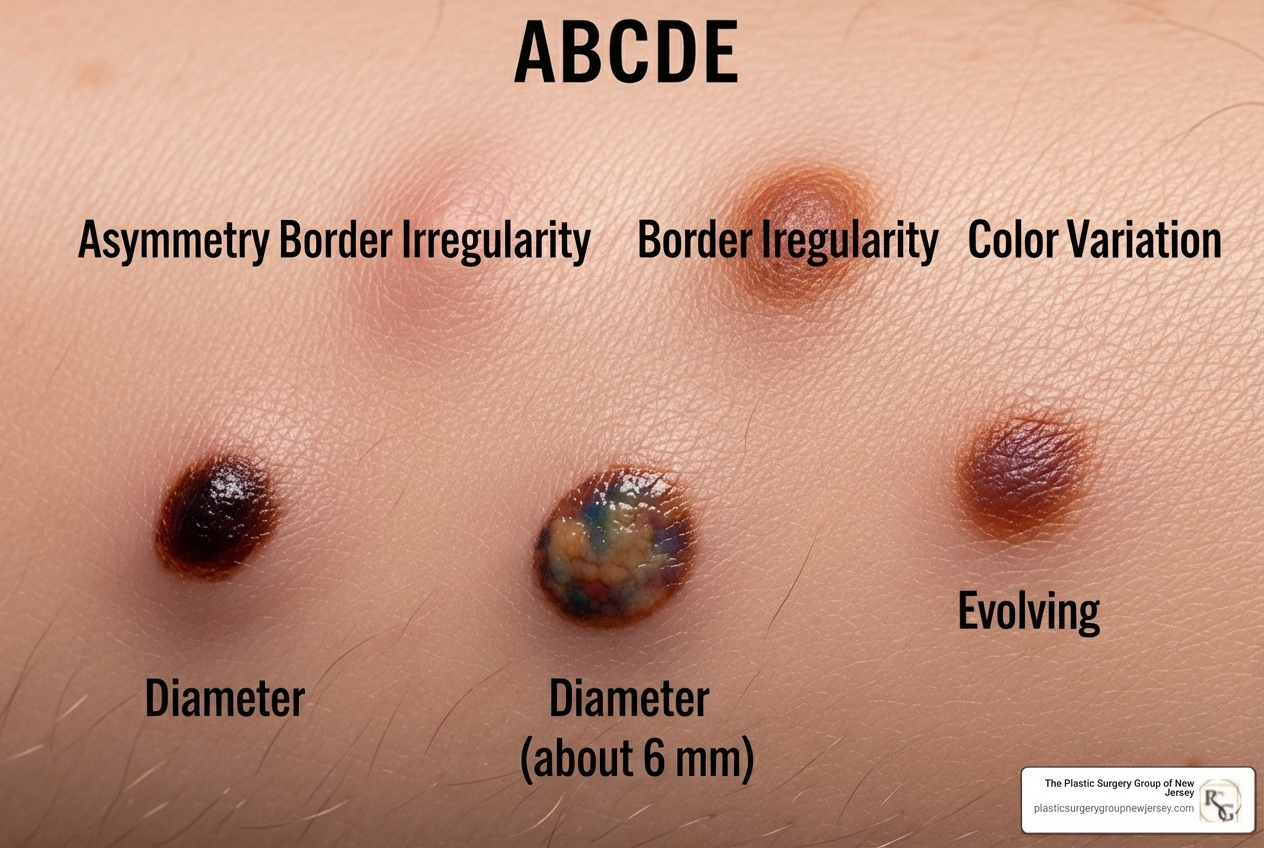
Knowing the warning signs of melanoma is vital for early detection and successful treatment. We recommend familiarizing yourself with the ABCDE rule, a widely recognized guide for identifying potentially cancerous moles:
- A – Asymmetry: One half of the mole does not match the other half. Imagine drawing a line through the middle; if the two sides look different, it’s a red flag.
- B – Border Irregularity: The edges of the mole are ragged, notched, blurred, or poorly defined, rather than smooth and even.
- C – Color Variation: The mole has uneven color distribution, with shades of brown, black, tan, white, red, or blue. A harmless mole usually has a consistent color throughout.
- D – Diameter: The mole is larger than 6 millimeters (about the size of a pencil eraser). While melanoma can be smaller, this is a general guideline for concern.
- E – Evolving or Changing Moles: The mole is changing in size, shape, color, elevation, or any new symptom like bleeding, itching, or crusting. Any noticeable change over time warrants immediate attention.
Beyond the ABCDEs, you should also be concerned if a mole is painful, itchy, inflamed, or begins to bleed or crust. New moles appearing after young adulthood can also be a cause for concern. If a mole appears suspicious, it is important to have your dermatologist evaluate it promptly. For more detailed information, the American Academy of Dermatology provides excellent resources on Moles: Diagnosis and treatment.
Professional Mole Removal: Medical and Cosmetic Options
At The Plastic Surgery Group of New Jersey, our board-certified plastic surgeons are experts in evaluating and removing moles for both medical and cosmetic reasons. The decision to remove a mole is always made with your health and aesthetic goals in mind.
Medical Reasons for Removal: The primary medical reason for mole removal is to diagnose or treat skin cancer, particularly melanoma. If a mole exhibits any of the ABCDE warning signs, or if it’s constantly irritated, bleeding, or itching, our surgeons will recommend removal. The removed tissue is then sent for biopsy and pathology to determine if cancerous or pre-cancerous cells are present. This diagnostic step is critical, as early detection of skin cancer significantly improves treatment outcomes. In cases where skin cancer is confirmed, further treatment, such as Mohs surgery, might be necessary. To understand more about specialized treatments, you can explore More info about Mohs Surgery: How It Works in NJ.
Cosmetic Reasons for Removal: Many patients choose to have moles removed for cosmetic reasons. A mole might be in a prominent location on the face or body, making you feel self-conscious. It could also be a source of irritation, constantly catching on clothing, jewelry, or getting nicked during shaving. In these instances, even if the mole is benign, its removal can significantly improve your comfort and confidence. Our goal is to achieve the best possible aesthetic outcome, minimizing scarring and enhancing your natural appearance.
The expertise of board-certified plastic surgeons and dermatologists is paramount in mole removal. While dermatologists specialize in diagnosing skin conditions, plastic surgeons bring a unique skill set, especially in meticulous closure techniques that help minimize scarring.
| Factor | Surgical Excision | Shave Removal | Laser Removal |
|---|---|---|---|
| Best For | Deep, suspicious, or large moles | Raised, benign moles | Small, flat, non-cancerous moles |
| Procedure | Cut out with scalpel; stitches required | Shaved off at skin level with a blade | Light energy used to break down pigment |
| Scarring | Linear scar; can be minimized with good technique | Flat or slightly indented scar; good cosmetic result | Minimal; potential for hypopigmentation or discoloration |
| Biopsy Possible | Yes; provides complete tissue sample for pathology | Yes; provides tissue sample for pathology | No; tissue is destroyed, no sample for pathology |
| Average Cost | $150-$400 per mole | $100-$300 per mole | $200-$500 per session |
Surgical Excision
Surgical excision is often considered the “gold standard” for mole removal, especially for moles that are deep, large, or show any signs of suspicion for skin cancer. This method involves using a scalpel to cut out the entire mole, along with a small margin of healthy surrounding skin to ensure complete removal. The wound is then carefully closed with stitches (sutures), which may be dissolvable or require removal at a follow-up appointment.
The primary advantage of surgical excision is its thoroughness. It provides a complete tissue sample for pathology, allowing for an accurate diagnosis. Because the mole is fully removed, surgical excision boasts the lowest recurrence rate among removal methods. While it results in a linear scar, our plastic surgeons at The Plastic Surgery Group of New Jersey use advanced stitching techniques to minimize its appearance and promote optimal healing. For complex cases, especially following skin cancer removal, More info about Mohs Reconstruction for Skin Cancer details our reconstructive capabilities.
Shave Removal
Shave removal is a quick and effective method typically used for raised, benign moles that are not deeply rooted. In this procedure, a specialized surgical blade is used to carefully shave off the mole so it’s flush with the surrounding skin. Unlike surgical excision, shave removal usually does not require stitches.
This method is popular for its speed and simplicity, often completed during a routine office visit. It typically leaves a flat or slightly indented scar that often blends well with the skin. While shave removal is effective for many raised moles, it does carry a slightly higher chance of regrowth compared to surgical excision because the deeper cells of the mole might not be entirely removed. However, if regrowth occurs, the mole can often be re-treated.
Laser Mole Removal
Laser mole removal uses focused beams of light energy to break down the pigment in the mole. This method is generally reserved for small, flat, non-cancerous moles and is often chosen for cosmetic purposes due to its potential for minimal scarring.
While laser removal can be effective for certain benign moles, it has some limitations. It typically requires multiple sessions to achieve the desired result, and because the laser destroys the tissue, it does not provide a sample for pathological examination. This means it cannot be used for moles that are suspicious for skin cancer, as a biopsy is essential for diagnosis. Additionally, moles treated with laser can sometimes have a higher recurrence rate compared to surgical excision. However, for the right type of benign mole, laser removal can offer excellent cosmetic outcomes, particularly for those concerned about visible scars.
The Procedure and Recovery Process
Undergoing mole removal at The Plastic Surgery Group of New Jersey is a straightforward process designed with your comfort and safety in mind. Our state-of-the-art facilities in Montclair, Livingston, and Manhattan are equipped to provide you with a seamless experience from consultation to full recovery.

Preparing for Your Procedure
Your journey begins with a thorough consultation. One of our board-certified plastic surgeons will carefully examine your mole(s) and discuss your medical history and aesthetic goals. We’ll answer any questions you have and explain the recommended removal method in detail. If deemed medically necessary, we may take pictures of the mole for documentation.
On the day of your procedure, the area around the mole will be cleaned, and the mole itself might be marked. The most crucial step for your comfort is the administration of a local anesthetic. This is typically done via a small injection around the mole. You might feel a brief, initial needle prick, but this discomfort quickly subsides as the numbing medicine takes effect. Our team takes every measure to ensure you are comfortable and relaxed throughout the entire process.
What to Expect During Mole Removal
Once the area is numb, the actual mole removal procedure is quite quick. Depending on the method chosen (surgical excision or shave removal), the process itself usually takes only a few minutes. From start to finish, you can expect to be in our office for approximately 15-30 minutes.
During the procedure, you should feel no pain, only perhaps some pressure or movement as our surgeon works. After the mole is removed, we’ll carefully address the site, which may involve closing with sutures for excisions or applying a topical dressing for shave removals. A sterile bandage will then be applied to protect the wound. You’ll be able to return home shortly after your procedure.
Aftercare and Healing
Proper aftercare is essential for optimal healing and minimizing scarring. Our team will provide you with detailed wound care instructions to follow at home. Generally, these instructions include:
- Keeping the site clean and moist: We advise keeping a bandage on the site for about 24 hours. After this, you can gently remove the bandage and wash the area with mild soap and water daily.
- Applying Vaseline or Aquaphor: It is recommended to apply a thin layer of petroleum jelly (like Vaseline) or Aquaphor to the wound site and cover it with a fresh band-aid daily until it has healed. Keeping the wound moist helps prevent scabbing and promotes faster, smoother healing.
- Bandage changes: Change your bandage daily, or more often if it becomes wet or dirty.
The healing timeline can vary. For most small mole removals, initial healing typically takes two to three weeks. However, the location of the mole plays a significant role: wounds on your face or the upper part of your body may heal in about 1–2 weeks, while wounds on your legs or lower body can take longer, often 1–2 months, due to differences in blood supply and skin tension. During this time, you can usually resume your daily activities, though some soreness is normal. For individuals who prioritize their appearance and seek confidence-boosting procedures, understanding recovery is key. This commitment to self-care is universal, and you can learn more about how we cater to various aesthetic needs, including More info about Cosmetic Procedures for Men.
Risks, Scarring, and Important Safety Warnings
While professional mole removal procedures performed by our experienced plastic surgeons are generally safe and effective, it’s important to be aware of potential risks, understand how to manage scarring, and, critically, avoid dangerous at-home removal methods.
Potential Risks and Side Effects
Any time the skin is broken, there are inherent risks. While rare, potential risks and side effects of mole removal include:
- Infection: Signs of infection include increasing redness, swelling, warmth, pus, or fever. It’s important to contact our office immediately if you notice any of these symptoms.
- Bleeding: Minor bleeding can occur during or after the procedure. Persistent or heavy bleeding should be reported to us.
- Nerve Damage: In very rare cases, if a mole is located near a nerve, temporary or permanent nerve damage could occur, leading to numbness or altered sensation.
- Allergic Reaction to Anesthetic: Although uncommon, some individuals may experience an allergic reaction to the local anesthetic.
- Mole Recurrence: Despite thorough removal, some moles can grow back. This is more common with shave removal or laser treatment compared to surgical excision. If a mole returns, it’s crucial to have it re-evaluated.
How to Minimize Scarring After Mole Removal
Our plastic surgeons are renowned for their meticulous techniques, which play a significant role in minimizing scarring. However, any procedure that breaks the skin’s surface will leave some form of scar. The good news is that there’s a lot you can do to help your scar heal optimally:
- Following Aftercare Instructions: Adhering strictly to our post-procedure wound care instructions, especially keeping the wound clean and moist, is the single most important step.
- Sun Protection (SPF 30+): Protecting the healing site and new scar from sun exposure is critical. UV rays can cause a new scar to darken and become more noticeable. We recommend applying a broad-spectrum sunscreen with an SPF of 30 or higher to the area for at least 6-12 months after the procedure.
- Silicone Sheets or Gels: Once the wound has fully closed, silicone-based scar creams, sheets, or gels can be highly effective in improving scar appearance. These products help to hydrate the scar and reduce collagen overproduction.
- Avoiding Picking Scabs: Resist the urge to pick at any scabs that form, as this can delay healing and worsen scarring.
- Scar Maturation Over Time: Scars take time to mature and fade. While they may initially appear red or raised, they typically flatten and lighten over several months to a year.
For individuals particularly concerned about scar appearance, we offer specialized options. If you’re interested in learning more about refining existing scars, explore More info about Scar Revision Surgery.
The Dangers of At-Home Mole Removal
We cannot stress this enough: never attempt to remove a mole at home. The internet is unfortunately rife with dangerous DIY mole removal “hacks” and products, including unapproved creams, chemical solutions, and mole pens. These methods pose significant risks to your health and skin:
- DIY Risks: At-home attempts can lead to severe complications such as chemical burns, uncontrolled bleeding, and painful infections.
- Incomplete Removal: Most home methods only address the surface of the mole, leaving behind deeper cells. This incomplete removal can cause the mole to grow back, potentially making it harder to treat professionally.
- Delayed Skin Cancer Diagnosis: This is perhaps the most serious risk. If a mole is cancerous, attempting to remove it yourself destroys the tissue, preventing a pathologist from examining it. This delay can allow skin cancer to grow and spread, significantly worsening your prognosis. The FDA has issued strong warnings about these products, emphasizing that they can cause serious side effects, including scarring and delayed diagnosis. For more information directly from the source, you can Learn more about the risks of at-home products from the FDA. Trust us, your skin and your health are too important to risk with unproven, unsafe methods.
Frequently Asked Questions about Mole Removal
We understand you likely have many questions about mole removal. Here, we address some of the most common inquiries our patients have.
What is the cost of mole removal and is it covered by insurance?
The cost of mole removal can vary significantly depending on the method used, the size and location of the mole, and whether it’s for medical or cosmetic reasons.
- Surgical Excision: Typically ranges from $150-$400 per mole.
- Shave Removal: Generally costs $100-$300 per mole.
- Laser Removal: Can range from $200-$500 per session, and often requires multiple sessions.
Insurance coverage for mole removal is a common concern. In general, insurance plans in New Jersey and New York will cover the cost of mole removal if it is deemed medically necessary. This includes moles that are suspicious for skin cancer, pre-cancerous, or causing symptoms like irritation, bleeding, or itching. Our team will work with your insurance provider to determine coverage for medically indicated procedures.
However, if a mole is removed purely for cosmetic reasons (e.g., you simply don’t like its appearance but it poses no health risk), it is usually considered an elective procedure and is not covered by insurance. In these cases, the cost will be an out-of-pocket expense. We always provide a clear estimate of costs before any procedure.
Does the procedure hurt?
One of the most frequent questions we hear is about pain during mole removal. We’re happy to reassure you that the procedure itself is not painful.
Before we begin, a local anesthetic is injected into the area around the mole. You might feel a brief, sharp sting or pinch from the initial needle prick, similar to a bee sting. However, this sensation quickly subsides as the numbing agent takes effect. Once the area is completely numb, you won’t feel any pain during the actual removal, though you might sense some pressure or movement.
After the anesthetic wears off, which is usually a few hours later, it’s normal to experience some mild soreness, tenderness, or a stinging sensation at the removal site for a few days. This discomfort is typically well-managed with over-the-counter pain relievers like ibuprofen or acetaminophen.
Can moles grow back after being removed?
The possibility of a mole growing back after removal depends largely on the removal method and the nature of the mole itself.
- Surgical Excision: This method, which involves cutting out the entire mole and stitching the wound, has the lowest recurrence rate. Because the mole is completely removed, it is less likely to grow back.
- Shave Removal: Moles removed by shave incision are somewhat more likely to come back. Since this method shaves the mole flush with the skin, some deeper pigment cells might remain, leading to regrowth.
- Laser Removal: Similar to shave removal, laser treatment can also have a higher recurrence rate because it may not destroy all the pigment cells, especially if the mole has a deeper component.
Most moles do not grow back after being professionally removed. However, if a mole does return, it is crucial to schedule a follow-up visit with our plastic surgeons right away. A recurrent mole, especially if it appears different from its original form, could potentially indicate a cancerous growth or a change in its benign nature. We’ll evaluate any regrowth carefully to ensure your ongoing skin health.
Conclusion: Making an Informed Decision for Your Skin
Navigating mole removal can seem daunting, but with the right information and professional guidance, it becomes a clear path toward healthier, more confident skin. We’ve explored what moles are, why they form, and critically, how to identify when a mole might be a cause for concern using tools like the ABCDE rule.
We’ve also detailed the professional methods available for mole removal – surgical excision, shave removal, and laser treatment – each with its own benefits, considerations, and healing process. Understanding these options, along with the importance of proper aftercare, empowers you to make informed decisions. Most importantly, we’ve emphasized the critical dangers of at-home mole removal and why professional evaluation by experienced plastic surgeons like ours is non-negotiable for your safety and optimal results.
At The Plastic Surgery Group of New Jersey, our board-certified plastic surgeons, including Dr. Allen Rosen and Dr. Ablaza, are dedicated to providing natural, beautiful results through highly regarded expertise and a state-of-the-art facility in Montclair, Livingston, and Manhattan. Whether your concerns are medical or cosmetic, our team is here to guide you through every step of the process, ensuring your comfort, safety, and satisfaction.
Your skin health is a lifelong journey, and we are here to be your trusted partners. If you have a mole that concerns you, or one you wish to have removed for cosmetic reasons, don’t hesitate to seek expert advice.
Learn more about your mole removal options and schedule a consultation with us today. We look forward to helping you achieve your aesthetic and health goals.


