
Is Non-Surgical Skin Tightening Worth It?
Non surgical skin tightening is a group of in-office treatments that use energy — like radiofrequency, ultrasound, or laser — to stimulate collagen and elastin production deep in the skin, gradually firming and lifting without surgery or significant downtime.
Here’s a quick overview of what you need to know:
| What You Want to Know | The Short Answer |
|---|---|
| What it treats | Mild to moderate loose skin on face, neck, arms, abdomen, and more |
| How it works | Heat energy triggers your body’s natural collagen rebuilding process |
| Who it’s best for | Healthy adults with mild to moderate skin laxity |
| Results timeline | 2 to 6 months after treatment |
| How long results last | 1 to 3 years with proper maintenance |
| Average cost | $755 to $4,000+ depending on technology and area |
| Downtime | Little to none |
Maybe you’ve hit a major weight loss milestone and noticed your skin didn’t quite follow. Or perhaps you’re looking in the mirror and seeing changes that crept up quietly over the years. Either way, you’re not alone — and the good news is that surgery isn’t your only option.
Non-surgical treatments have grown into one of the fastest-moving categories in aesthetic medicine, and for good reason. They offer real, measurable results for the right candidates — without the recovery time, scars, or cost of a surgical procedure.
That said, they’re not magic. Knowing what they can and can’t do is the key to making a smart decision.
I’m Dr. Valerie J. Ablaza, M.D., a board-certified plastic surgeon and partner at The Plastic Surgery Group of New Jersey, with decades of experience helping patients achieve natural, confidence-boosting results through both surgical and non surgical skin tightening approaches. In this guide, I’ll walk you through everything you need to know to decide if these treatments are the right fit for you.
Understanding Non-Surgical Skin Tightening and How It Works
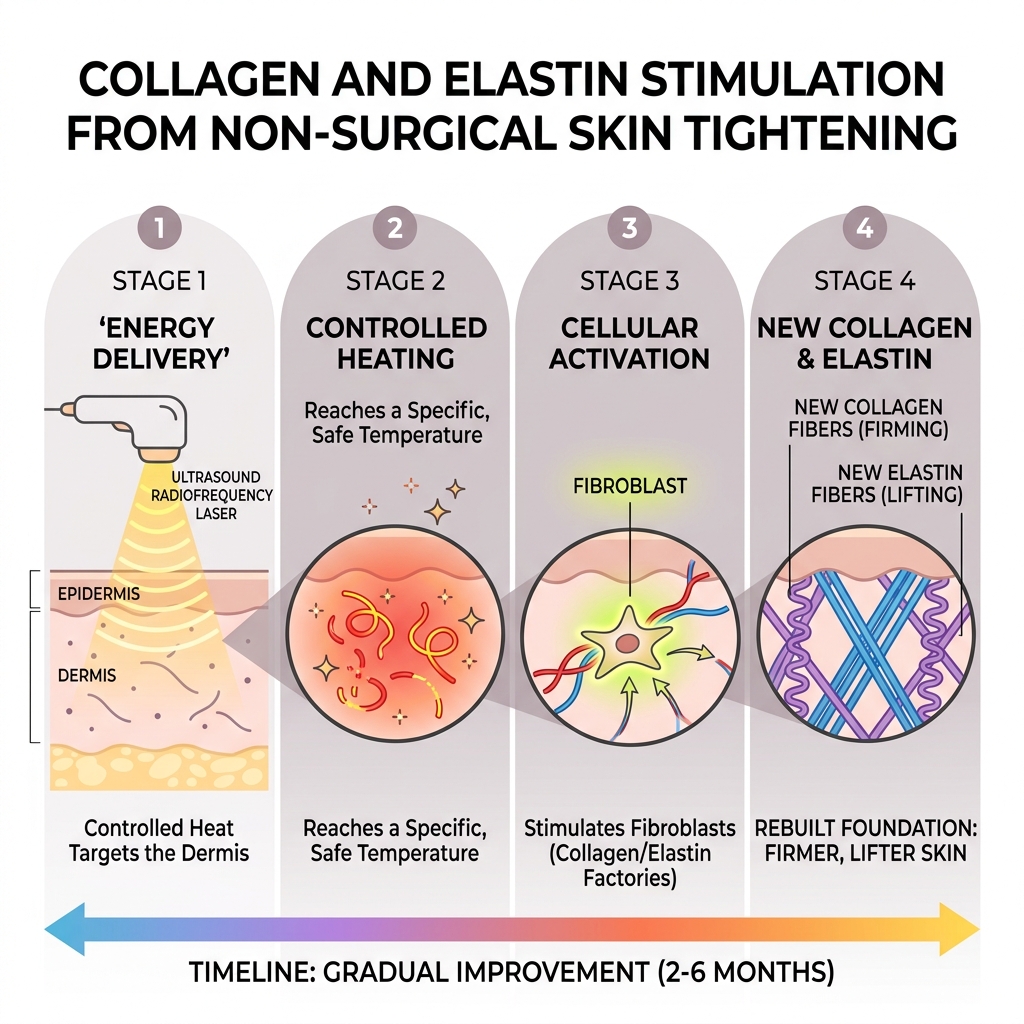
At its core, non surgical skin tightening is about sending a “wake-up call” to your skin’s deeper layers. As we age, our skin’s natural repair mechanisms slow down. These treatments use various forms of energy—ultrasound, radiofrequency (RF), or light—to penetrate the epidermis and heat the dermis (the deeper layer of skin) to a specific, controlled temperature.
This process relies on two primary biological responses:
- Immediate Tissue Contraction: The existing collagen fibers in your skin contract when heated, providing a subtle, immediate smoothing effect.
- Fibroblast Activation: The heat creates a form of “controlled stress.” This signals your body’s fibroblasts—the cells responsible for making structural proteins—to go into overdrive. Over the next several months, your body produces a fresh supply of new collagen and elastin.
According to the Skin Tightening Treatments: Different Types and Who They Benefit guide, these procedures are categorized as non-invasive (acting on the surface) or minimally invasive (using tiny needles or probes). Unlike a surgical lift, which physically removes excess skin, these technologies remodel the skin you have from the inside out.

Why Skin Loses Elasticity: Aging, Weight Loss, and Pregnancy
To understand why we need these treatments, we have to look at why skin sags in the first place. Think of your skin like a high-quality rubber band. When it’s new, it snaps back instantly. Over time, or if it’s stretched too far for too long, it loses that “snap.”
The Aging Process
Starting in our mid-20s, our collagen production drops by about 1% every year. Elastin, the protein that allows skin to bounce back, also begins to degrade. This intrinsic aging is often accelerated by sun damage, which breaks down fibers even faster.
The Impact of Weight Loss
Whether you’ve reached your goals through diet and exercise or Skin Elasticity After Weight Loss has become a concern following bariatric surgery, rapid volume depletion often leaves the skin “envelope” too large for the new body contours. We are also seeing a surge in patients concerned about Ozempic and Skin Elasticity. While these medications are for weight health, the rapid loss can lead to what some call “Ozempic Face” or body laxity. This is why Non-Surgical Skin Tightening and Ozempic have become such a popular combination in our New Jersey offices.
Pregnancy and Stretching
During pregnancy, the skin on the abdomen undergoes extreme stretching. For many women, the skin doesn’t fully retract afterward, leading to a “crepey” texture or mild sagging that exercise alone cannot fix.
Top Technologies for Non-Surgical Skin Tightening
Not all energy-based treatments are created equal. Depending on your goals and the area of the body, we may recommend one technology over another.
| Technology | Best For | Depth | Typical Sessions |
|---|---|---|---|
| Ultrasound (Ultherapy) | Lifting the brow, chin, and neck | Up to 5mm | 1 session |
| Radiofrequency (RF) | Face, neck, abdomen, and arms | Subdermal | 2–6 sessions |
| Laser/IPL | Surface texture and mild tightening | Superficial to Mid-dermis | 3–5 sessions |
Ultrasound Therapy (Ultherapy)
Ultherapy is often considered the “gold standard” for non-invasive lifting. It uses micro-focused ultrasound energy to reach depths of up to 5mm—the same foundational layer addressed in surgical facelifts. As noted by the American Board of Cosmetic Surgery, it is the only FDA-cleared procedure to actually lift skin on the neck, chin, and brow. It’s also fantastic for smoothing out wrinkles on the chest (décolletage).
The Power of Radiofrequency (RF) Non-Surgical Skin Tightening
RF treatments use electromagnetic waves to generate heat. Unlike ultrasound, which targets specific points, RF provides a more bulk-heating effect that is excellent for body contouring and skin smoothing.
Popular devices like Morpheus8 combine RF with microneedling, allowing the energy to be delivered deeper into the skin through tiny pins. This is particularly effective for Treatments for Double Chin and Neck Laxity. According to the Cleveland Clinic, RF is safe for all skin tones and carries a very low risk of pigmentation issues.
Laser and IPL Treatments
While lasers are often associated with hair removal, fractional CO2 lasers and non-ablative resurfacing are powerful tools for skin firming. These treatments use light energy to create “micro-channels” of heat. This not only tightens the skin but also improves texture and pigmentation. As WebMD suggests, these are excellent alternatives for those who want to avoid the “pulled” look of a facelift while still seeing significant rejuvenation.
Non-Surgical vs. Surgical: Choosing the Right Path
One of the most frequent questions we hear at our Montclair and Livingston locations is: “Do I need a tummy tuck, or can I just do a laser treatment?”
The answer depends entirely on the degree of skin laxity and your personal goals.
- Non-Surgical is best for: Mild to moderate sagging, patients who want to avoid anesthesia, and those who cannot afford weeks of downtime. It’s also a great preventative measure for younger patients.
- Surgery is best for: Severe sagging, “apron” skin after massive weight loss, or cases where the underlying muscle (like the abdominal wall) needs repair.
In our practice, we often discuss Neck Laxity and Skin Rejuvenation in NJ as a spectrum. If you can pinch more than an inch of loose skin, or if the skin hangs in folds, non-surgical options may provide a modest improvement but will likely not meet your expectations for a “flat” or “tight” result.
When to Choose Surgery Over Non-Surgical Skin Tightening Options
If you have significant “hanging” skin after losing 50 or 100 pounds, a surgical body lift or tummy tuck is usually the only way to achieve your desired silhouette. Surgery allows us to physically remove the excess tissue and tighten the remaining skin for an immediate, dramatic transformation.
What to Expect: Treatment, Results, and Maintenance
If you decide that non surgical skin tightening is the right path, here is what your journey will look like.
During the Procedure
Most sessions last between 30 and 90 minutes. Depending on the device, we may apply a topical numbing cream to ensure you’re comfortable. You might feel a warm sensation or a light tingling—some patients describe it as a “hot stone massage” or a light rubber band snap.
Recovery and Side Effects
One of the biggest perks? You can usually go right back to work or your daily New York City commute immediately. You might experience:
- Mild redness (usually fades in a few hours)
- Slight swelling or tenderness
- Minor bruising (more common with microneedling RF)
The Results Timeline
Patience is key. While you might see a tiny “glow” immediately, the real magic happens as your body builds collagen. Most patients see the full effect between 2 and 6 months after their final session.
Longevity and Maintenance
Results typically last between 1 and 3 years. However, your skin is a living organ that continues to age. To protect your investment, we recommend:
- Medical-grade skincare: Look for products with retinoids and peptides to support collagen.
- Sun Protection: UV rays are the #1 enemy of collagen. Wear SPF 30+ every single day.
- Healthy Lifestyle: A nutrient-rich diet (high in Vitamin C and Omega-3s) and staying hydrated help your skin maintain its “snap.”
Frequently Asked Questions about Skin Firming
How much does non-surgical skin tightening cost?
The cost varies based on the technology used and the size of the area being treated. National averages for ultrasound therapy are around $993, while radiofrequency averages roughly $755 to $2,000 per session. For a full-face and neck treatment series, you can expect a range between $1,000 and $4,000. During your consultation, we provide a transparent, personalized quote.
Is the procedure painful?
We prioritize your comfort. While some technologies (like Ultherapy) reach deep layers and can be felt, we use topical numbing and other cooling techniques to make the experience very tolerable. Most patients describe it as a temporary discomfort rather than “pain.”
How many sessions will I need for optimal results?
While some patients see great results from a single Ultherapy session, RF treatments usually require a series of 2 to 6 sessions spaced a few weeks apart. The results are cumulative—each session builds on the last.
Next Steps
At The Plastic Surgery Group of New Jersey, we believe that everyone deserves to feel confident in their skin. Whether you are dealing with the aftermath of a major weight loss journey, the changes that come with motherhood, or simply the natural progression of time, non surgical skin tightening offers a powerful, science-backed way to reclaim your contours.
Dr. Rosen, Dr. Ablaza, and our entire team are dedicated to providing natural, beautiful results in our state-of-the-art facilities. We don’t believe in a one-size-fits-all approach; we take the time to listen to your goals and design a treatment plan that fits your lifestyle and your anatomy.
If you’re ready to see if these treatments are worth the hype for you, we invite you to schedule a private consultation at one of our New Jersey locations. Let us help you achieve the ultimate body transformation.


