
Why Your Nose Size Matters More Than You Think
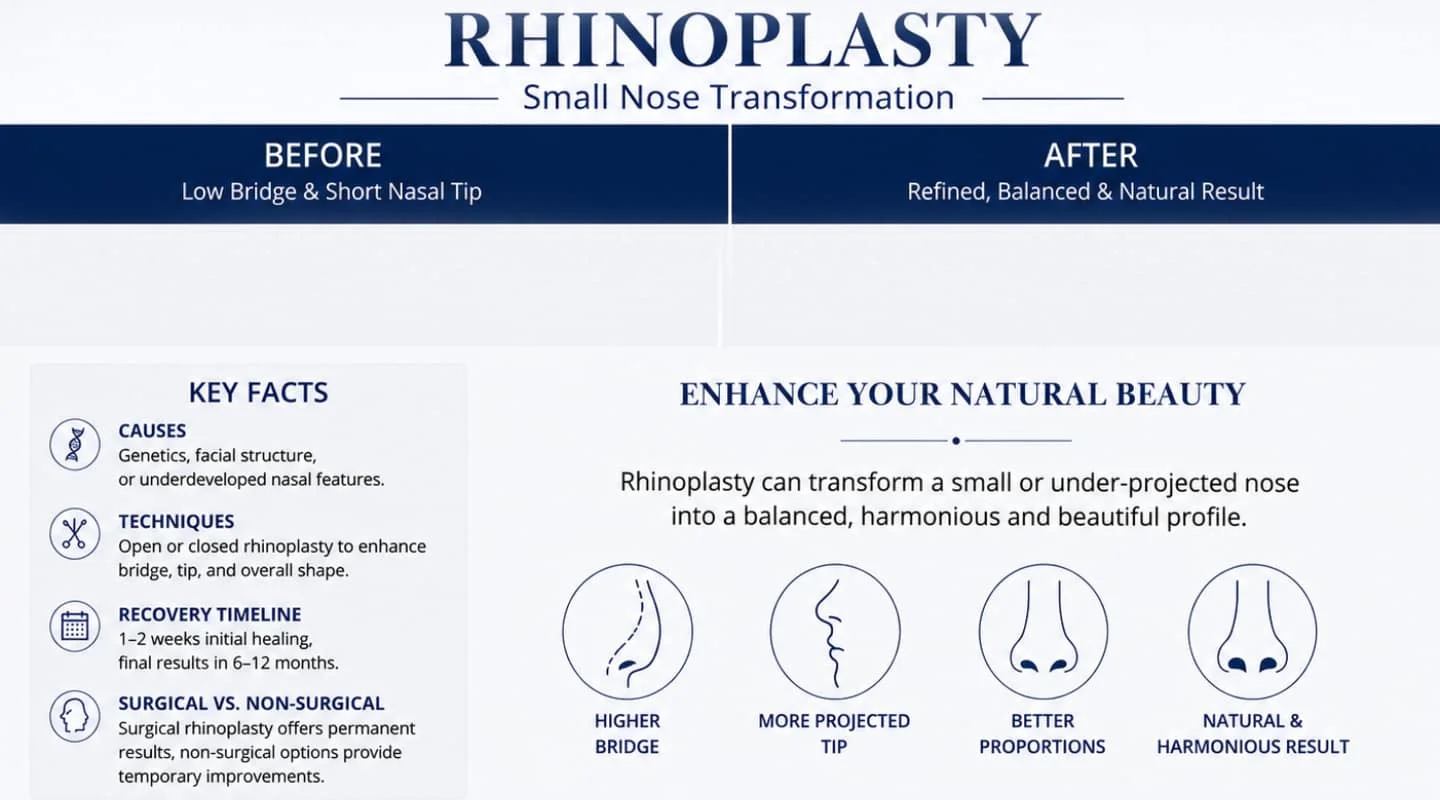
Rhinoplasty for a small nose is a specialized procedure that adds structure, height, and definition to a nose that feels too flat, short, or undefined for your face.
Quick answers for common questions:
| Question | Answer |
|---|---|
| Can rhinoplasty make a small nose bigger? | Yes — through cartilage grafting and structural reshaping |
| Is it permanent? | Yes, results last a lifetime |
| Who is a good candidate? | Healthy adults with realistic expectations who have finished facial growth |
| How long is recovery? | Most return to work in 1–2 weeks; full results visible after 9–12 months |
| Are non-surgical options available? | Yes, but fillers are temporary and cannot permanently add structure |
Your nose sits at the exact center of your face. When it feels out of balance — too flat, too short, or lacking definition — it can affect how you see yourself every time you look in the mirror.
The good news? That imbalance is correctable.
A nose that appears too small can stem from genetics, past trauma, a previous surgery that removed too much tissue, or simply natural aging. No matter the cause, the goal is the same: restore proportion and harmony so your features work together, not against each other.
This is not about chasing a celebrity’s nose or hitting an arbitrary size target. It’s about building a bridge — literally and figuratively — between how you look and how you feel.
Very small changes to nasal structure, even just a few millimeters, can make a significant difference in overall facial balance. That’s what makes this procedure both powerful and precise.
I’m Dr. John A. Cece, a fellowship-trained plastic and reconstructive surgeon who trained under world leaders in rhinoplasty at the Manhattan Eye, Ear, and Throat Hospital — experience that gives me a deep understanding of the nuanced techniques required for rhinoplasty for a small nose. In the sections below, I’ll walk you through exactly what this procedure involves, who it’s right for, and what to expect every step of the way.
Understanding Rhinoplasty for Small Nose Correction
When most people hear the word “rhinoplasty,” they immediately think of a “nose job” that makes a large nose smaller. However, rhinoplasty for a small nose is often the opposite. In plastic surgery, we call this augmentation rhinoplasty. Instead of removing bone and cartilage, we are often adding it to build a more defined profile.
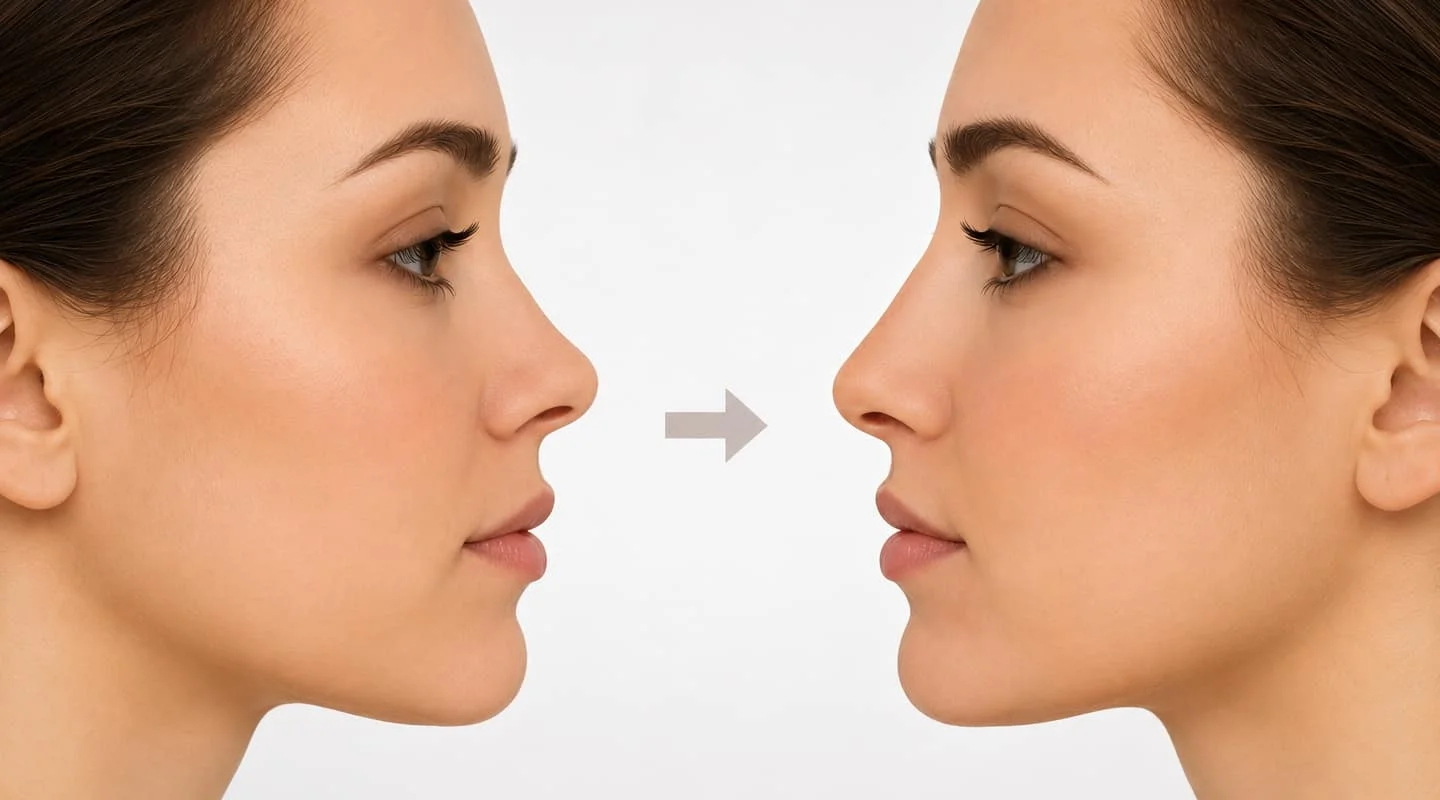
The primary challenge with a small nose is maintaining structural integrity while increasing the nasal dorsum (the bridge). If a nose is too flat or “scooped,” it can make the eyes appear further apart and the face appear wider. By building up the bridge, we create a more vertical line that brings the facial features into better focus.
At The Plastic Surgery Group of New Jersey, we focus on facial harmony. We don’t just look at the nose in isolation; we look at the forehead, the lips, and the chin. In fact, sometimes a nose looks small because the chin is overly prominent, or vice versa. If you’ve ever thought, “I just don’t like my profile,” but couldn’t put your finger on why, it might be a lack of nasal projection. If you find yourself frequently wondering what to do if I hate my nose, understanding the anatomy of a small nose is the first step toward a solution.
Common Reasons for Seeking Nasal Augmentation
Why would someone want a larger or more defined nose? It usually comes down to one of several factors that have left the nose looking “under-projected” or “short.”
- Congenital Features: Many patients are simply born with a low bridge or a short nasal tip. This is particularly common in certain ethnic backgrounds, where the goal of surgery is to add definition while strictly preserving ethnic identity.
- Saddle Nose Deformity: This occurs when the bridge of the nose collapses, often due to trauma or previous medical issues. It creates a “saddle” shape that lacks the height necessary for a balanced profile.
- Nasal Trauma: Accidents can break the delicate bones and cartilage of the nose, causing it to heal in a compressed or flattened state.
- Over-Resection (Revision Surgery): Unfortunately, we often see patients who had a previous rhinoplasty elsewhere where too much tissue was removed. This “over-scooped” look can appear unnatural. Revision surgery is needed to “rebuild” the bridge.
- Age-Related Changes: As we age, the ligaments in the nose can loosen, and the tip can droop, making the bridge appear shorter or less defined than it once was.
- Functional Needs: Sometimes, a nose is so small or collapsed that it interferes with breathing. We often perform rhinoplasty for breathing issues alongside cosmetic augmentation to ensure you look great and breathe clearly.
Surgical Techniques for Rhinoplasty for Small Nose Augmentation
Building a nose is a bit like architecture. You need a solid foundation and the right materials. To increase the size or length of a nose, we use specialized techniques that go beyond the “standard” reduction procedure.

The Choice of Approach: Open vs. Closed
For rhinoplasty for a small nose, we often prefer the open rhinoplasty approach. This involves a tiny, nearly invisible incision across the columella (the tissue between the nostrils). This allows us full visualization of the nasal structures, which is crucial when we are meticulously placing grafts to ensure they don’t shift. Closed rhinoplasty, where incisions are hidden inside the nostrils, may be used for minor refinements, but for significant building, the open approach offers the precision needed for a natural look.
Cartilage Grafting for a Small Nose Rhinoplasty
The “gold standard” for building up a nose is using autologous grafts—which is just a fancy way of saying we use your own natural tissue.
- Septal Cartilage: This is our first choice. It’s the cartilage inside your nose. If there is enough available, it’s the perfect material for building a columellar strut or small bridge adjustments.
- Ear Cartilage: If we need more material, ear cartilage is excellent for tip refinement because it has a natural curve.
- Rib Cartilage: For significant augmentation or revision cases where other cartilage is gone, rib cartilage is the “heavy lifter.” It provides strong, straight support for a brand-new nasal bridge.
Structural Support and Tip Refinement
It isn’t just about the bridge; the tip needs to follow suit. We use spreader grafts to widen a narrow bridge and tip grafts to increase projection. If the nose is too short, we use septal extension grafts to physically lengthen the nose downward, creating a more elegant silhouette. You can see how these techniques transform a profile in our before and after nose gallery.
Recovery Timeline and Long-Term Results
Rhinoplasty is a journey, not an overnight transformation. Because we are often adding material and stretching the skin to accommodate a new shape, the healing process requires patience.
The Recovery Milestone Table
| Timeline | What to Expect |
|---|---|
| Days 1–3 | Maximum swelling and bruising around the eyes. Keep your head elevated! |
| Week 1 | Splint and stitches are removed. You’ll see the basic new shape, though it will be very swollen. |
| Weeks 2–3 | Most “socially visible” bruising is gone. Many patients return to work in Montclair or NYC. |
| Month 3 | About 70% of the swelling has subsided. The bridge looks more defined. |
| Year 1 | The final result! The skin has fully “shrink-wrapped” around the new structure. |
Pro tip: Avoid wearing heavy glasses directly on the bridge of your nose for at least 4–6 weeks. Use contacts or “tape” your glasses to your forehead to protect your new bridge!
Non-Surgical Alternatives vs. Rhinoplasty for Small Nose Refinement
In May 2026, “liquid rhinoplasty” is more popular than ever. But is it right for a small nose?
Liquid Rhinoplasty for Small Nose Adjustments
A non-surgical nose job uses dermal fillers (like Hyaluronic Acid) to add volume to the bridge.
- The Pros: Instant results, no downtime, and it’s performed in our office in just 15 minutes.
- The Cons: It’s temporary (lasting 8–24 months), and it can only add volume. It cannot narrow a nose or fix internal breathing issues.
Limitations of Non-Surgical Approaches
While fillers can “camouflage” a small bump or slightly raise a bridge, they have a major limitation: they cannot provide structural support. If you keep adding filler to a small nose year after year, you risk creating a “heavy” look or building up scar tissue. Surgical rhinoplasty for a small nose is the only way to achieve a permanent, structurally sound, and naturally proportioned result.
Frequently Asked Questions about Small Nose Rhinoplasty
Who is a good candidate for this procedure?
The best candidates are those who have reached physical maturity (usually age 16 for females and 17 for males). You should be a non-smoker, as smoking significantly hinders the healing of cartilage grafts. Most importantly, you should have realistic expectations. We aim for “better,” not “perfect.”
What are the risks associated with nasal augmentation?
Every surgery has risks, including infection or reaction to anesthesia. Specifically for augmentation, there is a small risk of graft displacement (the cartilage moving) or asymmetry as the nose heals.
How long does the surgery typically take?
A typical rhinoplasty for a small nose takes between 1.5 to 3 hours. It is usually performed as an outpatient procedure under general anesthesia, meaning you get to go home the same day to recover in the comfort of your own bed.
Next Steps
Building a better bridge isn’t just about changing the size of your nose—it’s about restoring the balance of your entire face. Whether you were born with a petite nose or have experienced changes due to trauma or age, modern surgical techniques allow us to sculpt a profile that looks natural and feels like you.
At The Plastic Surgery Group of New Jersey, Dr. Rosen, Dr. Ablaza, Dr. Cece and our entire team are dedicated to providing a state-of-the-art experience in our Montclair facility. We combine artistic vision with surgical precision to ensure your results are both beautiful and permanent.
Ready to see what’s possible for your profile? Schedule a consultation for Rhinoplasty for Small Nose today and let’s build your better bridge together.


