
What to Do About an Inverted Nipple After Pregnancy
Inverted nipple after pregnancy is more common than most new mothers realize — and in most cases, it’s manageable with the right techniques.
Here’s a quick overview of what you need to know:
- What it is: A nipple that points inward or lies flat instead of protruding outward
- How common: Up to 1 in 3 first-time pregnant women experience some degree of inversion; about 10% still have it by the time baby arrives
- Main causes: Hormonal changes, breast engorgement, milk duct shortening, or pre-existing congenital inversion
- Can you breastfeed? Yes — most women with flat or inverted nipples can breastfeed successfully with the right support
- Does it resolve? Mild cases often improve on their own; moderate to severe cases may need corrective aids or medical treatment
- When to worry: See a doctor if inversion is sudden, affects only one breast, or comes with discharge, lumps, or skin changes
The experience can feel overwhelming in those first days after birth — you’re navigating milk coming in, a hungry newborn, and nipples that aren’t cooperating. You’re not alone, and there are clear steps you can take.
I’m Dr. John A. Cece, a fellowship-trained plastic and reconstructive surgeon with specialized expertise in aesthetic breast surgery, including solutions for inverted nipples after pregnancy. Having trained at Manhattan Eye, Ear, and Throat Hospital under world leaders in breast surgery, I’ll walk you through everything — from simple at-home techniques to when surgical correction makes sense.
Quick inverted nipple after pregnancy terms:
Understanding Inverted Nipple After Pregnancy: Causes and Grades
When we talk about an inverted nipple after pregnancy, we are describing a nipple that retracts into the breast tissue rather than pointing out toward the baby. While many women are born with this (congenital), others notice it for the first time or see it become more pronounced after the “milk comes in.”
To understand how to handle it, we first need to look at the severity. Medical professionals use a three-grade system to classify inversion:
| Grade | Description | Breastfeeding Impact |
|---|---|---|
| Grade 1 | Often called “shy nipples.” They protrude easily with stimulation or cold and stay out for a while. | Usually minimal; baby can often draw the nipple out. |
| Grade 2 | Can be pulled out manually but tend to retract quickly once stimulation stops. | Can make latching difficult; may require tools like shields. |
| Grade 3 | Severely inverted; the nipple cannot be pulled out manually and stays retracted. | Significant challenge; often requires a breast pump or surgery. |
Why Does This Happen Now?
If you didn’t have this issue before, you might be wondering why you’re dealing with an inverted nipple after pregnancy. Several factors are at play:
- Congenital Factors: About 10% to 20% of the general population is born with flat or inverted nipples. You might have had a mild case that only became obvious when your breasts changed size.
- Milk Duct Shortening: Sometimes, the milk ducts are physically too short, acting like tight tether wires that pull the nipple inward.
- Breast Engorgement: This is the most common “sudden” cause postpartum. When your milk comes in, the surrounding breast tissue becomes so swollen and firm that it flattens the nipple or pushes it inward. It’s like trying to grab a button on an over-inflated balloon.
- Hormonal Fluctuations: Pregnancy hormones increase skin elasticity, but they also change the internal architecture of the breast.
For many women, these changes are temporary. However, it is important to distinguish between a nipple that is simply “flat” and one that is truly retracted. You can learn more about the specific retracted inverted nipples causes symptoms treatment to see which category you fall into.
How to Breastfeed Successfully with Flat or Inverted Nipples
The most important thing to remember is that a baby does not breast-feed; they breast-feed. This means they need a mouthful of breast tissue, not just the nipple itself.
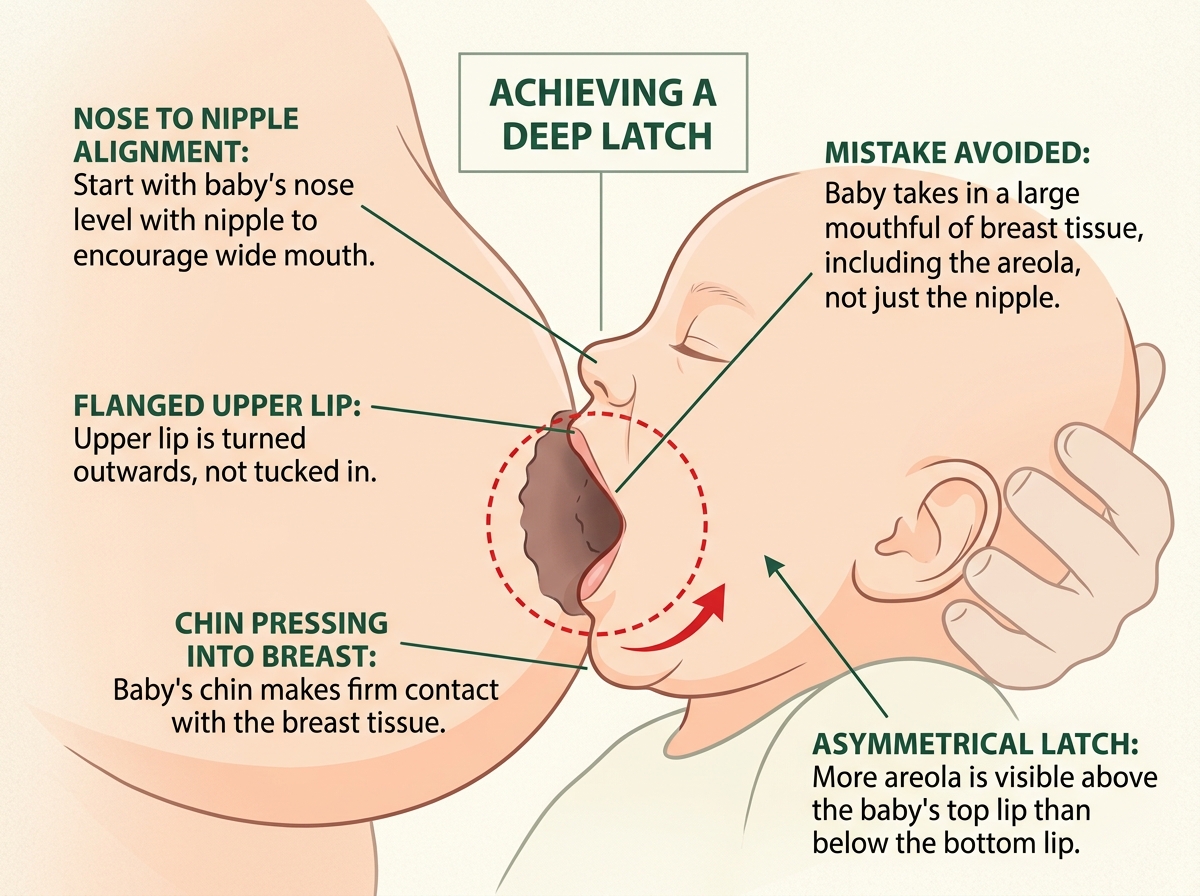
If you are struggling with an inverted nipple after pregnancy, here are our top strategies for success:
The “Sandwich” or Areola Compression
Before offering the breast, compress your areola (the dark circle around the nipple) between your fingers to form a “C” or “U” shape. This makes the tissue narrower and easier for the baby to get deep into their mouth. Once they have a good mouthful of tissue, the suction they create will often pull the nipple out into the proper position.
Manual Stimulation and Cold Compresses
For Grade 1 or “shy” nipples, a little bit of “wake-up call” helps. Gently roll the nipple between your thumb and forefinger for a minute before feeding. Alternatively, applying a cold cloth or an ice cube for a few seconds can trigger the erector muscles in the nipple to contract and protrude.
Using a Breast Pump to “Prime” the Nipple
If your breasts are engorged, use a breast pump for 2–5 minutes before bringing the baby to the breast. This serves two purposes:
- It softens the areola by removing the initial “tight” milk.
- The vacuum pressure of the pump physically draws the nipple out, making it a much easier target for your newborn.
According to a 2021 randomized study, mothers with inverted nipples who received specialized postnatal support—like learning these specific suction and latching techniques—had significantly higher breastfeeding success rates compared to those receiving standard care. We encourage our New Jersey patients to work closely with a lactation consultant to master these moves.
Step-by-Step Techniques to Correct Inversion Postpartum
If simple stimulation isn’t enough, there are several mechanical ways to encourage a more permanent “outward” position for an inverted nipple after pregnancy.
The Hoffman Technique
This is a manual exercise designed to break up the tiny adhesions (connective tissue) that are pulling the nipple inward.
- Place your thumbs on either side of the nipple, directly on the edge of the areola.
- Press firmly into the breast tissue while simultaneously pulling your thumbs away from each other.
- Repeat this vertically (thumbs at 12 and 6 o’clock) and horizontally (thumbs at 3 and 9 o’clock).
- Do this about five times every morning.
A 2023 clinical study confirmed significant improvement in breastfeeding outcomes for women with mild inversion who performed these manual exercises regularly.
Suction Devices and Correctors
There are several over-the-counter devices designed to apply gentle, prolonged suction.
- Nipple Extractors: These look like small syringes or suction cups. You place them over the nipple for a few minutes several times a day to stretch the milk ducts.
- Breast Shells: These are plastic domes worn inside your bra. They apply constant, gentle pressure to the base of the nipple, encouraging it to poke through a central hole. Unlike nipple shields, these are worn between feedings.
Nipple Shields: A Temporary Bridge
A nipple shield is a thin, silicone cover worn during breastfeeding. It provides a firm, protruding shape for the baby to latch onto. While they are incredibly helpful for Grade 2 and 3 inversions, we recommend using them under the guidance of a professional to ensure your milk supply stays strong and the baby continues to transfer milk effectively.
When to See a Doctor for Nipple Changes
While an inverted nipple after pregnancy is usually a result of benign (harmless) changes in breast tissue or engorgement, any new change in your breasts deserves a professional look.
We recommend scheduling a consultation if you notice:
- Sudden Inversion: If your nipple was always out and suddenly pulls in over the course of a few days (and you aren’t currently engorged).
- Unilateral Changes: If only one nipple is changing while the other remains the same.
- Mastitis Symptoms: Redness, heat, fever, or extreme pain.
- Discharge: Especially if you notice an inverted nipple leaking fluid that is bloody or clear rather than milky.
Identifying Red Flags: Is it an Inverted Nipple After Pregnancy or Something Else?
In rare cases, nipple inversion can be a sign of underlying issues. While about 10–20% of people have naturally inverted nipples, “acquired” inversion (meaning it happened later in life) needs to be screened for breast cancer.
- Paget’s Disease: This is a rare form of breast cancer that starts in the nipple ducts. It often looks like eczema—crusty, scaly, or itchy skin—and can cause the nipple to flatten or invert.
- Inflammatory Breast Cancer: This can cause the breast to look swollen or red, sometimes pulling the nipple inward.
Research on nipple inversion and cancer risks suggests that while most cases are benign, sudden changes in adulthood—especially those that are persistent and not related to the immediate postpartum period—warrant a diagnostic workup.
Diagnostic Tests for Acquired Inversion
If you come to see us in Montclair with a concerning nipple change, we may recommend:
- Diagnostic Mammogram: To look for masses or calcifications.
- Breast Ultrasound: To see if a fluid-filled cyst or a solid mass is pulling on the duct.
- Ductography: A specialized X-ray that uses dye to look inside the milk ducts.
- MRI or Biopsy: If the initial imaging shows anything suspicious.
Long-Term Solutions and Surgical Options
For some women, an inverted nipple after pregnancy doesn’t resolve with exercises or time. If the inversion causes physical discomfort, recurrent infections (like thrush or mastitis trapped in the fold), or if you are unhappy with the aesthetic appearance, surgery is a highly effective option.
At The Plastic Surgery Group of New Jersey, we offer two main surgical approaches:
- Duct-Preserving Surgery: This is our preferred method for women who may want to breastfeed in the future. We carefully release the tight fibers pulling the nipple in while keeping the milk ducts intact.
- Duct-Dividing Surgery: This is often used for more severe Grade 3 cases. By dividing the shortened ducts, we can achieve a more dramatic and permanent protrusion. This is typically recommended for women who have finished their childbearing years.
The procedure is usually performed under local anesthesia and takes less than an hour. You can see the types of results possible by viewing our before and after nipple procedure gallery.
Frequently Asked Questions about Postpartum Nipples
Can I still nurse with Grade 3 inversion?
It is challenging, but not impossible. Grade 3 inversion involves severe fibrosis (scarring) and very short ducts. Many mothers with Grade 3 inversion choose to use a high-quality electric breast pump to maintain their milk supply and feed their baby via a bottle. However, some find success using nipple shields. A lactation consultant is your best ally here.
Will my nipples stay inverted forever?
Not necessarily! Many women find that the constant “tugging” and suction of a breastfeeding baby naturally stretches the milk ducts and connective tissue over time. By the end of their breastfeeding journey, many find their nipples protrude much more than they did before pregnancy.
Does an inverted nipple after pregnancy affect milk supply?
Inversion itself does not affect how much milk your breasts make. However, if the baby cannot latch properly, they won’t be able to “empty” the breast. Since milk production is a supply-and-demand system, if the milk isn’t removed, your body will eventually slow down production. Using a pump can help bridge this gap and keep your supply high while you work on latching.
Moving Forward with Confidence
Dealing with an inverted nipple after pregnancy can feel like one more hurdle in the marathon of new motherhood. Whether your goal is to achieve a comfortable breastfeeding relationship or to restore the aesthetic appearance of your breasts, there are solutions available.
At The Plastic Surgery Group of New Jersey, our surgeons—including Dr. Rosen, Dr. Ablaza, and Dr. Cece—specialize in providing natural, beautiful results for women navigating postpartum changes. We understand the delicate balance between function and form.
If you are ready to explore Inverted Nipples Solutions or simply want a professional evaluation of recent changes, we are here to help. From our state-of-the-art facility in Montclair, we provide the expert care you need for your ultimate body transformation.
Ready to take the next step? Contact us today to schedule a consultation and regain your confidence.


