
Nipple Reduction Surgery: What It Changes and What to Consider
Quick Answer: Nipple reduction is surgery to make a nipple shorter, narrower, or both. People may choose it when nipples rub against clothing, show through shirts, or feel out of proportion. The goal is a natural-looking shape, but surgery leaves a scar and may change nipple sensation or affect future breastfeeding. The right approach depends on which dimension you want to change and whether preserving milk ducts is a priority.
In this guide, I’ll explain the main techniques, recovery, and risks so you can have a more useful conversation with your surgeon. I’m Valerie J. Ablaza, M.D.; my fellowship training in breast and aesthetic surgery and my cosmetic and reconstructive practice shape my balanced approach to nipple reduction.

Understanding Nipple Hypertrophy and Aesthetic Proportions
Even though nipples are relatively small anatomical structures, disproportionate size can create significant physical and emotional frustration. Patients often tell us that overly prominent nipples dictate their wardrobe choices—forcing them to wear heavily padded bras or thick shirts to avoid visibility in public.
Clinical Definition and Causes of Nipple Hypertrophy
Nipple hypertrophy refers to an enlargement of the nipple in terms of projection (height), diameter (width), or both.
Several factors may influence nipple size and prominence:
- Genetics and Congenital Factors: Some individuals naturally develop larger or more prominent nipples during puberty.
- Hormonal Fluctuations: Hormonal changes during adolescence and pregnancy may influence nipple size and appearance.
- Pregnancy and Breastfeeding: Changes in breast and nipple tissue during pregnancy and nursing may result in persistent nipple elongation.
Prominent nipples may experience chafing, inflammation and discomfort from repeated contact with clothing.
Managing these concerns often involves individualized surgical planning, as discussed in clinical research on the treatment of hypertrophic nipples.
Aesthetic Considerations for Nipple Projection and Diameter
Aesthetic proportions vary according to breast anatomy, body proportions and individual preferences. Published research on nipple reduction surgery discusses the following dimensions as potential surgical planning guidelines:
- Projection (Height): Approximately 8 mm, with a suggested range between 6 mm and 10 mm.
- Diameter (Width): Approximately 8 mm, with a suggested range between 6 mm and 10 mm.
These measurements are not universal standards. Some patients primarily require a reduction in nipple projection, while others may benefit from a combination technique that narrows the base and shortens the height.
Surgical Approaches to Nipple Reduction
Nipple reduction is a precise, outpatient procedure typically performed under local anesthesia with or without light oral sedation. During your consultation, we carefully evaluate the central ductal architecture, neurovascular supply, and skin elasticity to select the most appropriate surgical technique for your anatomy and goals. You can explore real patient outcomes in our before and after nipple procedure gallery.
Fanous Technique and Physiological Preservation
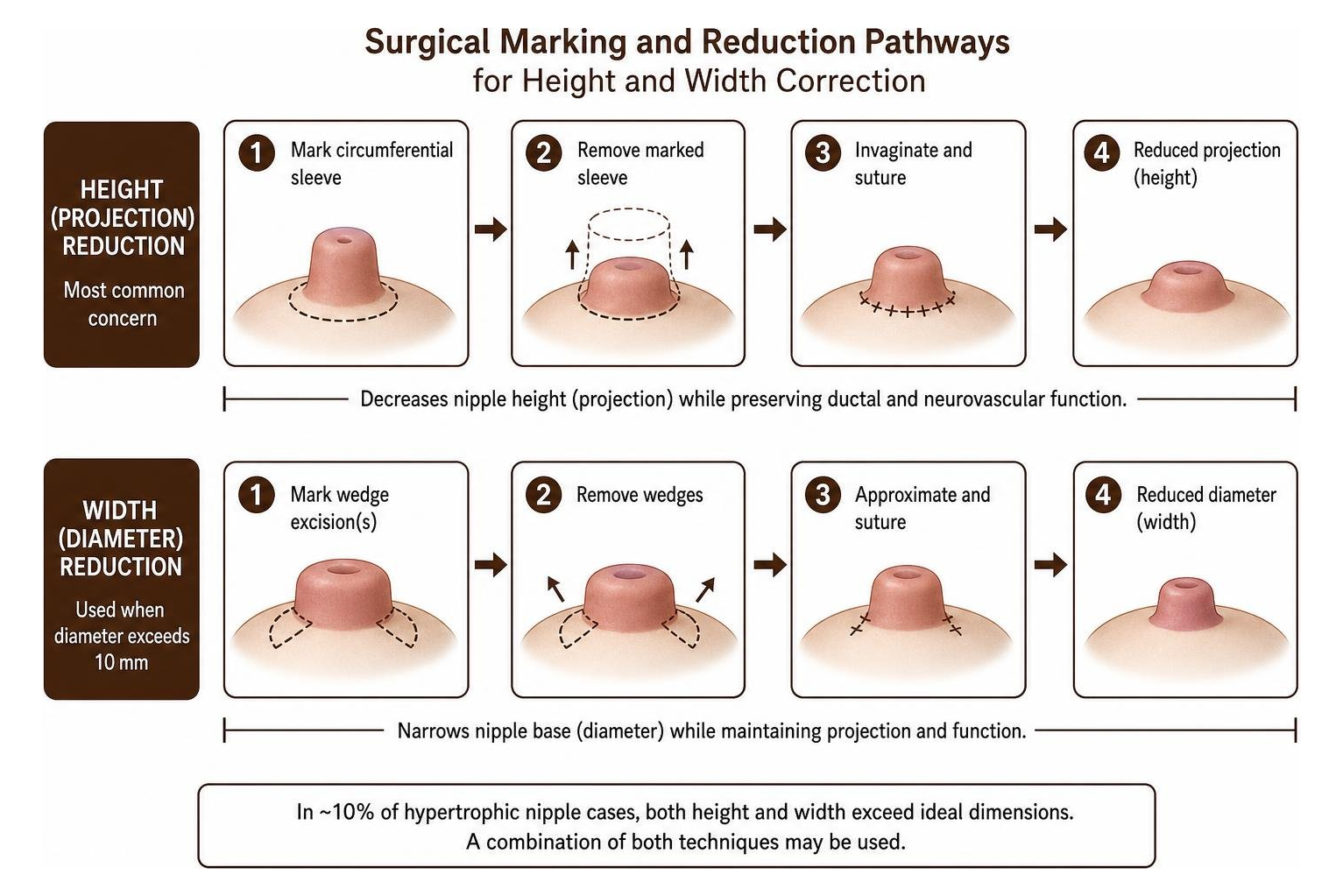
One surgical approach designed to reduce nipple projection while preserving important anatomical structures is circumferential sleeve resection with invagination, described by Fanous et al. (2009).
In this procedure:
- A circumferential band of skin (a “sleeve”) is meticulously marked and deepithelialized around the lower to middle column of the nipple.
- The core containing the central lactiferous (milk) ducts and the sensory nerve plexus is carefully preserved.
- The distal tip of the nipple is telescoped (invaginated) down toward the areolar base and secured with fine, dissolvable sutures.
This method reduces nipple projection while aiming to preserve the underlying nerve pathways and milk ducts. Although the technique is designed to protect these structures, changes in nipple sensation and breastfeeding ability remain possible.
Addressing Projection vs. Diameter Discrepancies
Nipple height and nipple width require distinct surgical maneuvers:
- Reducing Height (Projection): Corrected by removing a cylindrical cuff of outer skin at the base (circumferential base resection) or invaginating the distal core into the breast parenchyma.
- Reducing Width (Diameter): Corrected by excising one or more triangular or wedge-shaped sections of skin and tissue from the side or base of the nipple (wedge resection), then reapproximating the edges to taper the column.
When both dimensions are enlarged, an inferior wedge resection can be combined with a circumferential base excision. Positioning the wedge closure along the 6 o’clock position may help minimize scar visibility along the lower curve of the nipple.
Primary Closure vs. Secondary Intention Healing
Nipple reduction surgery can involve several different surgical approaches. The following table compares two techniques that differ in tissue removal, wound closure and potential effects on nipple function.
| Feature | Circumferential Resection with Primary Closure | Simplified Amputation (Moliver Technique) |
|---|---|---|
| Surgical Concept | Removal of a circumferential sleeve of skin | Removal of the distal portion of the nipple |
| Suture Lines | Fine sutures near the nipple base | Healing without primary suture closure |
| Lactation Preservation | Designed to preserve central milk ducts | May disrupt milk ducts and affect breastfeeding |
| Healing Timeline | Varies depending on incision healing | Gradual healing through secondary intention |
| Sensory Preservation | Designed to minimize nerve disruption | Changes in sensation are possible |
The simplified amputation method, evaluated in a clinical study by Moliver et al., reduces nipple height by removing a portion of the distal nipple and allowing the surgical site to heal through secondary intention. Because this approach may disrupt milk ducts, patients considering future breastfeeding should discuss alternative techniques with their surgeon.
Gender Considerations and Combination Procedures

Nipple anatomy and aesthetic goals differ considerably across genders, influencing how we design each surgical plan.
Gender-Specific Approaches for Women and Men
- Female Patients: Women often seek female nipple reduction to address tissue elongation following childbearing, natural developmental differences or asymmetry. The objective is to achieve a natural projection that complements breast proportions while minimizing disruption to nipple sensation and function.
- Male Patients: Men seeking a male nipple reduction generally desire a flatter, less prominent contour beneath fitted shirts or swimwear. Surgical planning focuses on reducing excessive projection or width while maintaining natural chest proportions.
Combining Nipple Reduction with Other Breast Procedures
Nipple reshaping is frequently performed alongside other aesthetic and corrective breast surgeries:
- Breast Augmentation: Nipple reduction may be performed alongside breast augmentation to address nipple prominence and improve overall breast proportions, as discussed in published research on hypertrophic nipple treatment.
- Breast Lift (Mastopexy) & Breast Reduction: When reshaping the breast tissue and repositioning the areola, addressing nipple size simultaneously may help improve overall proportions and symmetry.
- Gynecomastia Surgery: When removing glandular tissue or performing male chest contouring, reducing excessive nipple projection may help achieve a flatter, more balanced chest appearance as part of comprehensive cosmetic procedures for men.
Recovery Timeline, Postoperative Care, and Complications
Recovery following nipple reduction surgery is generally manageable, although healing times vary depending on the surgical technique, individual health and whether additional breast procedures are performed.
Postoperative Healing and Scar Management
- Days 1–3: Mild tenderness and swelling are expected. You will wear a soft, non-compressive dressing with non-stick gauze and antibacterial ointment to protect the suture lines from clothing friction.
- Weeks 1–2: Most patients return to desk work and light routines within 24 to 48 hours. Suture lines begin sealing rapidly. Strenuous exercise, heavy lifting, and direct chest impact should be avoided for 2 to 3 weeks.
- Months 1–6: Surgical scars gradually soften and fade. Applying medical-grade silicone scar gels and protecting the area from UV exposure helps incisions blend into the surrounding natural pigmentation.
Potential Risks and Complications of Nipple Reduction
Although nipple reduction is a relatively small surgical procedure, potential risks and complications include:
- Sensory Changes: Temporary or permanent numbness, altered sensitivity or hypersensitivity may occur following surgery.
- Lactation Disruption: Depending on the technique chosen, partial ductal scarring or transection may affect future breastfeeding.
- Asymmetry or Under-Correction: Differences in diameter or height may occasionally require additional surgical refinement.
- Infection or Delayed Healing: As with any surgical procedure, infection and delayed wound healing are possible.
- Scarring: Surgical scars are permanent, although their visibility may decrease over time.
- Changes in Blood Supply: Disruption of circulation to nipple tissue may affect healing and potentially cause tissue damage.
Frequently Asked Questions About Nipple Surgery
Will nipple reduction surgery affect my ability to breastfeed?
Duct-sparing procedures, such as the Fanous circumferential sleeve technique, are designed to preserve the central milk ducts. However, internal scarring or ductal damage may affect future breastfeeding. Patients planning future pregnancies should discuss surgical timing and breastfeeding concerns during their consultation.
Is nipple reduction surgery painful, and what type of anesthesia is used?
Most nipple reduction procedures are performed under local anesthesia. Postoperative tenderness and discomfort can typically be managed with surgeon-recommended pain medication. Anesthesia requirements and recovery experiences may vary depending on the procedure.
How visible will the surgical scars be after healing?
Depending on the surgical technique, incision lines may be positioned along the natural junction where the nipple meets the areola or within the natural texture of the nipple. Scars generally become less noticeable as they mature, although individual healing and scar visibility vary.
Restoring Balance and Confidence at The Plastic Surgery Group of New Jersey
Nipple reduction can help reduce clothing irritation, improve symmetry and create proportions that better complement a patient’s breast or chest anatomy. Achieving natural-looking results requires careful consideration of tissue structure, nerve pathways, nipple function and individual aesthetic goals.
At The Plastic Surgery Group in Montclair, New Jersey, board-certified plastic surgeons Dr. Allen D. Rosen and Dr. Valerie J. Ablaza provide personalized, patient-centered surgical care in a state-of-the-art facility. If you are considering reshaping options, we invite you to schedule a plastic surgery consultation for female nipple reduction to discuss a treatment plan tailored to your goals.
References
- Fanous N, Tawile C, Fanous A. Nipple reduction – An adjunct to augmentation mammaplasty. Canadian Journal of Plastic Surgery. 2009;17(3):81–88.
- Olivera Whyte LM, Ahualli PE, Prezzavento GE. Treatment of the Hypertrophic Nipple in Breast Augmentation. Plastic Surgery. 2025.
- Moliver C, Kargel J, Sullivan M. Treatment of Nipple Hypertrophy by a Simplified Reduction Technique. Aesthetic Surgery Journal. 2013;33(1):77–83.
- Current Surgical Techniques for Nipple Reduction: A Literature Review.


