
Understanding What You’ll Pay for Professional Mole Removal
The cost of mole removal by dermatologist typically ranges from $150 to $1,500 per mole, depending on several factors:
- Surgical Excision: $100 to $950 per mole
- Shave Excision: $100 to $350 per mole
- Laser Removal: $150 to $500 per mole
- Consultation Fees: $50 to $200
- Follow-up Visits: $50 to $150 per visit
Most standard procedures cost between $400 and $650.
Insurance typically covers removal only when medically necessary (suspicious for cancer, causing pain, bleeding, or functional problems). Cosmetic removal is paid out-of-pocket.
If a mole concerns you—whether it’s changing, causing discomfort, or affecting your confidence—understanding the financial side of removal is key. The price depends on the mole’s size and location, the removal method, if a biopsy is needed, and your insurance.
Some moles are harmless, while others can signal serious conditions like melanoma. Choosing an experienced provider matters for your health and wallet, as proper removal can prevent complications and additional procedures.
I’m Dr. Allen Rosen, a board-certified plastic surgeon. For over two decades in New Jersey, I’ve helped thousands of patients steer the cost of mole removal by dermatologists and plastic surgeons, ensuring they receive safe, effective care custom to their needs.

Breaking Down the Cost of Mole Removal by a Dermatologist
The total cost of mole removal by dermatologist isn’t a single figure but is influenced by several factors. Understanding these elements helps you prepare.
The mole’s size is a primary cost determinant. Smaller moles (1-2 mm) are less expensive to remove than larger ones (over 6 mm), which often require more intricate techniques.
The mole’s location is also significant. Moles on sensitive or prominent areas like the face or neck demand more precision, which can increase the cost. Our team emphasizes aesthetic preservation for facial mole removal, using advanced techniques to ensure the best results.
The number of moles removed also impacts the cost. While the total bill increases, some clinics offer a reduced rate per mole for multiple removals in one session.
The complexity of the mole is another critical factor. A simple, benign surface mole is less costly to remove than an Atypical mole (dysplastic nevus). These are often larger with irregular features and require more thorough removal and lab analysis to rule out skin cancer, adding to the cost.
Finally, the clinic’s reputation and provider’s experience are key. Esteemed dermatologists and plastic surgeons may charge more, but this investment often yields superior results, less scarring, and greater peace of mind. We pride ourselves on the natural results our experienced plastic surgeons deliver.
What is the average cost of mole removal by a dermatologist?
The average cost of mole removal by dermatologist varies, but in our New Jersey and New York City locations, a single mole removal generally ranges from $150 to $1,500. Most standard private procedures fall between $400 and $650.
If you’re considering the removal of a mole on your face for cosmetic reasons, you might anticipate a cost in the range of $500 to $800 per mole. When the removal includes a lab analysis, which is often crucial for suspicious moles, the cost typically ranges from $500 to $950.
Here’s a list of typical price ranges for common mole removal scenarios:
- Surgical Excision: $100 to $650 per mole (for a simple removal)
- Laser Removal (including CO2 Laser): $150 to $500 per mole
- Shave Excision: $100 to $350 per mole
- Electrosurgery (Electrocautery): $100 to $300 per mole
- Cryotherapy (Liquid Nitrogen): $150 to $325 per lesion
- Radiofrequency Ablation: $200 to $600 per mole
- Facial Mole Removal (Cosmetic): $500 to $800 per mole
- Excision with Lab Analysis: $500 to $950 (for suspicious moles)
- Scar Refinement (if needed post-removal): $500 to $1,500
Don’t Forget These Additional Expenses
Beyond the procedure, which is the bulk of the cost of mole removal by dermatologist, remember to budget for potential additional expenses:
- Consultation fees: An initial consultation to assess your mole costs $50 to $200. This fee may sometimes be applied to the procedure cost.
- Anesthesia costs: Local anesthesia is often included. For complex cases or extra sedation, separate costs of $100 to $300 might apply.
- Pathology fees for biopsy: If a mole is suspicious, a tissue sample is sent to a lab for analysis. This crucial step incurs pathology fees, generally between $50 and $200+.
- Follow-up visits: A follow-up visit to monitor healing may be recommended, costing $50 to $150.
- Scar treatment products: We may recommend creams, gels, or silicone sheets to minimize scarring. These are typically out-of-pocket expenses.
- Potential for Scar Revision Surgery: In rare cases, a separate scar revision procedure ($500 to $1,500) might be considered later to improve the aesthetic result.
Mole Removal Methods and Their Price Tags
The chosen removal method impacts cost and outcome. Our team will help you select the best option based on your mole’s characteristics, location, and removal reason.

Here’s a comparison of common techniques, their typical costs, scarring potential, recovery times, and best use cases:
| Method | Cost Range ($) | Scarring Potential | Recovery Time | Best Use Cases |
|---|---|---|---|---|
| Surgical Excision | 100 – 950 | Moderate to High | 7-14 days (stitches) | Deep-rooted, suspicious, or larger moles; ensures complete removal & biopsy. |
| Shave Excision | 100 – 350 | Minimal | Days to 1 week | Raised, benign moles; often used for biopsy of superficial lesions. |
| Laser Removal | 150 – 500 | Minimal | Days to 1 week | Flat, superficial, or cosmetic moles; multiple sessions may be needed. |
| Cryotherapy | 150 – 325 | Minimal | Days to 1 week | Small, benign, superficial moles or skin tags. |
| Electrosurgery/RF | 100 – 600 | Minimal | Days to 1 week | Small, benign skin growths, skin tags, or smaller moles. |
Surgical Excision: For Deeper or Suspicious Moles
Surgical excision is the gold standard for deep, large, or suspicious moles. Our surgeon cuts out the entire mole plus a small margin of tissue and closes the incision with stitches.
The cost is $100 to $650 per mole, or $500 to $950 with a lab analysis. While the initial scar may be more noticeable, this method offers the highest chance of complete removal, reducing recurrence risk. It also allows for a biopsy to provide a definitive diagnosis, which is invaluable if skin cancer is a concern. You can find more info about Skin Cancer Treatment on our website.
Shave Excision: For Raised, Benign Moles
Shave excision is excellent for raised, benign moles. This less invasive technique uses a blade to shave the mole flush with the skin. No stitches are needed, and the wound heals with a minimal scar.
Costing $100 to $350 per mole, patients appreciate the minimal scarring and quick recovery. However, since it’s a shallower removal, there’s a higher potential for recurrence if pigment cells remain. It’s best for confirmed benign moles.
Laser, Cryotherapy, and Electrosurgery
For flat, superficial, or cosmetic moles, less invasive techniques like laser removal, cryotherapy, or electrosurgery are options.
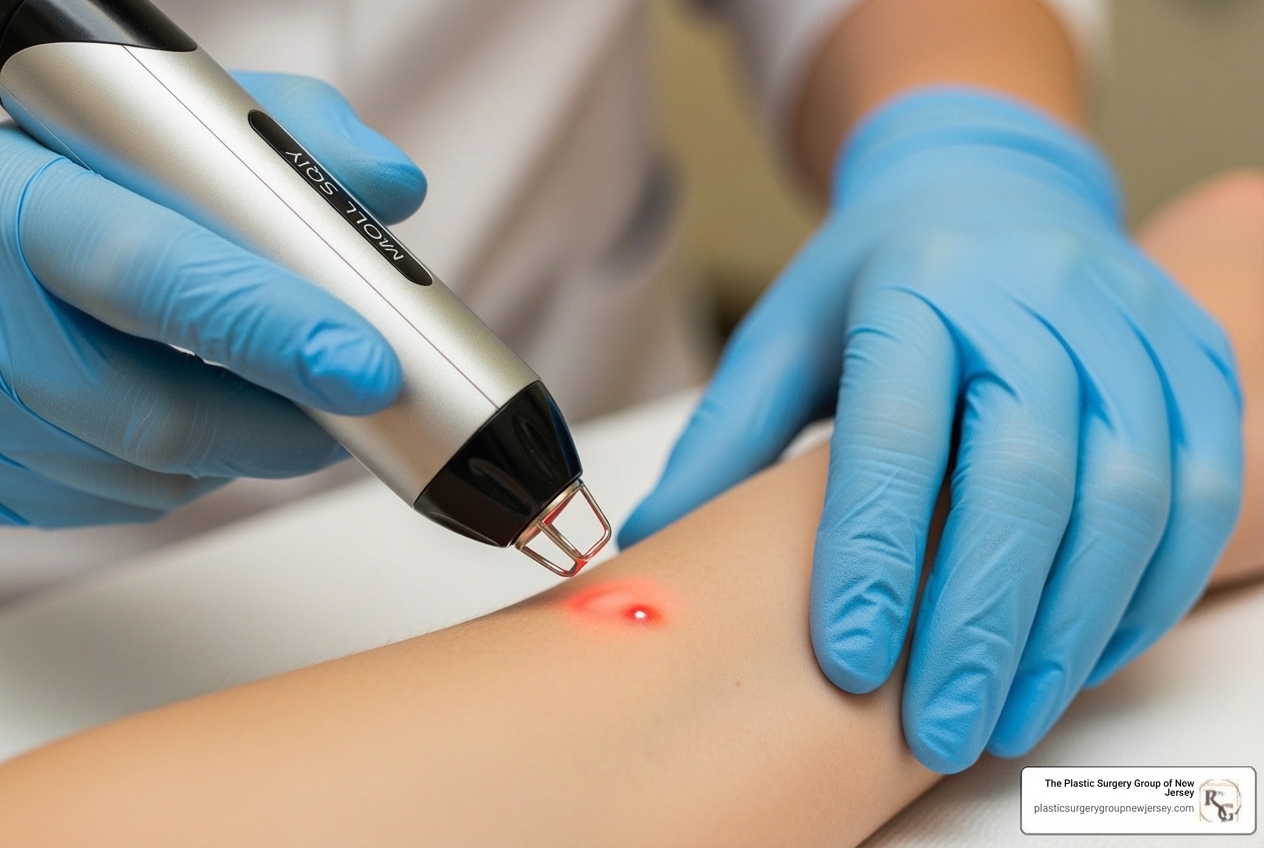
- Laser Removal: This method uses concentrated light energy to break down the pigment in the mole. It’s best suited for flat, superficial moles and can be particularly effective for cosmetic concerns. The cost of laser mole removal typically ranges from $150 to $500 per mole. Multiple sessions might be needed to achieve the desired result, and laser removal is generally not used for suspicious moles because it destroys the tissue, preventing biopsy.
- Cryotherapy: This technique involves freezing the mole with liquid nitrogen, causing the cells to die and the mole to eventually flake off. It’s often used for smaller, benign lesions or skin tags. Cryotherapy costs approximately $150 to $325 per lesion. Like laser removal, it may require more than one treatment and is not suitable for suspicious moles.
- Electrosurgery (Electrocautery): Using an electrical current, this method burns off the mole. It’s effective for small, benign skin growths and can cost around $100 to $300 per mole, with radiofrequency ablation (a similar technique) ranging from $200 to $600 per mole.
These methods offer minimal scarring and quick recovery, but regrowth is possible if any mole cells remain.
Will Insurance Cover Your Mole Removal?
This is one of the most common questions we hear, and the answer, like many things in healthcare, is: it depends! The key distinction lies between “medical necessity” and “cosmetic procedure.”
Most health insurance plans, including Medicare, will only cover mole removal if it’s deemed medically necessary. This means your doctor must determine that the mole poses a health risk or causes significant medical problems. If you’re having a mole removed purely for aesthetic reasons—because you don’t like how it looks—you’ll almost certainly have to pay out-of-pocket. Original Medicare doesn’t cover cosmetic surgery, and this principle extends to most private insurance plans as well.
It’s crucial to communicate openly with your provider about your concerns and the reasons for removal. They can help you understand whether your situation might qualify for insurance coverage and assist with any necessary documentation.
When is Mole Removal “Medically Necessary”?
A mole removal is generally considered “medically necessary” by insurance providers under several circumstances:
- Suspicion of cancer: This is the most critical reason. If a mole exhibits any of the ABCDE criteria (Asymmetry, Border irregularity, Color variation, Diameter larger than 6mm, Evolution), it raises concern for melanoma or other skin cancers. In such cases, removal and biopsy are essential for diagnosis and treatment.
- Irritation from clothing or daily activities: Moles that are constantly rubbed by clothing, jewelry, or interfere with activities like shaving can become irritated, inflamed, or even bleed. If a mole causes persistent discomfort or pain due to its location, its removal may be covered.
- Bleeding or itching: A mole that bleeds spontaneously, itches persistently, or shows other concerning symptoms like crusting or ulceration, warrants immediate medical attention and is usually considered medically necessary for removal.
- Functional impairment: If a mole interferes with a bodily function or causes significant physical discomfort, its removal might be covered.
- Biopsy for diagnostic uncertainty: Sometimes, even if a mole isn’t overtly suspicious, a dermatologist may recommend a biopsy to confirm its benign nature, especially if there’s any diagnostic uncertainty. This diagnostic procedure is typically covered.
For more general information on moles from the AAD, you can visit their website. We encourage you to seek a professional evaluation if you have any doubts about a mole.
Paying for Cosmetic Mole Removal
If your mole removal is primarily for aesthetic reasons, it will likely fall under out-of-pocket costs. But don’t despair! There are several ways to manage the expense:
- Financing options: Many healthcare facilities, including ours, offer payment plans to help you spread the cost over several months. This can make cosmetic procedures more accessible. You might also encounter “buy now, pay later” (BNPL) short-term healthcare loans, which allow you to pay in installments, often with no interest if you adhere to the payment schedule.
- Medical credit cards: Specialized medical credit cards, like CareCredit, are designed specifically for healthcare expenses. They often offer promotional financing options, such as interest-free periods, if the balance is paid off within a certain timeframe.
- Clinic payment plans: We understand that investing in your appearance is important, and we’re committed to making our services accessible. We invite you to discuss our available payment options during your consultation. You can also Pay Online for your procedure through our secure portal.
Why Your Choice of Provider Matters for Safety and Results
When it comes to something as personal as your skin and appearance, especially if a mole is suspicious, your choice of provider is paramount. You wouldn’t trust just anyone with your precious skin, would you?
There’s a significant difference between a general practitioner, a dermatologist, and a plastic surgeon when it comes to mole removal. While a family doctor can assess a mole and refer you, and a dermatologist specializes in skin conditions, a board-certified plastic surgeon offers unparalleled expertise, especially for moles on visible areas or those requiring precise surgical techniques. Our team comprises highly experienced, board-certified plastic surgeons. You can learn more about Our Team of experts on our website.
Choosing an experienced and board-certified professional helps in risk mitigation. They are adept at identifying cancerous moles, performing the removal with minimal complications, and ensuring proper aftercare. This minimizes risks such as infection, excessive bleeding, nerve damage, or significant scarring. Furthermore, a skilled hand reduces the chances of incomplete removal, which can lead to recurrence of the mole.
How provider choice affects the cost of mole removal by a dermatologist
The provider you choose can certainly influence the cost of mole removal by dermatologist or plastic surgeon, but this is an area where investing wisely can pay dividends in the long run.
- Specialist expertise: A board-certified plastic surgeon, like those on our team, brings a refined aesthetic sensibility and advanced surgical skills to every procedure. This expertise is particularly valuable for facial moles or those in highly visible areas, where minimizing scarring and achieving an optimal cosmetic outcome are crucial. This specialized skill set may be reflected in the cost.
- Advanced techniques: Experienced providers often have access to and proficiency with a wider array of advanced techniques and state-of-the-art equipment. This allows them to tailor the removal method precisely to your mole, ensuring the most effective and aesthetically pleasing result.
- State-of-the-art facility: Our practice operates within a modern, fully accredited surgical facility. This ensures the highest standards of safety, hygiene, and patient care, which are inherent in our service costs.
- Long-term value: While the initial cost might be higher with a highly experienced plastic surgeon, consider the long-term value. A well-executed removal the first time can prevent the need for costly re-do procedures, complications, or extensive scar revision down the line.
- Minimizing need for scar revision: A primary goal for us is to ensure the best possible cosmetic outcome from the start, minimizing the need for additional procedures like scar refinement, which can range from $500 to $1,500. We strive for a result that you’ll be happy with for years to come.
We invite you to Meet our Experienced Plastic Surgeons and find the difference that specialized expertise makes.
Recovery, Scarring, and Achieving the Best Outcome
After your mole removal, your journey isn’t quite over. Proper recovery and diligent aftercare are crucial for minimizing scarring and achieving the best possible outcome, both medically and cosmetically.
The post-procedure care instructions will vary slightly depending on the removal method. Generally, you’ll need to keep the treated area clean and moist. This often involves gently washing the site daily with mild soap and lukewarm water, applying a recommended antibiotic ointment, and covering it with a fresh bandage as instructed.
The healing timeline can also vary. For surgical excisions with stitches, initial healing typically takes 7-14 days, after which the stitches are removed. The scar itself will continue to mature and fade over several months, usually softening and blending with the skin by 3-6 months. For shave excisions or laser treatments, the surface wound heals much faster, often within days to a week, but the underlying skin continues to heal for a longer period.
Sun protection is non-negotiable during the healing phase and beyond. New scars are particularly vulnerable to sun damage, which can lead to hyperpigmentation (darkening) and a more noticeable scar. We’ll always advise you to keep the area covered and use a high-SPF sunscreen.
We also provide guidance on scar management techniques, which might include the use of silicone scar gels, tapes, or even, in some cases, follow-up treatments like laser touch-ups to further refine the appearance of a scar. Our commitment to your results extends through your recovery. You can even View our Mohs Reconstruction Gallery to see examples of our work in managing complex skin excisions and achieving excellent aesthetic outcomes.
Frequently Asked Questions about Mole Removal
We understand that you might have many questions about mole removal. Here are some of the most common ones we address with our patients.
Will my mole grow back after removal?
The possibility of a mole growing back depends heavily on the removal method used and the completeness of the initial procedure.
- Surgical Excision: This method removes the entire mole, including its deeper cells. When performed correctly, surgical excision has the lowest recurrence rate, making it very rare for the mole to grow back. This is why it’s often preferred for suspicious moles or those with deep roots.
- Shave Excision, Laser, Cryotherapy, and Electrosurgery: These methods remove the mole closer to the skin’s surface. While effective for many benign moles, there’s a higher chance of recurrence (estimated at 5-10% of cases) if any pigment-producing melanocytes are left behind in the deeper layers of the skin. If a mole does recur, it’s crucial to have it re-evaluated by a dermatologist or plastic surgeon.
The importance of complete removal cannot be overstated, especially for moles that show any signs of being atypical or potentially cancerous. Regular follow-up checks are always a good idea to monitor the treated area.
Will I have a scar after mole removal?
Yes, any time the skin is cut or altered, a scar is an inevitable part of the healing process. However, the appearance of that scar can vary greatly. Our goal, especially as plastic surgeons, is always to ensure the scar is as minimal and inconspicuous as possible.
Several factors influence scar appearance:
- Surgeon’s skill: An experienced plastic surgeon will use meticulous techniques, such as aligning incisions with the natural folds and contours of your skin, to help the scar blend in.
- Mole size and location: Larger moles or those in areas of high skin tension (like joints) may result in more noticeable scars. Moles on the face require particular care to minimize aesthetic impact.
- Removal method: Surgical excision typically leaves a linear scar, while shave excisions, laser, and cryotherapy often result in a flat, lighter area of skin, sometimes resembling a small divot.
- Individual healing: Everyone heals differently. Some individuals are prone to raised or discolored scars (hypertrophic or keloid scars).
- Aftercare importance: Diligent post-procedure care, including keeping the wound clean and moist, avoiding sun exposure, and using recommended scar treatment products, plays a crucial role in improving the final appearance of your scar.
How do I know if my mole needs to be removed?
Knowing when to seek professional advice about a mole is vital for your health. While we recommend regular self-examination of your skin, consult a dermatologist or plastic surgeon for any concerns.
We primarily use the ABCDEs of melanoma to evaluate moles:
- A – Asymmetry: One half of the mole does not match the other half.
- B – Border Irregularity: The edges are ragged, notched, or blurred.
- C – Color Variation: The mole has different shades of tan, brown, black, or sometimes patches of red, white, or blue.
- D – Diameter: The mole is larger than 6 millimeters (the size of a pencil eraser).
- E – Evolution: The mole is changing in size, shape, color, or elevation, or you experience new symptoms such as bleeding, itching, or crusting.
Any of these changes in mole appearance or new symptoms like itching or bleeding are red flags that warrant a professional evaluation. Even if a mole isn’t suspicious but is causing irritation (e.g., rubbing against clothing) or significantly impacting your self-confidence, we’re here to help you explore removal options.
Conclusion: Investing in Your Skin and Confidence
Understanding the cost of mole removal by dermatologist or plastic surgeon involves much more than just looking at a price list. It’s about weighing the factors that influence the cost—like the mole’s size, location, and complexity, as well as the chosen removal method—against the invaluable benefits of professional care.
While cosmetic mole removal is an out-of-pocket expense, and medically necessary procedures are typically covered by insurance, the ultimate investment is in your health, safety, and confidence. Choosing a highly experienced and board-certified plastic surgeon, like those at The Plastic Surgery Group of New Jersey, ensures you receive not only expert medical attention but also the meticulous aesthetic care needed to achieve the best possible outcome.
We believe in providing transparent information and personalized care, helping you balance cost with the quality and safety you deserve. Your skin is your body’s largest organ, and its health and appearance are worth protecting.
If you have a mole that concerns you, whether for medical reasons or aesthetic preferences, don’t hesitate to seek expert advice. We are here to guide you through every step of the process. Schedule your professional Mole Removal consultation with us today, and let us help you achieve peace of mind and beautiful, healthy skin.


