
Muscle Dynamics and Biomechanics of Breast Augmentation for Athletes
When designing a surgical strategy for breast augmentation for athletes, understanding the mechanics of the chest wall and surrounding musculature is critical. Active women often possess a lower percentage of body fat, tighter soft tissue coverage, and heightened upper-body awareness. When an implant is placed on the chest wall, it influences the center of gravity, chest wall movement, and biomechanics.
Pectoral strength and upper-body power depend on how the pectoralis major muscle contracts against the rib cage. Placing an implant beneath or near this muscle alters how force moves through the chest during push-ups, bench presses, or swimming strokes. Extensive research indicates that improved body harmony following surgery can enhance confidence during active training, which is detailed in studies on how quality of life improves after breast augmentation.
Submuscular vs. Subglandular Placement in Athletes
The debate surrounding implant placement centers on balancing soft tissue coverage with preserving functional chest muscle dynamics.
- Submuscular Placement: The implant is positioned beneath the pectoralis major muscle. In a study surveying active fitness competitors, 72.8% underwent submuscular breast augmentation. This plane offers natural coverage for lean women, but dissecting muscle fibers can temporarily disrupt chest power. Furthermore, implant movement during pectoral exercises was found to be 2.5 times more likely with submuscular augmentations compared to other placements.
- Subglandular Plane: The implant sits directly behind the natural breast tissue and on top of the pectoralis major muscle. It leaves the chest muscle untouched, preserving raw strength and eliminating dynamic movement during heavy lifts. However, lean athletes with limited natural tissue may risk visible implant edges or rippling.
- Subfascial Technique: This muscle-sparing approach places the implant beneath the fascia overlying the pectoralis major. It keeps the muscle intact while using the strong fascial layer to provide extra soft tissue coverage and edge blending.
- Dual Plane: Combining submuscular and subglandular strategies, the upper portion of the implant rests under the upper pectoralis muscle, while the lower portion rests under the breast tissue. It provides upper-pole coverage while allowing the lower muscle attachment to relax.
| Surgical Placement Plane | Impact on Pectoral Power | Tissue Coverage (Lean Frame) | Risk of Dynamic Movement |
|---|---|---|---|
| Submuscular | Temporary strength adjustment; altered muscle leverage | High (blends implant edges well) | High (2.5x more likely to shift during chest flex) |
| Subglandular | None; muscle remains completely untouched | Low to Moderate (depends on existing fat/tissue) | Zero |
| Subfascial | None; muscle fibers are uninjured | Moderate (fascia provides extra layer) | Zero |
| Dual Plane | Minimal to Moderate (partial upper muscle coverage) | Moderate to High | Low to Moderate |
Understanding Animation Deformity and How to Avoid It
Animation deformity occurs when the pectoralis major muscle contracts tightly over a submuscular or dual plane implant, distorting the breast’s natural shape, flattening it, or pushing it sideways. For bodybuilders performing flexed poses or cross-training athletes doing push-ups, animation deformity can be noticeable.
To minimize or prevent animation deformity, muscle-sparing techniques like subfascial or prepectoral placement are ideal. These prepectoral planes keep the muscle uninjured. If a lean athlete requires partial submuscular placement for adequate coverage, we carefully evaluate muscle density and soft tissue depth to choose an appropriate pocket depth, keeping animation risks as low as possible.
Choosing the Right Implants for Performance and Proportions
Selecting the ideal implant involves evaluating volume, projection profile, surface texture, and physical weight. Athletes must balance aesthetic desires against physical performance to avoid restricted shoulder movement or neck strain.

Implant profile refers to how far forward the implant projects from the chest wall (low, moderate, high, or ultra-high projection). High-profile implants extend forward on a narrower base, whereas moderate-profile implants distribute volume across a wider base. For active women, moderate or moderate-plus profiles typically yield the most natural contour without interfering with cross-body arm motions or running mechanics.
Weight is another crucial factor. Larger implant volumes add physical mass to the chest, which can pull on posture and increase vertical motion during high-impact sports. Lightweight options, such as B-Lite technology, use advanced gel matrices infused with microscopic air spheres to weigh approximately 30% less than traditional silicone implants of equivalent size. Reducing total chest weight lessens physical stress on muscles, back tissues, and sports bras during high-mileage runs or repetitive jumps.
Silicone vs. Saline and Cohesive Gel Options
The internal material of an implant dictates how it feels, holds its shape, and responds to physical impact:
- Cohesive Gel (“Gummy Bear”) Implants: These silicone implants feature a firm cross-linked gel that retains its shape even under mechanical stress. They offer a natural feel with a low incidence of rippling—an advantage for low-body-fat athletes. Reviewing cohesive gel gummy bear vs silicone implants can help patients understand how different gels hold their form under pressure.
- Standard Silicone Gel Implants: These offer a softer feel and natural movement, requiring adequate soft tissue coverage to maintain seamless edges.
- Saline Implants: Filled with sterile saltwater, saline implants offer adjustability during placement. However, on lean chest walls, they carry a higher risk of visible rippling and feel firmer. Active individuals can learn more by exploring saline implants for breast augmentation.
Sports-Specific Recommendations for Breast Augmentation for Athletes
Different athletic disciplines subject the body to unique physical forces. Tailoring implant choices to these demands optimizes comfort and function:
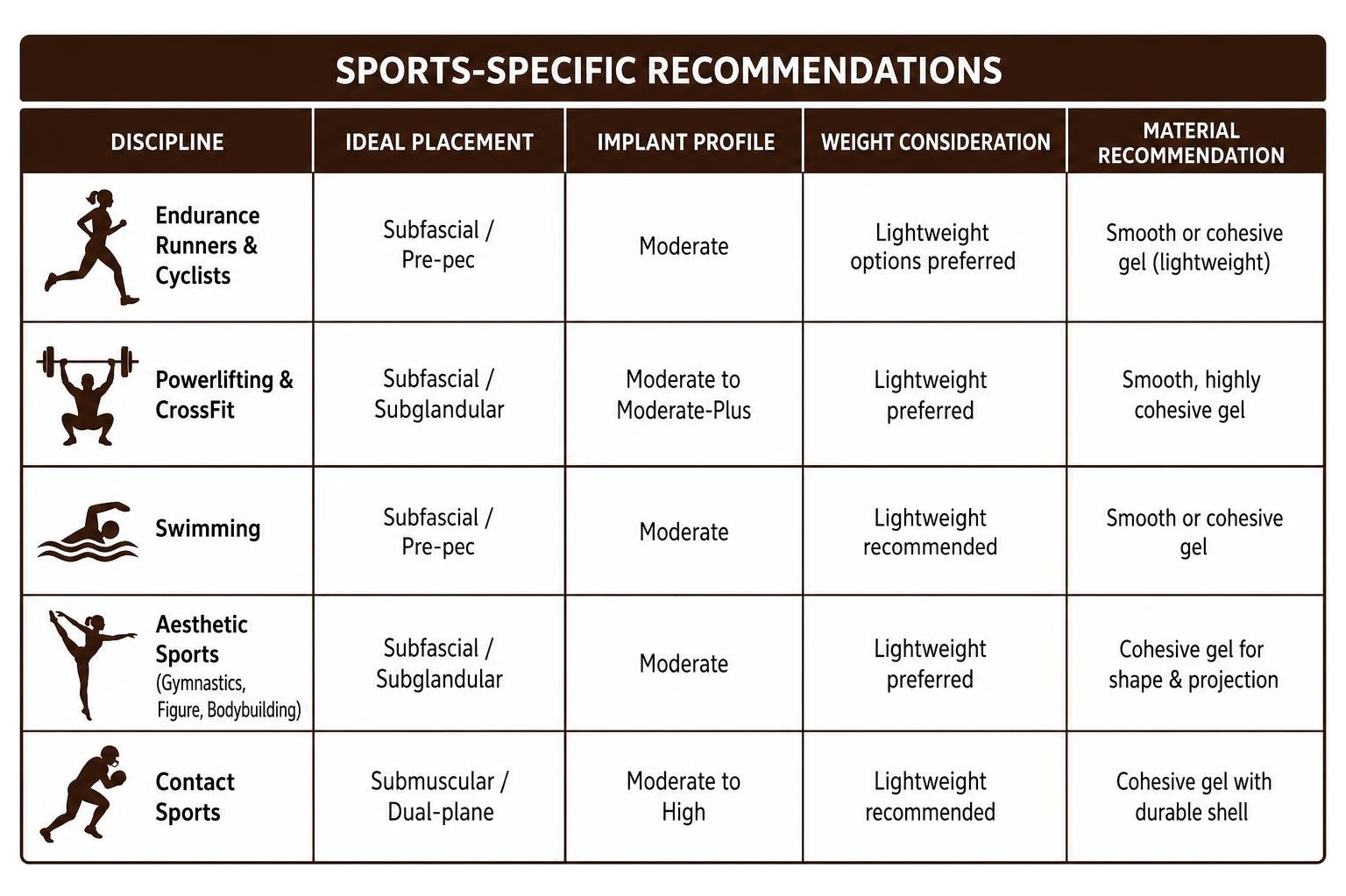
- Endurance Runners & Cyclists: High-frequency impacts require low overall weight and stable placement. Moderate volumes, lightweight construction, and subfascial placement help reduce chest motion and lower back strain.
- Powerlifting & CrossFit Athletes: Heavy bench pressing, overhead lifts, and pull-ups require unhindered pectoralis major movement. Subfascial or subglandular placements prevent muscle distortion and dynamic movement during max effort lifts.
- Swimmers: Swimmers need a full shoulder range of motion. Moderate-profile implants placed in a muscle-sparing plane prevent stiffness and minimize aerodynamic drag in the water.
- Aesthetic Sports (Gymnastics, Figure, Bodybuilding): Proportion, balance, and clean lines at rest and during movement are paramount. Muscle-sparing placements eliminate animation distortion during flexed poses.
- Contact Sports: High-impact collisions require robust shell integrity. Smooth, cohesive gel implants placed in a dual-plane or subfascial pocket offer durability and comfort beneath protective padding.

Recovery Timelines and Returning to Training Safely
A structured post-operative protocol prevents complications like bleeding, seroma formation, or implant displacement. Timing the surgery during an off-season or light training window allows complete internal tissue healing before high-intensity strain is reintroduced.
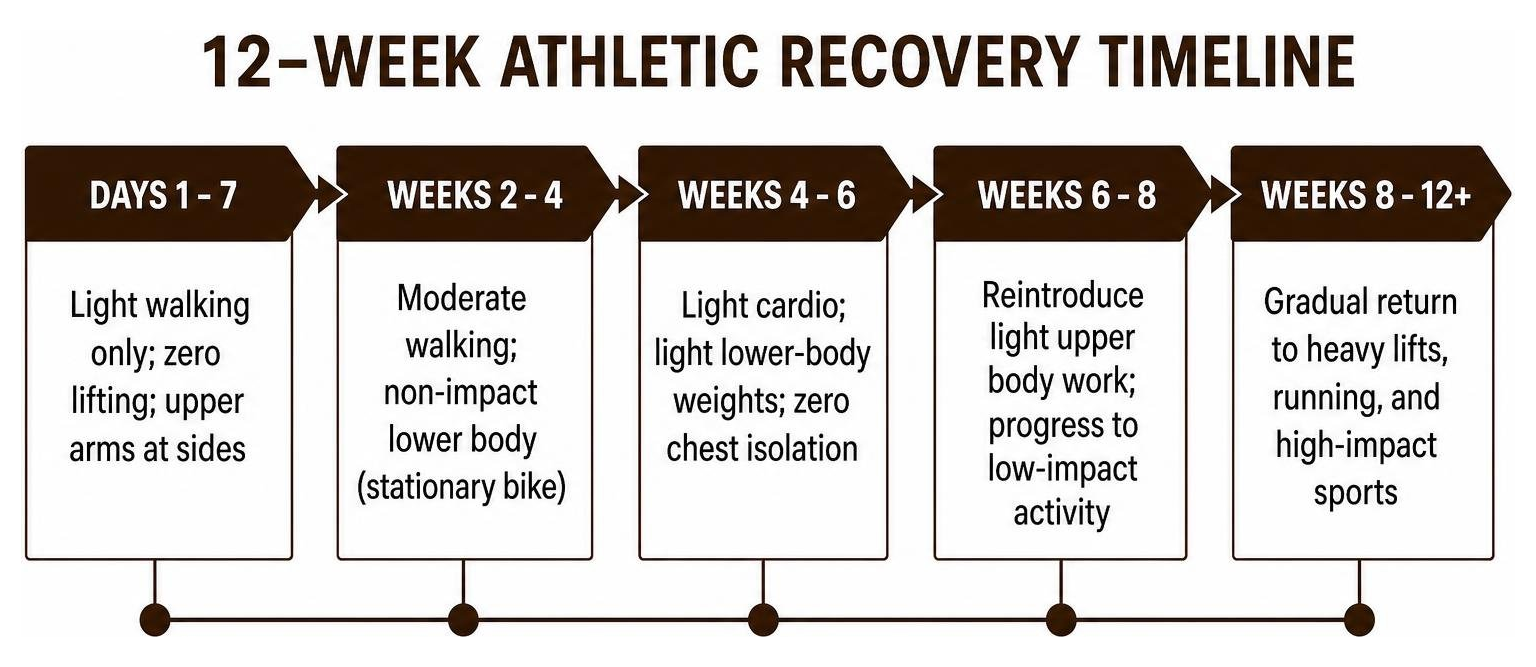
Proper support is vital during recovery. Athletic compression bras minimize bounce, decrease shear stress on internal healing tissues, and lower the risk of fluid accumulation. Reviewing our breast augmentation recovery time guide provides realistic expectations for post-operative care and activity progression.

Postoperative Milestones for Breast Augmentation for Athletes
- Immediate Post-Op (Days 1–7): Focus entirely on resting, protecting incisions, and light walking to preserve circulation. Keep arms close to the torso and avoid raising elbows above shoulder height.
- Early Recovery (Weeks 2–4): Walking speed can increase, and stationary leg exercises (like seated leg curls or bodyweight squats) may begin once cleared. No running, jumping, or heavy lifting.
- Intermediate Recovery (Weeks 4–6): Light upper-body movements without chest strain may begin. Avoid bench presses, push-ups, or heavy shoulder presses.
- Advanced Recovery (Weeks 6–8): Low-impact sports, light jogging, and mild chest exercises using light weights can be gradually reintroduced.
- Full Performance Clearance (Weeks 8–12+): Tissue healing is stable. Athletes can resume heavy bench pressing, high-impact running, CrossFit workouts, or competitive contact sports under surgeon guidance. Most athletes regain full pre-surgery strength within 3 to 6 months post-procedure.
Frequently Asked Questions About Athletic Breast Augmentation
Will breast implants permanently weaken my bench press or chest strength?
No. While submuscular placement requires a temporary adaptation period where chest strength gradually returns over 3 to 6 months, long-term functional loss is rare. Furthermore, muscle-sparing techniques—such as subfascial or subglandular placement—leave the pectoralis major muscle completely intact, ensuring that bench press power and push-up force remain uncompromised.
How long after surgery can I resume high-impact running and heavy training?
Most active individuals return to light walking within the first week, low-impact lower-body training by weeks 2 to 4, and progressive jogging or light resistance training between weeks 6 and 8. Full return to high-impact running, explosive plyometrics, and heavy upper-body weightlifting typically occurs between weeks 8 and 12, provided healing progresses smoothly and your surgeon grants clearance.
What is the overall satisfaction rate for active women undergoing breast enhancement?
Satisfaction rates among active women are exceptionally high. Clinical surveys show that 95% of active women report high satisfaction with their overall outcome. Long-term studies indicate a 92% satisfaction rate even at a 10-year follow-up. Among competitive fitness athletes, 92.6% reported high satisfaction with their aesthetic appearance at rest, and 79.0% remained highly satisfied during active, flexed training sessions.
Tailored Surgical Planning in Montclair, New Jersey
Designing the right strategy for breast augmentation for athletes requires balancing cosmetic goals with physical function. By selecting appropriate implant dimensions, lighter materials, and precise placement relative to the pectoralis muscle, active women can achieve their desired appearance without compromising strength or athletic performance.
At The Plastic Surgery Group of New Jersey, our board-certified plastic surgeons—Dr. Allen D. Rosen, M.D., and Dr. Valerie J. Ablaza, M.D.—alongside Dr. Cece, fellowship-trained, bring deep surgical expertise to every consultation. Located in our state-of-the-art facility in Montclair, New Jersey, we personalize every procedure to your anatomy, body composition, and athletic lifestyle. We invite you to learn more about customized breast augmentation procedures in Montclair NJ and schedule a consultation with our surgical team today.


