
How to Explore Fat Transfer in Montclair
If you are considering fat transfer in Montclair, start with a comprehensive personal consultation. During this visit, we evaluate whether you have enough donor fat to harvest, determine which recipient areas can be enhanced, and discuss realistic surgical expectations. Fat transfer involves moving your own natural fat from one region of your body to another to restore lost facial volume, soften creases, or refine body contours. Because a percentage of transferred fat cells naturally resorbs before vascular integration takes place, individualized planning and refined surgical technique are essential to achieving optimal, enduring results.
At The Plastic Surgery Group of New Jersey, you can discuss your aesthetic goals with board-certified plastic surgeons Dr. Allen D. Rosen or Dr. Valerie J. Ablaza. Together, our team provides personalized guidance across a full spectrum of autologous procedures.
I’m Dr. Allen Rosen, founding partner and medical director of the practice. For patients exploring fat transfer Montclair options, I draw on more than two decades of surgical experience to help explain how autologous techniques work. Patients frequently choose our practice to explore subtle facial fat grafting to replenish hollow contours, gentle natural breast augmentation without foreign implants, and sophisticated reconstructive breast surgery to correct asymmetry or tissue deficits after prior operations.

Understanding Autologous Fat Grafting and Its Key Benefits
Autologous fat grafting—commonly known as fat injection, lipomodeling, or natural fat transfer—harnesses your body’s own living tissue to restore lost volume, soften deep folds, and sculpt natural curves. Over time, factors such as intrinsic aging, gravity, sun exposure, genetics, and natural weight changes lead to a depletion of subcutaneous fat. This volume loss often creates a hollowed or tired facial expression, deflated breast contours, or diminished fullness in the hands and buttocks.
By taking excess adipose tissue from donor regions like the abdomen, flanks, or thighs and placing it precisely where volume is needed, we achieve a dual aesthetic benefit: slimming the donor area and rejuvenating the recipient site. Because we are transferring your own autologous cells, the treatment offers complete biocompatibility with no risk of immune rejection or adverse foreign material reactions. The tissue contains regenerative adipose-derived stem cells that naturally integrate into surrounding blood vessels, improving the quality, elasticity, and texture of overlying skin while providing long-lasting fullness and structural support.
| Feature | Autologous Fat Grafting | Synthetic Dermal Fillers | Synthetic Implants |
|---|---|---|---|
| Material Source | Your own living fat cells | Hyaluronic acid / Synthetic gels | Silicone or saline shells |
| Biocompatibility | 100% natural, hypoallergenic | Highly biocompatible | Biocompatible foreign body |
| Longevity | Permanent once integrated | Temporary (6–18 months) | Long-lasting (may require replacement) |
| Texture & Feel | Completely soft and natural | Soft, subtle | Firm to natural feel |
| Secondary Benefit | Body contouring at donor site | None | None |
Autologous Fat vs. Synthetic Fillers and Implants
While off-the-shelf hyaluronic acid injectables are excellent for quick, minor touch-ups, they are temporary solutions that dissolve over several months and require ongoing maintenance appointments. In contrast, comparing fat transfer breast augmentation vs breast implants reveals that transferred fat becomes a permanent part of your living anatomy once blood supply is established.
Unlike synthetic implants, autologous fat carries zero risk of foreign-body rejection, allergic reaction, implant rupture, or capsular contracture. It moves, softens, and ages alongside your natural anatomy, providing an authentic look and feel that cannot be replicated by foreign materials. Furthermore, fat grafting allows for artistic, micro-level sculpting that adapts precisely to your unique anatomical contours.
Common Treatment Areas for Natural Fat Injections
We employ autologous fat grafting across several distinct anatomical areas to achieve balanced, elegant rejuvenation:
- Facial Contours: Delicate facial fat grafting replenishes midface volume, fills hollow temples, softens nasolabial folds, and smooths tear troughs under the eyes to create a refreshed, well-rested appearance.
- Breasts: A specialized fat transfer breast augmentation increases breast volume by one to two cup sizes, improves symmetry, and creates subtle cleavage without synthetic implants or visible scars.
- Buttocks: Natural body sculpting transfers donor fat into the gluteal area to improve projection, refine silhouette balance, and smooth out contour indentations.
- Hands: Injecting micro-droplets of fat restores youthful volume to the backs of the hands, concealing prominent veins and tendons that become pronounced with aging.
Step-by-Step Guide to the Fat Transfer Montclair Procedure

A successful fat grafting procedure involves careful technical artistry across every phase, ensuring that harvested fat cells remain viable and healthy throughout the transfer.
Preparing for Fat Transfer in Montclair with 3D Imaging
Every transformation begins with an in-depth surgical consultation at our Montclair facility. We evaluate your medical history, inspect potential donor tissue reserves, and map out your aesthetic objectives with thorough precision.
To help you visualize your potential outcomes, we utilize our advanced Vectra 3D imaging body preview system. This cutting-edge tool renders high-resolution, three-dimensional simulations of your body or face, allowing us to plan the exact volume requirements, simulate graft placement, and set clear, realistic surgical goals before entering the operating room.
Harvesting, Purifying, and Grafting Donor Fat
The surgical phase follows three meticulous steps:
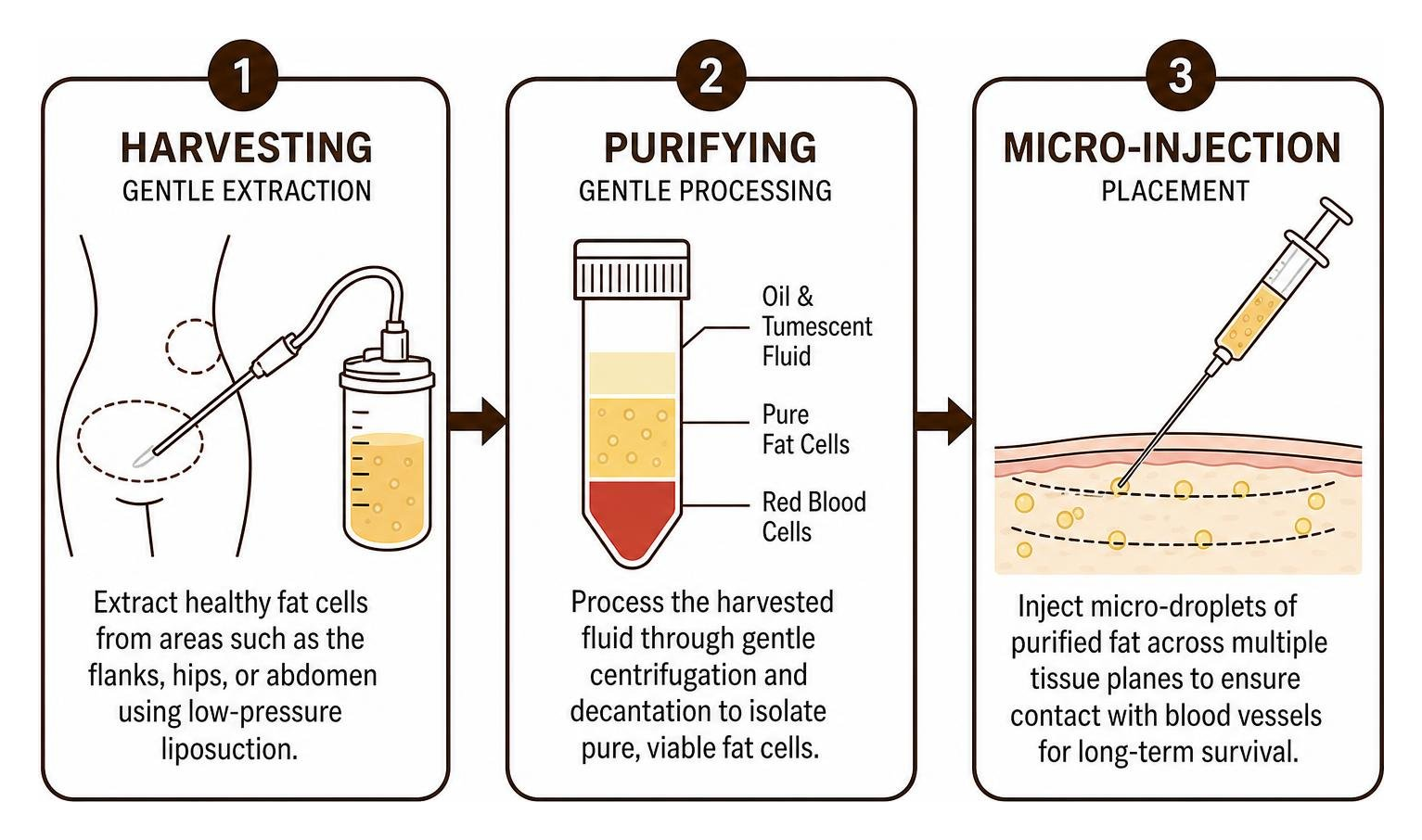
- Gentle Extraction: Using specialized, low-pressure techniques during liposuction surgery, we carefully extract healthy adipose cells from designated areas such as the flanks, hips, or abdomen. This gentle technique protects delicate cell membranes while delivering smooth, natural looking liposuction contours at the donor site.
- Purification: The harvested liquid is processed through gentle centrifugation, filtering, and decantation. This crucial step isolates pure, viable fat cells from damaged oil, tumescent fluid, and red blood cells, ensuring only the healthiest graft material is prepared for re-injection.
- Micro-Droplet Placement: Using fine cannulas, we inject tiny micro-droplets of purified fat across multiple tissue planes in the recipient area. Distributing the fat in ultra-thin layers ensures each droplet establishes immediate contact with adjacent blood vessels, which is critical for long-term cell survival. These steps integrate seamlessly with broader body contouring procedures for balanced, harmonious proportions.
Recovery Timeline, Safety, and Long-Term Results

Understanding the healing journey ensures you feel comfortable, well-prepared, and confident at every stage of your recovery.
Post-Procedure Care and Managing Downtime
Following your procedure, you will wear a mild compression garment over the donor sites to minimize swelling, support tissue healing, and optimize your new body contours. As detailed in the lipo lowdown recovery guide, most patients manage mild post-operative soreness with prescribed medication for the first two to three days before transitioning smoothly to over-the-counter pain relievers.
Light walking is encouraged immediately after surgery to promote healthy circulation and reduce the risk of blood clots. However, strenuous exercise, heavy lifting, and direct mechanical pressure on the newly grafted areas should be avoided for two to four weeks to protect the delicate developing capillary networks. Most individuals comfortably return to desk work and daily social routines within seven to ten days.
Fat Cell Survival Rates and Longevity
During the first few months following surgery, your body naturally reabsorbs a portion of the transferred liquid and non-viable cells—typically around 20% to 40% of the initial injected volume. To account for this natural process, we plan initial placement accordingly without overfilling recipient tissues.
By three to six months post-procedure, the surviving fat cells establish a permanent blood supply (neovascularization) and become living tissue. As outlined in our comprehensive overview of fat transfer breast augmentation, these integrated cells will expand or contract naturally with future weight fluctuations, providing permanent, lasting enhancement as long as you maintain a stable weight through healthy lifestyle habits.
Frequently Asked Questions About Fat Grafting
What Is the Average Cost of Fat Transfer in Montclair?
The cost of fat grafting varies depending on the number of donor sites treated, the total volume of fat required, and whether you are addressing delicate facial areas or performing full breast enhancement. Your surgical quote includes surgeon fees, operating room facility costs, specialized post-operative care, and board-certified anesthesia services. To assist with budgeting, our office provides flexible financing options and custom payment plans to make your aesthetic goals accessible and manageable.
What Are the Primary Risks and Side Effects of Fat Injections?
When performed by experienced, board-certified plastic surgeons, fat grafting has an outstanding safety profile. Standard, temporary side effects include localized swelling, bruising, and minor donor-site tenderness, all of which resolve naturally over several weeks. Rare risks include minor contour irregularities, asymmetry, or fat necrosis (small, benign oil cysts that form if a droplet does not establish adequate blood flow). Choosing a qualified surgeon with extensive technical training minimizes these risks through meticulous purification and placement techniques.
Who Is an Ideal Candidate for Autologous Fat Transfer?
Ideal candidates are healthy men and women who possess sufficient donor fat deposits in areas like the abdomen, flanks, or thighs and desire moderate, natural-looking volume restoration. Candidates should be non-smokers at a stable body weight who maintain realistic expectations about what natural tissue transfer can achieve. During your initial plastic surgery consultation, we evaluate your tissue quality, medical background, and anatomy to ensure fat grafting is the most effective approach for your aesthetic goals.
Plan Your Transformation at The Plastic Surgery Group of New Jersey
For patients seeking natural rejuvenation without synthetic materials, autologous fat grafting offers a safe, long-lasting solution tailored to your anatomy. At The Plastic Surgery Group of New Jersey, board-certified plastic surgeons Dr. Allen D. Rosen and Dr. Valerie J. Ablaza bring over 25 years of combined clinical excellence, surgical artistry, and patient-first care to every procedure.
Operating from our state-of-the-art, 15,000-square-foot contemporary facility in Montclair, New Jersey, we provide an individualized experience designed around your unique anatomy, safety, and aesthetic goals. Schedule a consultation for plastic surgery in Montclair, NJ today to explore how autologous fat transfer can help you achieve subtle, beautiful, and lasting results.
— Dr. Allen Rosen, M.D., F.A.C.S.


