
Total Full Body Skin Removal Surgery Cost Breakdown in 2026
Losing a massive amount of weight is a remarkable accomplishment, but managing redundant skin is often an unexpected final hurdle. In 2026, the overall investment reflects not just operating room time, but the comprehensive care required to safely reshape multiple areas of the body. Across the United States, patients undergoing multi-area transformations pay a national average between $40,000 and $55,000, with total costs ranging from $20,000 for targeted contouring up to $80,000 or more for comprehensive head-to-toe reshaping.
Industry pricing data shows that over the five-year period from 2022 to 2026, the average cost of body-contouring operations rose by approximately 17.7%. This increase is driven by rising surgical facility overhead, specialized instrumentation, and growing demand for post-bariatric procedures.
Because “full body skin removal” is customized rather than a single standardized operation, the total price is the sum of various procedures. Below is a comparison of typical costs for individual surgeries versus comprehensive packages:
| Procedure Type | Target Areas | Average Standalone Cost (2026) | Typical Combined Package Range |
|---|---|---|---|
| Panniculectomy | Lower abdominal apron | $8,000 – $12,000 | Included in lower body contouring |
| Extended Tummy Tuck | Full abdomen and muscle wall | $10,000 – $18,000 | $8,500 – $14,000 (when combined) |
| Lower Body Lift (360°) | Abdomen, flanks, buttocks, outer thighs | $18,000 – $30,000 | $16,000 – $25,000 (core foundation) |
| Brachioplasty (Arm Lift) | Upper arms and axilla | $7,000 – $12,000 | $5,500 – $9,500 (as an add-on) |
| Thigh Lift (Thighplasty) | Inner and upper thighs | $8,500 – $14,000 | $7,000 – $11,500 (as an add-on) |
| Upper Body / Chest Lift | Breasts, chest wall, lateral bra rolls | $9,000 – $16,000 | $7,500 – $13,000 (as an add-on) |
| Total Comprehensive Package | 3 to 5 distinct anatomical regions | $50,500 – $102,000 (if done separately) | $38,000 – $75,000+ (staged or bundled) |
Understanding what goes into each component helps clarify these numbers. For instance, reviewing our guides on arm lift surgery cost, options for thigh lift surgery, and the tummy tuck after weight loss cost provides deeper insight into single-area pricing. To see how these components merge into a circumferential transformation, explore what does a body lift include.
Factors That Influence Full Body Skin Removal Surgery Cost
Every body is unique, and surgical quotes vary based on several critical factors:
- Surgeon Experience and Credentials: Post-massive-weight-loss surgery is technically demanding. Surgeons with advanced fellowship training and proven expertise in post-bariatric reconstruction charge fees that reflect their safety records, meticulous technique, and lower revision rates.
- Geographic Location: Where you have surgery matters significantly. Coastal metropolitan hubs such as New York City, Los Angeles, and San Francisco frequently command rates 40% to 60% higher than cities in the Midwest or South due to real estate, staffing, and malpractice costs.
- Facility Accreditation: Top-tier procedures are performed in accredited ambulatory surgical centers (such as AAAASF or Quad A certified suites) or hospital operating rooms, which charge higher facility fees than unaccredited office suites to guarantee rigorous safety standards.
- Tissue Volume and Surgical Complexity: The total amount of excess skin, presence of residual localized fat deposits, and degree of muscular separation (diastasis recti) dictate surgical time and complexity. Patients seeking comprehensive body contouring after weight loss often require multi-vector lifting to restore a natural contour.
At The Plastic Surgery Group of New Jersey in Montclair, our board-certified plastic surgeons—Dr. Allen D. Rosen M.D. and Dr. Valerie J. Ablaza M.D.—work alongside our experienced surgical team to tailor every surgical plan around patient safety and aesthetic harmony.
Staged vs. Single-Session Full Body Skin Removal Surgery Cost
One of the biggest financial and medical decisions you will face is whether to combine procedures into a single operation or stage them across several months.
Combining multiple procedures into one operation (for example, performing a lower body lift and a brachioplasty together) typically saves 15% to 30% on the overall price tag. This savings stems from paying for the operating room suite, surgical staff, and general anesthesia team only once rather than multiple times.
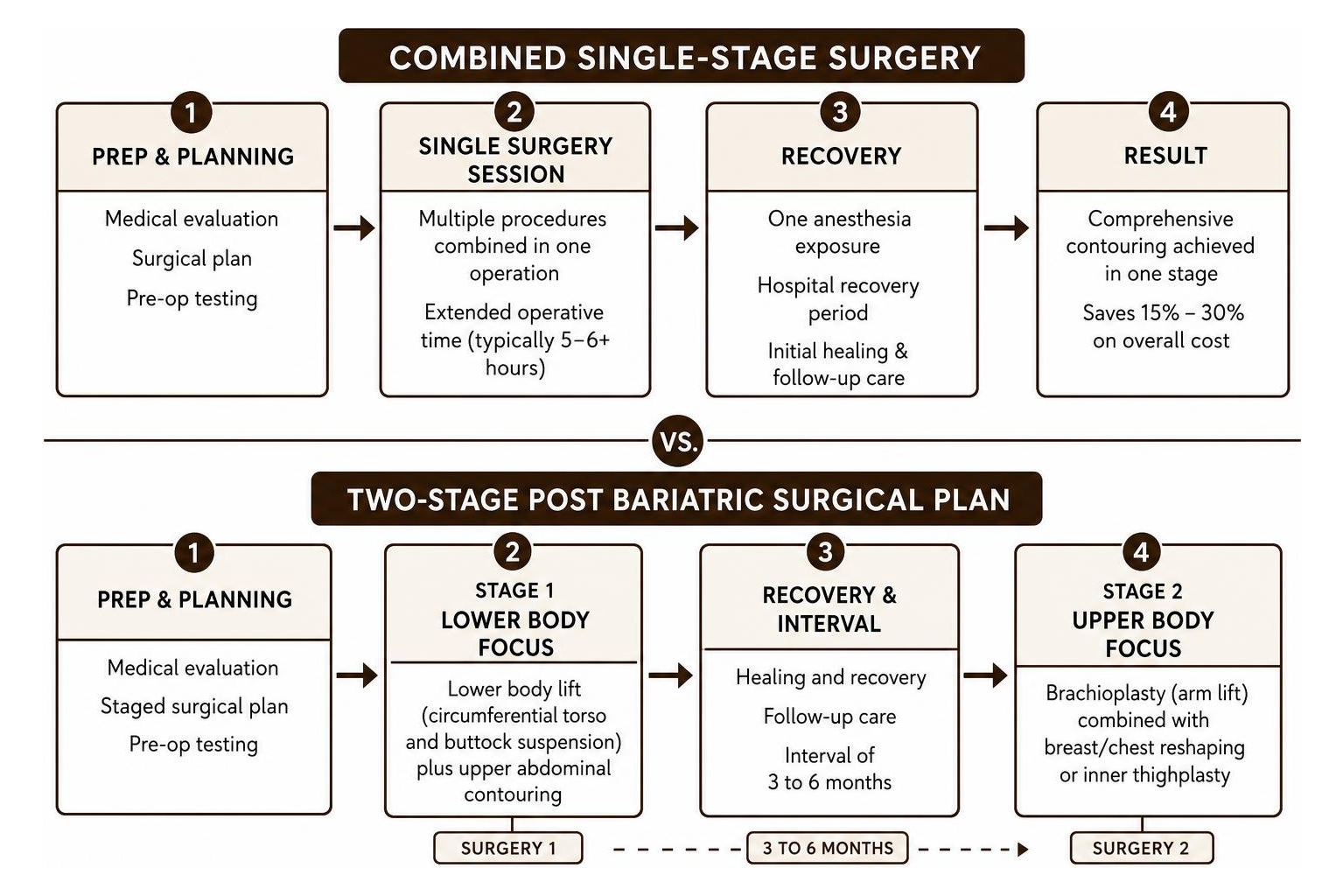
However, cost savings must never override patient safety. Extended operative times—typically those exceeding five to six hours—increase risks associated with blood loss, hypothermia, venous thromboembolism (blood clots), and delayed wound healing. For patients requiring extensive skin excision across four or five regions, dividing the journey into two or three planned stages is often the wisest path. A common staged plan includes:
- Stage 1: Lower body lift (circumferential torso and buttock suspension) plus upper abdominal contouring.
- Stage 2 (3 to 6 months later): Brachioplasty (arm lift) combined with breast/chest reshaping or inner thighplasty.
While staging incurs duplicate facility and anesthesia charges, it provides an easier post-bariatric surgery recovery and reduces physical strain on the body.
Insurance Coverage: Panniculectomy vs. Cosmetic Body Contouring
One of the most frequent questions patients ask is whether private medical insurance will pay for their skin removal. The short answer is: insurance covers functional, medically necessary skin removal, but almost never covers aesthetic body contouring.
To navigate this distinction, you must understand the difference between a panniculectomy and cosmetic contouring:
- Panniculectomy (Functional): The surgical removal of the hanging “apron” of skin and fat (the panniculus) below the belly button. It does not tighten abdominal muscles, reposition the navel, or address the waistline. When severe overhanging skin causes persistent intertrigo (chronic fungal or bacterial skin fold rashes), skin breakdown, ulcerations, or ambulation difficulties that fail to resolve with prescription medications, insurers may classify it as medically necessary.
- Abdominoplasty or Body Lift (Cosmetic): A complete tummy tuck surgery procedure or 360° lift tightens the abdominal wall musculature, lifts the mons pubis, sculpts the flanks, and repositions the umbilicus. Because these steps are performed to enhance appearance rather than resolve an active disease process, insurers consider them cosmetic.
When an insurer approves coverage for a panniculectomy, it can reduce out-of-pocket costs by $5,000 to $15,000. Many patients elect to “bridge” or combine this coverage with cosmetic contouring. In this scenario, insurance covers the facility time and surgeon fee for the functional panniculus removal, while the patient pays an out-of-pocket cosmetic fee for the concurrent muscle repair and waistline sculpting. For detailed criteria, review these clinical benchmarks for loose skin removal surgery cost.
To build a strong case for insurance pre-authorization:
- Document rashes, skin infections, and hygiene issues with your primary care physician for a minimum of 3 to 6 consecutive months.
- Maintain pharmacy records of prescription topical antifungals, barrier creams, or oral antibiotics.
- Include clinical photographs showing the panniculus hanging at or below the level of the pubic symphysis.
Hidden Expenses and Recovery Investment to Anticipate
When comparing surgical estimates, beware of quotes that list only the surgeon’s fee. A comprehensive financial plan must account for several additional expenses:
- Board-Certified Anesthesiologist Fees: Dedicated MD or CRNA anesthesia care ranges from $1,500 to $4,000 depending on surgical duration.
- Accredited Operating Room Overhead: Facility fees generally range from $2,000 to $6,000 for advanced, multi-hour procedures.
- Pre-Operative Medical Clearance: Diagnostic blood panels, metabolic screenings, nutritional lab evaluations, and cardiac clearances typically cost $300 to $800 out-of-pocket depending on your insurance copays.
- Medical Compression Garments: Medical-grade post-surgical body suits, arm sleeves, and binders provide necessary lymphatic support and cost $150 to $400 for multiple sets.
- Prescriptions and Wound Care Supplies: Pain medications, anti-nausea drugs, antibiotics, scar therapy gels, and sterile drain-care dressings add $150 to $350.
- Lost Wages and Childcare: Recovery downtime requires 2 to 6 weeks away from work. Factoring in unpaid leave or supplemental childcare is essential for accurate budgeting.
The Importance of Weight Stability
Before scheduling skin removal surgery, plastic surgeons recommend maintaining a stable weight for at least 6 to 12 months. Experiencing major weight loss—whether through bariatric surgery, diet, or GLP-1 medications—stretches the skin beyond its point of natural recoil. Compromised skin elasticity after weight loss means that tissue needs time to stabilize.
Undergoing surgery while still losing weight can lead to residual skin laxity, requiring costly revisions down the road. Conversely, regaining weight after surgery compromises your surgical results. Patients exploring options like a tummy tuck body lift after Ozempic should ensure their medication dosage and body mass index have stabilized before investing in surgical contouring.
Strategic Ways to Budget, Finance, and Save on Surgery
Undergoing full body contouring is an investment in your long-term health and self-image. Here are several strategic ways to manage your investment without compromising safety:
- Obtain Multiple Consultations: Research indicates that patients who consult with 3 or more board-certified surgeons save an average of 35% on their overall journey. Multiple evaluations give you a clear perspective on realistic quotes, procedural bundling, and surgical philosophy. For broader pricing comparisons, see this full body skin removal cost guide.
- Utilize Pre-Tax HSA and FSA Accounts: While purely cosmetic procedures are ineligible for Health Savings Account (HSA) or Flexible Spending Account (FSA) reimbursement, any portion deemed medically necessary by insurance (such as a panniculectomy or associated lab work) can often be paid using pre-tax funds, yielding significant tax savings.
- Inquire About Combined Case Reductions: Most accredited surgical facilities discount their hourly overhead rates for consecutive procedures performed during the same operative session.
- Explore Medical Financing Programs: Specialized healthcare lending programs like CareCredit or Prosper Healthcare Lending allow patients to break down large surgical balances into manageable monthly payments, often with 0% promotional APR periods for 12 to 24 months. We provide a range of patient-friendly financing options to help align your treatment plan with your budget.
The Danger of Discount Surgery and Medical Tourism
It can be tempting to search for the lowest possible price online or consider traveling abroad to destinations like Turkey or Mexico, where all-inclusive packages are advertised for $10,000 to $15,000. However, extensive post-bariatric surgery carries higher complication rates than single-area cosmetic procedures, including risks of seroma, hematoma, and wound separation.
Traveling long distances shortly after major surgery sharply increases the risk of deep vein thrombosis and pulmonary embolism. Furthermore, if complications arise once you return home, emergency treatment and corrective revisions by domestic surgeons can quickly exceed the cost of having surgery performed locally by a board-certified specialist in the first place. Choosing your surgeon based primarily on skill, safety, and board certification remains the most cost-effective decision you can make.
Frequently Asked Questions About Full Body Skin Removal Surgery
How much does full body skin removal surgery cost without insurance?
In the United States, patients paying completely out-of-pocket without insurance coverage should expect total costs between $20,000 and $80,000. The exact price depends on the number of treatment areas (abdomen, arms, thighs, back, breasts), whether procedures are completed in a single session or staged over time, and regional market rates. A mid-range transformation involving a 360 lower body lift and an arm or thigh lift typically averages between $40,000 and $55,000, covering all surgical, anesthesia, and facility fees.
What documentation is required for insurance coverage of a panniculectomy?
To qualify for insurance coverage of a functional panniculectomy, your insurance carrier generally requires:
- A stable weight maintained for at least 6 consecutive months (or at least 12 to 18 months post-bariatric surgery).
- Documented clinical notes from your primary care physician detailing recurrent, severe rashes (intertrigo), skin breakdown, or infections beneath the abdominal fold over a 3- to 6-month period.
- Pharmacy records showing that prescription topical or oral treatments failed to resolve the symptoms.
- Clear clinical photographs demonstrating that the pannus hangs low enough to obscure the pubis or upper thighs.
How long is the recovery timeline and time off work?
Recovery varies depending on the extent of your surgery and whether your transformation is staged:
- Single Area (e.g., Arm or Thigh Lift alone): Expect 2 to 3 weeks of limited activity before returning to non-strenuous desk work.
- Extensive or Combined Lifts (e.g., 360 Lower Body Lift + Brachioplasty): Expect 4 to 6 weeks away from work, with total physical recovery taking 8 to 12 weeks. Strenuous exercise, heavy lifting (over 10 pounds), and high-impact activities are typically restricted for 6 to 8 weeks to allow incisions to heal securely.
Moving Forward With Your Body Contouring Journey
Completing a significant weight loss transformation takes immense dedication. Choosing to undergo skin removal surgery is the final step in matching your outer appearance to your inner vitality, health, and hard work. While the financial investment is significant, the physical comfort, improved mobility, and renewed self-confidence make it a life-changing decision for thousands of patients each year.
Navigating your options begins with a personalized, transparent evaluation. At The Plastic Surgery Group of New Jersey in Montclair, New Jersey, our board-certified plastic surgeons—Dr. Allen D. Rosen M.D. and Dr. Valerie J. Ablaza M.D.—and our clinical team provide thorough consultations, all-inclusive price estimates, and individualized surgical plans.
Explore our full range of body contouring surgical procedures or reach out to our Montclair office today to begin planning your ultimate body reveal.


