
Will Insurance Cover Breast Reduction?
If you’re asking, “will insurance cover breast reduction?”, the answer is sometimes. A health plan may cover surgery when breast size causes documented problems, such as ongoing back or neck pain, and you meet that plan’s medical-necessity rules. A reduction sought only to change appearance is usually not covered.
Start by asking your insurer for its current breast reduction policy and whether it requires approval before surgery. Your medical records, past treatments, and a plastic surgeon’s assessment can then help show whether you qualify. Coverage is not guaranteed, even when your symptoms are real.
I’m Valerie J. Ablaza, M.D., a board-certified plastic surgeon at The Plastic Surgery Group in Montclair, New Jersey, with training in breast and aesthetic surgery. When patients ask “will insurance cover breast reduction,” I focus on the evidence their plan requires and what the surgery may realistically do for them.

Living with symptomatic macromastia (disproportionately large breasts) places an immense strain on your physical frame and overall quality of life. Patients often endure years of chronic pain, restricted mobility, and emotional frustration before discovering that surgery can offer lasting relief. It is no surprise that breast reduction maintains a 97% “worth-it” rating on RealSelf. Understanding the exact benchmarks your carrier uses to evaluate claims is the most critical first step toward getting the treatment you need. If you are beginning this process, working with a breast reduction specialist NJ can help you understand what your plan requires and how to document your symptoms effectively. As you prepare, it also helps to know what to expect during breast reduction recovery week by week and how breast reduction scars typically heal.
Understanding Medical Necessity: When Will Insurance Cover Breast Reduction?
The primary hurdle in securing health insurance approval lies in proving that your procedure is reconstructive rather than cosmetic. While aesthetic breast surgery focuses purely on enhancing proportions, functional reduction addresses structural strain and physical impairment. Insurers categorize procedures that restore normal physical function under reconstructive breast surgery options, meaning they will only cover the procedure if clinical evidence demonstrates that excessive tissue directly harms your health.
| Criteria | Cosmetic Breast Reduction | Medically Necessary Breast Reduction |
|---|---|---|
| Primary Goal | Aesthetic reshaping and symmetry | Alleviation of chronic pain and physical disability |
| Symptom Documentation | None required | 3 to 12 months of documented physical symptoms |
| Conservative Therapy | Not applicable | Documented trials of physical therapy, supportive bras, etc. |
| Tissue Resection Volume | Determined by patient preference | Must meet insurer thresholds (e.g., Schnur Scale percentiles) |
| Insurance Coverage | 100% Patient Out-of-Pocket | Covered subject to deductible, co-insurance, and policy limits |
To classify your case as a medical necessity, insurance medical directors look for clear proof that your symptoms stem from breast weight rather than unrelated spinal or dermatological conditions.
Documenting Chronic Symptoms: Will Insurance Cover Breast Reduction for Back Pain?
Chronic musculoskeletal strain is the most common reason patients seek relief. Heavy breast tissue pulls the shoulders forward, causing cervical spine tension, thoracic strain, and poor posture. Seeking a breast reduction for back pain relief is widely recognized by carriers, but you must provide objective clinical proof of your symptoms.
Your medical record should clearly describe:
- Chronic, persistent neck and upper back pain that worsens with activity
- Deep, painful bra strap shoulder grooving from constant downward tension
- Recurrent intertrigo (chronic fungal or bacterial skin infections) in the inframammary fold
- Upper body paresthesia, such as numbness or tingling in your hands and fingers caused by brachial plexus nerve compression
- Tension-related migraine headaches radiating from the neck and trapezius muscles
Conservative Treatments and Specialist Documentation Requirements
Insurance carriers operate on a “stepped care” model. Before approving major surgery, they require documented evidence that non-surgical, conservative measures failed to resolve your symptoms.
Most major carriers require three to six months of documented non-surgical care from independent medical providers. Having two to three clinical reports from specialists—such as physical therapists, chiropractors, dermatologists, or orthopedists—significantly strengthens your claim. Your documentation must show that you attempted targeted physical therapy for postural strengthening, sought regular chiropractic adjustments, used prescription topical treatments for skin rashes, and wore professionally fitted wide-strap supportive bras, all without adequate relief.
The Schnur Sliding Scale and Minimum Tissue Removal Guidelines
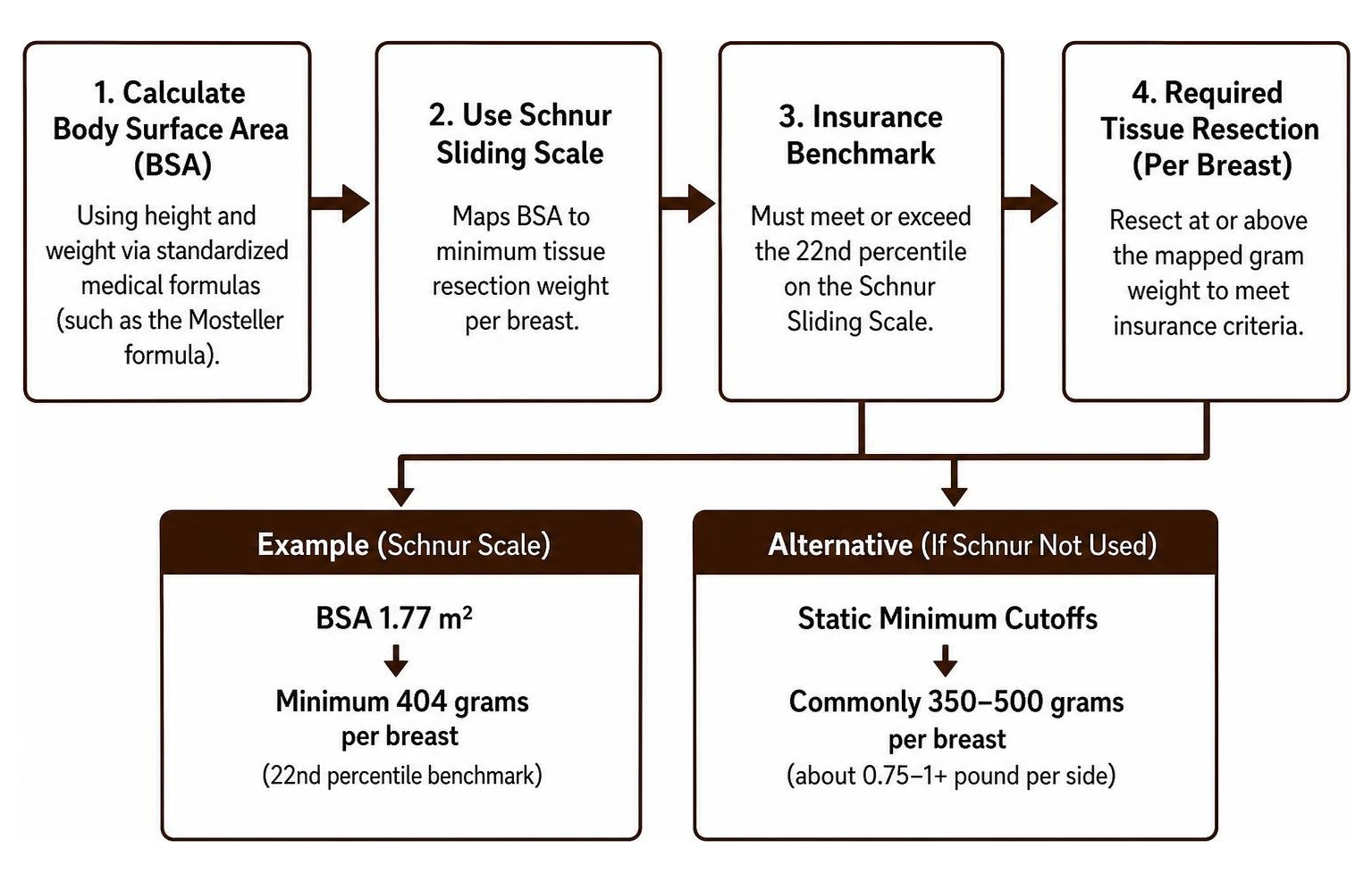
Beyond symptom documentation, many insurance policies use mathematical formulas to assess medical necessity. The most well-known metric is the Schnur Sliding Scale, developed in 1991 to correlate a patient’s Body Surface Area (BSA) with an expected minimum weight of resected tissue.
BSA is calculated using your height and weight via standardized medical formulas (such as the Mosteller formula). Insurance policies often require that the projected tissue removal from each breast falls at or above the 22nd percentile on the Schnur Scale. For example, in an administrative review on Schnur scale criteria, a patient with a BSA of 1.77 square meters required at least 404 grams of tissue removed per breast to qualify under that percentile benchmark.
The American Society of Plastic Surgeons (ASPS) has noted Level I clinical evidence showing that reduction mammaplasty effectively treats breast hypertrophy regardless of the specific volume removed. Research published by Strong and Hall-Findlay also demonstrates that patients experience substantial relief even with smaller resection volumes. However, many insurance carriers continue to enforce these strict scale thresholds.
Tissue Removal Thresholds: How Policies Determine If Will Insurance Cover Breast Reduction
When carriers do not use the Schnur Scale, they typically set static minimum gram-weight cutoffs, commonly demanding between 350 and 500 grams per breast (roughly three-quarters of a pound to over one pound per side).
These requirements create challenges for petite women with dense glandular tissue who suffer severe pain but do not possess the tissue volume needed to safely remove 500 grams without causing severe deformity. During your consultation, we carefully weigh safety and aesthetic balance against your insurer’s resection guidelines.
Navigating BMI and Body Weight Policies
Body Mass Index (BMI) is another common metric used by insurance reviewers. Some carriers set strict cutoff thresholds (frequently a BMI of 30 or 35), arguing that upper-body pain may stem from general weight rather than isolated breast tissue.
If your BMI is above 30, your carrier may require documented weight stability over six to twelve months to confirm that your breast volume is true glandular hypertrophy rather than temporary weight fluctuations. Partnering with your primary care physician to document a stable weight history helps avoid automatic administrative denials.
Step-by-Step Pre-Authorization and Approval Roadmap
Securing prior authorization requires careful coordination between your primary care providers, your specialists, and our surgical team.
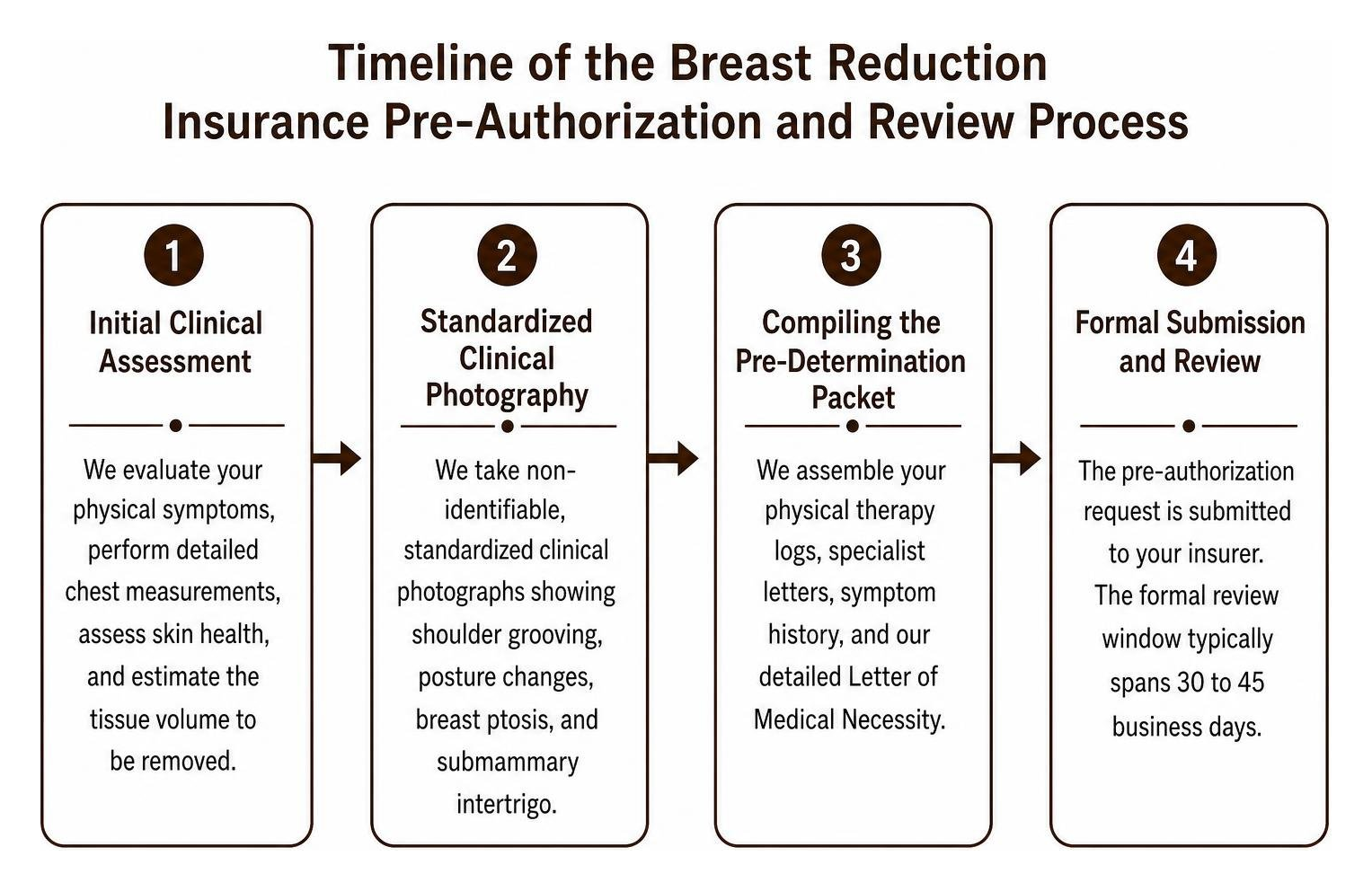
When preparing for a plastic surgery consultation, bring all relevant medical records to help us build a strong case:
- Initial Clinical Assessment: We evaluate your physical symptoms, perform detailed chest measurements, assess skin health, and estimate the tissue volume to be removed.
- Standardized Clinical Photography: We take non-identifiable, standardized clinical photographs showing shoulder grooving, posture changes, breast ptosis, and submammary intertrigo.
- Compiling the Pre-Determination Packet: We assemble your physical therapy logs, specialist letters, symptom history, and our detailed Letter of Medical Necessity.
- Formal Submission and Review: The pre-authorization request is submitted to your insurer. The formal review window typically spans 30 to 45 business days.
Overcoming Claim Denials and the Appeals Process
Receiving an initial denial can be discouraging, but it is often just the beginning of the appeals process. Initial reviews are frequently processed by automated systems or administrative staff looking for specific keywords.
Common denial reasons include missing therapy logs, estimated resection volumes below arbitrary thresholds, or lack of recent specialist notes. If your claim is denied, we can request a peer-to-peer review, where I speak directly with the insurance medical director to explain the medical necessity of your case. You also have the right to file formal internal appeals and, if necessary, request an independent external review through your state’s insurance commission.
Understanding Out-of-Pocket Costs and Alternative Payment Options
Even when an insurer approves your surgery, patients often encounter out-of-pocket expenses. Coverage is subject to your plan’s specific deductible, co-insurance percentage, and annual out-of-pocket maximum.
Additionally, insurance plans only cover functional tissue reduction. If your plan does not cover certain contouring techniques, such as lateral chest wall liposuction, those components are billed separately. When evaluating breast reduction surgical costs, we provide a clear, itemized breakdown of covered versus non-covered fees so you understand your financial responsibilities in advance.
If your insurance excludes breast reduction entirely or denies coverage after appeals, private payment plans and medical financing through healthcare lenders can make treatment manageable. Choosing self-pay allows you and your surgeon to focus purely on your ideal aesthetic outcome and personal comfort without insurance-mandated tissue minimums.
Frequently Asked Questions About Breast Reduction Insurance Coverage
How long does the insurance pre-authorization process take?
The entire process generally takes three to six months. This timeline includes completing the required trials of conservative therapy, gathering specialist records, and waiting for the insurer’s formal review, which takes about 30 to 45 business days.
Will insurance cover a breast lift alongside reduction surgery?
A standalone breast lift (mastopexy) is considered cosmetic and is not covered by insurance. However, during a medically necessary breast reduction, repositioning the nipple-areola complex and tightening the surrounding skin envelope are essential parts of the procedure, so they are included as part of the approved surgery.
What can I do if my insurance denies my breast reduction claim?
You can appeal the decision. First, obtain the specific written denial reason from your carrier. You can then work with your surgical team to supply missing records, schedule a physician peer-to-peer conference, or submit a formal appeal citing clinical evidence.
Your Path to Physical Comfort
Navigating health insurance requirements requires patience and detailed documentation, but finding relief from chronic physical pain makes the effort worthwhile. Demonstrating medical necessity, tracking conservative care, and partnering with an experienced surgical team will give you the best chance of securing approval.
At The Plastic Surgery Group in Montclair, New Jersey, Dr. Allen D. Rosen and I combine reconstructive precision with aesthetic care to help you achieve a balanced, comfortable shape. If you are ready to explore your options and see whether surgery is right for you, contact our team to schedule your personalized evaluation for breast reduction surgery.
Valerie J. Ablaza, M.D.


