
Natural Breast Augmentation: Fat Transfer vs. Implants
Natural breast augmentation usually means fat transfer: a surgeon removes fat from an area such as the abdomen or thighs with liposuction, purifies it, and injects it into the breasts for a modest increase in volume. It can be a strong option if you want subtle, natural-feeling fullness and have enough donor fat.
Breast implants can create a larger, more predictable size change. Fat transfer uses your own tissue, but not all transferred fat survives, and results are usually limited to about a half to one cup size per session. Creams, patches, and supplements may moisturize skin or temporarily improve the look of firmness, but there is not strong clinical evidence that they permanently grow breast tissue.
The best choice depends on your starting shape, desired size, available donor fat, and comfort with surgery. A consultation can clarify whether fat transfer, implants, or a combination approach fits your goals.
I am Dr. John A. Cece, a fellowship-trained, board-eligible plastic and reconstructive surgeon with advanced aesthetic and microsurgical breast fellowship training. My experience in breast aesthetic surgery and reconstruction helps inform a personalized discussion about natural breast augmentation and the options that may create a balanced result.

Additional natural breast augmentation content assets to explore.
What Is Natural Breast Augmentation?
When patients ask us about a truly natural approach to enhancing their bustline, they are almost always referring to autologous fat grafting. In clinical terms, natural breast enlargement avoids synthetic medical devices entirely. Instead, the procedure harnesses the patient’s own living adipose cells to restore shape, soften contours, and build subtle projection.
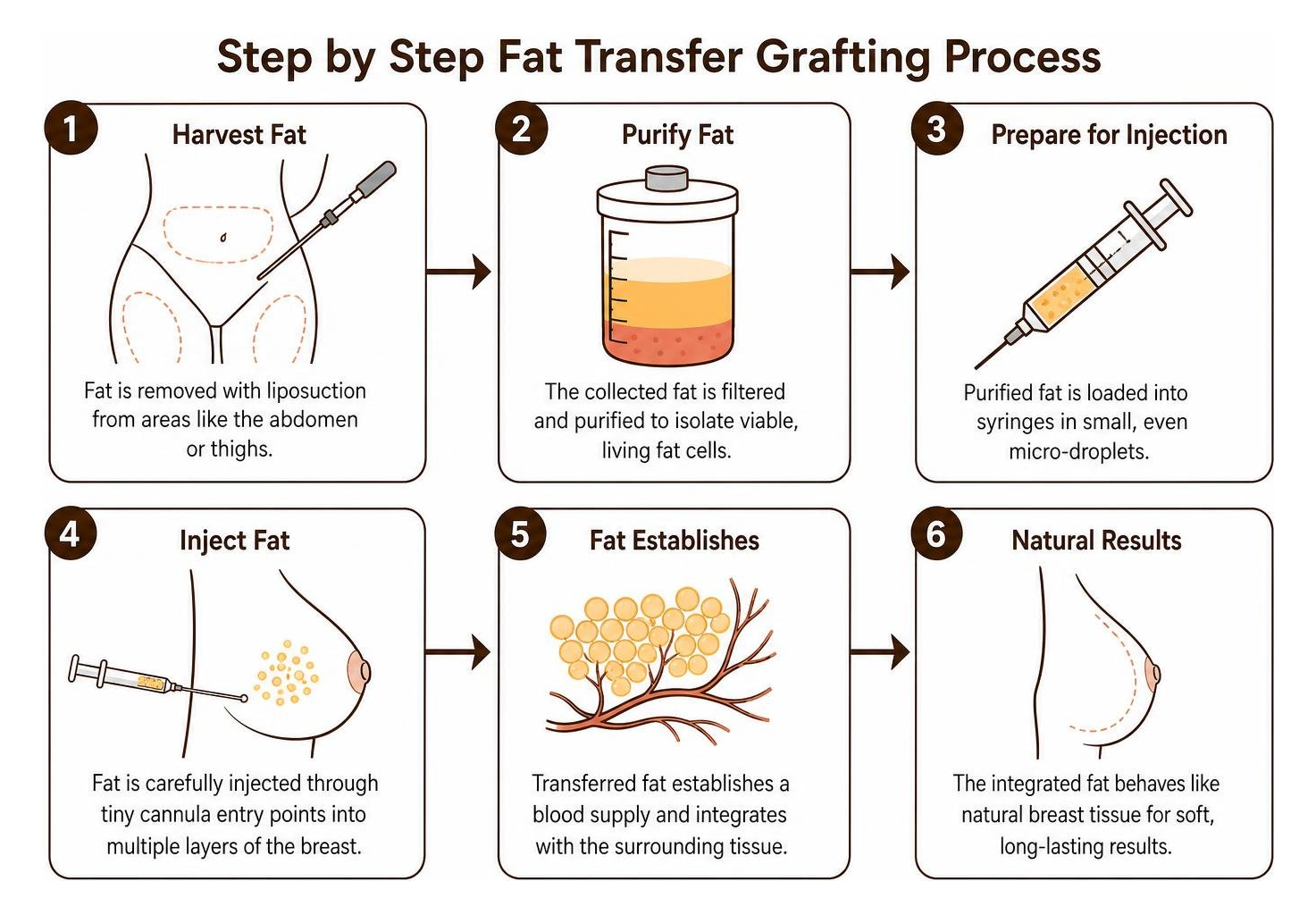
The process begins with gentle liposuction at an eligible donor site—most commonly the abdomen, flanks, outer thighs, or lower back. Once harvested, the adipose tissue is carefully filtered and purified to isolate viable, living fat cells. Your surgeon then injects these concentrated micro-droplets into various planes of the breast tissue.
For many women seeking an overview of fat transfer breast augmentation, the dual-benefit aspect is the main attraction: you slim down a stubborn trouble spot while simultaneously adding subtle fullness to your chest.
Because the harvested cells are introduced through tiny cannula entry points rather than surgical incisions, patients often achieve breast augmentation with no visible scars. Once the injected fat establishes a local blood supply, the integrated tissue behaves just like normal breast fat for long-lasting, soft results.
The Difference Between Surgical Implants and Natural Enhancement
Deciding between a natural fat transfer and traditional surgical implants involves evaluating how each method alters your silhouette, how it feels to the touch, and what maintenance it requires down the line.
When evaluating fat transfer breast augmentation vs breast implants, the differences in construction and anatomical placement become clear:
- Material and Biocompatibility: Implants use a medical-grade elastomer shell filled with either sterile saline solution or cohesive silicone gel. Fat grafting uses 100% autologous biological tissue, completely eliminating any risk of foreign body immune reactions.
- Tactile Sensation: Transferred fat feels completely natural because it is your own living tissue. While modern options like cohesive gel gummy bear vs silicone implants mimic natural breast tissue remarkably well, a skilled tactile exam can still occasionally detect an underlying prosthetic shell, particularly in women with thin native tissue.
- Incision Placement: Implant placement requires precise surgical incisions—placed in the inframammary fold, around the areola, or within the armpit—to seat the prosthetic pocket. Fat grafting relies on micro-punctures that typically heal into imperceptible specks.
- Volume Limitations: Implants can easily boost breast volume by multiple cup sizes in a single surgical session. Autologous fat transfer, by contrast, is biologically capped by the local blood supply of the recipient breast, safely allowing for an increase of roughly a half to one full cup size per procedure.
Non-Surgical Options and Myths: Creams, Patches, and Supplements
The aesthetic market is flooded with over-the-counter products promising fuller or firmer breasts without surgery. These include breast enhancement creams, patches, oils and supplements containing botanical ingredients, phytoestrogens and moisturizing agents. However, marketing claims for these products should not be confused with established evidence that they can produce a meaningful or lasting increase in breast size.
According to the Mayo Clinic’s guidance on natural breast enhancement, breast enhancement supplements are unlikely to work, and there is no evidence that phytoestrogens produce breast growth. For patients considering established surgical options, the American Society of Plastic Surgeons provides additional information about breast augmentation with implants or fat transfer.
Marketing materials for these topical lotions and transdermal patches frequently cite high user satisfaction for skin texture and tightness. For example, promotional surveys for Push Up Sen claim that 9 out of 10 women noticed an increase in volume in less than a month, 95% noted increased bust volume after four weeks, and 100% saw softer, rejuvenated skin. Similarly, products like Breast Max Plus claim to have served over 10,000 customers looking for firmer contours within 4 to 6 weeks.
However, it is essential to understand the biological difference between temporary dermal hydration and true structural breast enlargement:
- Topical Hydration vs. Glandular Growth: High-grade botanical creams and transdermal patches can effectively hydrate, tone, and smooth the skin of the décolletage. This can create an optical illusion of a perkier bustline, but topical formulations cannot permanently expand subcutaneous fat deposits or stimulate glandular tissue growth.
- Hormonal and Phytoestrogen Mechanisms: Many non-surgical enhancement products rely on phytoestrogens—plant-derived compounds that weakly mimic natural estrogen. While these may cause mild, transient water retention in breast tissue (similar to premenstrual swelling), they do not build permanent adipose volume.
- Clinical Reality: Real, lasting tissue augmentation requires the surgical transfer of living fat cells or the placement of an internal prosthetic device. Relying solely on supplements or topical lotions for significant cup-size growth will ultimately lead to disappointment.
Comparing Fat Transfer and Breast Implants
Choosing the right path comes down to aligning your personal aesthetic goals, anatomical baseline, and lifestyle preferences with the capabilities of each technique.
| Feature | Autologous Fat Transfer | Breast Implants (Silicone / Saline) |
|---|---|---|
| Primary Material | Purified autologous body fat | Cohesive silicone gel or sterile saline |
| Average Volume Increase | 0.5 to 1 full cup size per session | 1 to 3+ cup sizes in a single surgery |
| Incision Size | Tiny cannula punctures (1–2 mm) | Surgical incisions (3–5 cm) |
| Feel & Movement | 100% natural body tissue | Soft and natural; holds structured projection |
| Donor Site Requirement | Requires adequate localized fat stores | None |
| Longevity | Permanent once blood supply establishes | May require revision after 10–20 years |
| Anesthesia Type | General or twilight IV sedation | General anesthesia |
| Recovery Downtime | 3 to 7 days for most normal routines | 1 to 2 weeks for daily activities |
Achieving Your Ideal Volume and Shape
Every patient comes to our office with a unique vision for their shape. If your goal is subtle, graceful restoration—such as filling out the upper slope after nursing or smoothing out mild left-to-right breast asymmetry—autologous fat grafting delivers an exceptionally soft, understated contour.
However, if you are looking for pronounced upper-pole fullness, dramatic cleavage, or a transformation of two or more cup sizes, traditional implants remain the gold standard. To see how different approaches look on various body frames, you can browse the ultimate boob job lookbook for real-world visual comparisons.
It is also worth noting that neither fat transfer nor standard implants alone will correct moderate to severe breast sagging (ptosis). If you are looking to lift loose skin and reposition the nipple-areola complex higher on the chest wall, combining your procedure with a breast augmentation with lift will give you the most youthful, supported result.
Safety Profiles, Side Effects, and Recovery Timelines
Understanding the surgical healing process helps set clear, confident expectations for your recovery:
- Autologous Fat Transfer Recovery: Patients recover from two distinct areas: the liposuction harvest site and the breasts. You will wear a compression garment over the donor area to minimize swelling and support contouring. The breasts will initially appear slightly larger due to post-operative edema. Over the first 3 to 6 months, roughly 30% to 40% of the injected fat is naturally metabolized, while the remaining 60% to 70% integrates permanently. Potential risks include oil cysts, localized fat necrosis, or small calcifications, which an experienced surgeon works to avoid by using meticulous micro-droplet injection techniques.
- Breast Implant Recovery: Implant recovery centers primarily on chest wall tightness, muscular soreness (if placed beneath the pectoralis major), and incision care. Knowing the typical breast augmentation recovery time allows you to schedule time off work and arrange light assistance at home. Complication profiles specific to synthetic devices include capsular contracture, implant displacement, and long-term shell rupture.
- Pre-Surgical Education: Learning what breast surgery patients should know before their procedure ensures you are fully prepared for every phase of healing, garment wear, and post-operative care.
Cost Comparison and Long-Term Value
When weighing the financial investment of breast enhancement, look beyond just the initial surgical quote. The total cost reflects surgeon expertise, surgical facility fees, anesthesia care, and long-term maintenance.
A comprehensive review of breast augmentation new jersey cost highlights the differing value propositions of both procedures:
- Fat Transfer Investment: Fat grafting requires specialized liposuction harvesting, delicate micro-filtration processing, and precise anatomical injection. While it often carries a higher upfront cost than basic implant placement, it provides a permanent result that never requires device replacement, shell monitoring, or implant-related revision surgery. You also get the added benefit of body sculpting at the donor site.
- Implant Economics: Traditional implants carry a lower upfront procedural cost. However, because synthetic devices are not lifetime prosthetics, patients should anticipate future revision or replacement surgeries every 10 to 20 years.
To help make treatment accessible and stress-free, our practice offers flexible breast augmentation financing options to match your personal budget.
Advanced Innovations and Emerging Techniques in Natural Breast Augmentation
The field of regenerative aesthetics is advancing rapidly. One of the most promising areas of research combines autologous fat transfer with bio-absorbable structural matrixes.
Emerging research is also investigating scaffold-guided breast tissue engineering as a potential approach to breast augmentation and reconstruction. A clinical trial indexed by PubMed is evaluating biodegradable, medical-grade polycaprolactone breast scaffolds that are implanted and filled with a patient’s own fat. The porous scaffold is designed to provide temporary structural support while researchers evaluate the technique’s safety, surgical outcomes, complications and volume replacement. Because this approach remains under clinical investigation, it should not be considered an established alternative to conventional breast augmentation procedures.

Alongside regenerative tissue advances, modern clinical practice relies heavily on advances in 3D imaging technology to plan surgeries with incredible precision.
Candidate Selection for Natural Breast Augmentation
Autologous fat grafting is an outstanding option, but it is not the right fit for every patient.
Ideal Candidates for Fat Transfer:
- Have enough localized pinchable fat in donor areas like the abdomen, flanks, or thighs.
- Desire a modest, natural increase of roughly one cup size.
- Want to correct subtle asymmetries, fill post-pregnancy upper-pole deflation, or soften visible implant edges.
- Prefer an all-natural procedure without synthetic medical devices.
When Alternative Approaches Are Recommended:
- Very lean women or competitive athletes who lack adequate donor fat stores. For these patients, exploring tailored breast augmentation for athletes using cohesive silicone gel implants is usually the best approach.
- Patients seeking dramatic size increases of two or more cup sizes in a single procedure.
- Women with significant skin laxity or severe sagging who require formal tissue lifting rather than volume addition alone.
- Patients seeking dedicated fat transfer breast augmentation in NJ must also be in good overall health with realistic expectations about graft retention.
3D Imaging and Planning Your Natural Breast Augmentation Procedure
To take the guesswork out of your consultation, our Montclair facility uses advanced digital simulation systems.
Using a VECTRA 3D imaging body preview, we capture high-resolution anatomical scans of your chest wall and donor sites. This system lets us simulate various volume increases in real time, showing you how different levels of fat grafting or implant profiles will look on your specific frame.
Reviewing these digital simulations alongside verified before and after breast augmentation results helps ensure you and your surgeon share the exact same aesthetic vision before your surgery day.
Frequently Asked Questions About Natural Breast Augmentation
Are results from a natural fat transfer permanent?
Yes. Once the transferred fat cells successfully integrate and establish a local blood supply (a process that takes about three to six months), they become permanent living tissue in your breasts. While some transferred volume is naturally reabsorbed during early healing, the surviving cells will remain for life. They will also behave just like normal fat cells, naturally expanding or shrinking with future weight fluctuations.
Can over-the-counter creams replace surgical breast enhancement?
No. While quality cosmetic creams and transdermal patches can temporarily improve skin hydration, elasticity, and firmness, they cannot stimulate new adipose tissue growth or increase your bra cup size. True structural enlargement requires the physical transfer of living fat cells or the placement of surgical implants.
How many cup sizes can I gain with autologous fat transfer?
Most patients achieve an increase of about a half to one full cup size per fat grafting session. The amount of fat that can be safely injected is limited by the recipient tissue’s vascular capacity. Attempting to inject too much fat at once can prevent the cells from establishing a healthy blood supply. Patients seeking larger transformations can choose staged fat transfer sessions or select cohesive silicone implants.
Designing Your Personalized Breast Enhancement
Choosing between natural fat grafting and modern cohesive implants comes down to your personal goals, your anatomy, and how you want your results to look and feel. Whether you want to subtly restore lost volume using your own living tissue or achieve more dramatic contouring with implants, our team is here to guide you toward the safest, most flattering choice.
At The Plastic Surgery Group of New Jersey, our board-certified plastic surgeons—Dr. Allen D. Rosen, M.D., and Dr. Valerie J. Ablaza, M.D.—work alongside fellowship-trained Dr. John A. Cece and our surgical team in our fully accredited, state-of-the-art facility in Montclair, New Jersey. We focus on delivering personalized, natural-looking results tailored to your unique body frame.
To explore your options and see what is possible, schedule your personalized cosmetic consultation in Montclair with our expert surgical team today.


